
Best Flow Meters for Industrial Water Monitoring in Australia Guide
- 2 hours ago
- 9 min read
Industrial water monitoring is only as good as the meter in the pipe. A reliable flow meter can show where water is being used, where losses are creeping in, and whether a process is running inside its intended limits. A poor match can give false confidence, trigger nuisance alarms, or hide expensive leaks for months.
For Australian sites, the choice is shaped by more than pipe size and budget. Water quality varies widely between metro mains, bore water, recycled water, process water, irrigation channels, and treated effluent. Sites may face heat, dust, flooding, corrosive atmospheres, long cable runs, and remote telemetry needs.
This guide compares some of the best flow meters for industrial water monitoring in Australia, with a focus on features, accuracy, reliability, and practical fit across manufacturing, agriculture, mining, utilities, and food processing.

What matters most when choosing an industrial water flow meter
The best meter is not always the most expensive one. It is the one that matches the fluid, pipework, signal needs, and maintenance reality of the site.
For most industrial water applications, the key decision points are:
Water conductivity
Electromagnetic meters need conductive liquid. They suit potable water, recycled water, wastewater, many process waters, and irrigation water. They do not suit oils, gases, steam, or very low-conductivity fluids.
Pipe access
Inline meters need pipe cutting and shutdown time. Clamp-on ultrasonic meters can be fitted from outside the pipe, which makes them useful for existing systems.
Accuracy requirements
Billing, dosing, and compliance reporting need higher accuracy than general trend monitoring. Always confirm the manufacturer’s stated accuracy under the expected flow profile, pipe condition, and installation length.
Flow range
Some systems run near constant flow. Others move from low overnight flow to high production or irrigation demand. Choose a meter with stable performance across the real operating range.
Environment
Outdoor Australian installations often need strong ingress protection, sun exposure tolerance, lightning protection, and reliable operation in heat, dust, and wet pits.
Data integration
Look for outputs that suit the control system, such as 4 to 20 mA, pulse, Modbus, HART, Profibus, Ethernet, or battery-powered telemetry options.
A flow meter should be selected around the whole measuring point, not just the pipe diameter. Straight runs, grounding, water quality, cable routes, and maintenance access all affect the result.
Top flow meters for industrial water monitoring in Australia
The models below are widely recognised in industrial and utility water applications. Availability, certifications, and exact configurations should be confirmed with local suppliers, as each product family has several variants.
Flow meter model | Meter type | Typical accuracy class | Best fit | Key strengths |
Endress+Hauser Proline Promag W 400 or 800 | Electromagnetic | Often around ±0.2% to ±0.5%, depending on configuration | Water networks, process water, remote sites | Strong diagnostics, battery options, broad water utility use |
Siemens SITRANS FM MAG 5100 W with MAG transmitter | Electromagnetic | Often around ±0.2% to ±0.4%, depending on setup | Industrial water, wastewater, plant utilities | Proven mag meter platform, durable liner and electrode options |
ABB AquaMaster4 | Electromagnetic | Commonly used for utility-grade water measurement | District metering, abstraction, irrigation supply | Battery power, remote communications, buried or remote installations |
KROHNE WATERFLUX 3070 | Electromagnetic | Typically suitable for high-quality water measurement | Potable water, distribution, abstraction | Low maintenance, battery life options, no moving parts |
Yokogawa ADMAG AXW | Electromagnetic | Often specified for precise industrial service | Manufacturing, cooling water, process water | Stable signal processing, strong industrial integration |
Badger Meter Dynasonics TFX-5000 | Clamp-on ultrasonic | Often lower than inline mag meters, installation dependent | Retrofit monitoring, temporary checks, non-invasive measurement | No pipe cutting, useful for audits and difficult shutdown sites |
Accuracy ranges above are general product-family expectations, not a substitute for datasheet review. Final performance depends on pipe condition, minimum straight run, grounding, liner selection, flow profile, and commissioning quality.
Model-by-model comparison
Endress+Hauser Proline Promag W 400 and 800
The Promag W range is a strong contender for water and wastewater service where diagnostics and long-term stability matter. The 400 series suits connected plant environments, while the 800 series is often considered where battery operation or remote installation is needed.
Its main value is not only accuracy. The built-in verification and diagnostic features can help maintenance teams see whether the measuring point is healthy, affected by empty pipe conditions, or showing signal problems.
Good applications include:
Water intake and distribution
Cooling water circuits
Wastewater transfer
Remote pump stations
Recycled water monitoring
For Australian sites with remote assets, the battery and communications options can be useful where mains power is limited.
Siemens SITRANS FM MAG 5100 W
The Siemens MAG 5100 W sensor, commonly paired with a MAG transmitter, is a well-known electromagnetic meter for water and wastewater. It is often chosen for industrial sites that need a dependable inline meter with no moving parts and clear signal outputs to PLC or SCADA systems.
It suits applications where the water is conductive and the pipe can be shut down for installation. The range of liners, electrodes, and flange options makes it adaptable across plant water systems.
Good applications include:
Manufacturing process water
Wastewater and trade waste
Pump discharge monitoring
Plant utility water
Treated water transfer
It performs best when installed with correct grounding and enough straight pipe. Like other mag meters, it needs a full pipe for valid measurement.
ABB AquaMaster4
ABB AquaMaster4 is commonly associated with water network measurement, district metering, and remote abstraction points. It is suited to installations where power, communications, and site access are the hard parts of the job.
Its appeal lies in remote data options, battery operation, and fit-for-purpose utility water design. On farms, irrigation schemes, and remote water transfer systems, those features can reduce manual reads and improve visibility.
Good applications include:
Irrigation supply monitoring
Council or utility district metering
Remote bore or river abstraction
Water balance points across large sites
Pump station inflow and outflow
For remote Australian locations, check enclosure rating, antenna placement, battery access, and the expected communications coverage before final selection.

KROHNE WATERFLUX 3070
KROHNE WATERFLUX 3070 is designed for water measurement where long-term operation and low maintenance are priorities. It is often used in potable water networks, abstraction, and distribution systems.
A notable feature of the WATERFLUX family is its focus on stable water measurement with low pressure loss and low maintenance needs. No moving parts means less wear compared with mechanical meters, especially where the water carries small particles.
Good applications include:
Potable water distribution
Raw water abstraction
Reservoir and tank inlet monitoring
Pumped transfer lines
Rural water schemes
It is a practical choice where a site values dependable readings, infrequent service visits, and water-specific design.
Yokogawa ADMAG AXW
Yokogawa’s ADMAG AXW is a strong industrial electromagnetic option. It suits plant environments where measurement stability, output flexibility, and process integration matter.
It is often a good fit for manufacturing sites that already use industrial automation and want reliable flow measurement for water supply, cooling circuits, cleaning systems, or wastewater.
Good applications include:
Food and beverage process water
Chemical plant utilities
Cooling tower make-up
Batch water feed
Industrial wastewater
As with any mag meter, material selection matters. Check liner and electrode compatibility with cleaning chemicals, pH range, temperature, and suspended solids.
Badger Meter Dynasonics TFX-5000
Clamp-on ultrasonic meters are different from inline mag meters. They measure flow from outside the pipe using transducers mounted on the pipe wall. The Badger Meter Dynasonics TFX-5000 type of instrument can be useful when shutdown is costly or impossible.
Clamp-on meters are excellent for audits, retrofit monitoring, temporary studies, and checking balance across a site. They are usually more sensitive to pipe material, pipe wall condition, liner condition, installation skill, and flow profile.
Good applications include:
Water efficiency audits
Temporary pump performance testing
Retrofit monitoring on existing pipework
Large pipes where cutting is expensive
Non-critical trend monitoring
For critical custody or compliance measurement, inline meters are often preferred. For fast insight without pipe cutting, clamp-on ultrasonic meters are hard to beat.
Which meter suits each industry
Manufacturing
Manufacturing sites often need water data for production control, cost allocation, leak detection, and environmental reporting. Electromagnetic meters are usually the first choice for permanent measurement on conductive water lines.
Common monitoring points include:
Incoming mains water
Process water feeds
Cooling water loops
Boiler feed make-up
Washdown and clean-in-place systems
Trade waste discharge
For batch processes, response time and low-flow accuracy matter. For cooling systems, reliability and trend stability are often more important than ultra-high accuracy.
Agriculture and irrigation
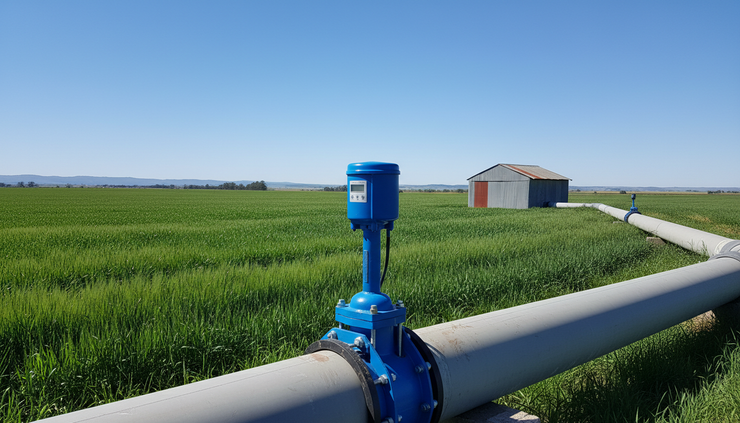
Agriculture needs flow data across pumps, bores, channels, storage tanks, fertigation systems, and irrigation zones. The meter must tolerate outdoor exposure, fluctuating flows, suspended particles, and remote access.
Battery-powered electromagnetic meters and water-focused utility meters often suit larger irrigation supply points. Clamp-on ultrasonic meters can help with pump testing or short-term checks.
For irrigation scheduling and water allocation, repeatable measurement is vital. A meter that fails during peak season is more expensive than one that costs a little more up front.
Mining and resources
Mining operations often run long pipelines, abrasive water, process water, dust suppression systems, and remote pump stations. Reliability under harsh conditions is the main priority.
Mag meters can work well on conductive mine water, provided the liner and electrode materials suit the fluid. For pipes that cannot be shut down, clamp-on ultrasonic meters can support troubleshooting and temporary monitoring.
Food and beverage
Food and beverage plants monitor water for production, cleaning, cooling, and wastewater. Accuracy is important, but hygienic design, material compatibility, and cleaning chemical resistance may also matter.
Electromagnetic meters with suitable wetted materials are common. Sites should confirm whether sanitary fittings or food-grade requirements apply to each measuring point.
Water utilities and councils
Utilities need dependable long-term meters for supply, distribution, district metering, abstraction, and wastewater. Battery life, remote communications, diagnostics, and low maintenance often carry more weight than advanced plant integration features.
Meters such as ABB AquaMaster4, KROHNE WATERFLUX, and Promag W variants are often considered for these types of assets.
Installation tips that protect accuracy
A high-quality meter can still perform poorly if the installation is wrong. Most flow meter problems trace back to pipe conditions, wiring, grounding, or commissioning.
Keep the pipe full
Electromagnetic and ultrasonic meters need a full pipe. Avoid installing a meter at a high point where air can collect. If the pipe may drain, place the meter in a section that remains flooded.
Respect straight-run guidance
Pumps, elbows, valves, reducers, and partially open control valves disturb the flow profile. Follow the manufacturer’s straight pipe requirements upstream and downstream. If space is tight, ask the supplier about flow conditioners or alternative meter locations.
Ground mag meters correctly
Electromagnetic meters measure a small voltage generated by conductive liquid moving through a magnetic field. Poor grounding can create unstable readings. Use grounding rings, straps, or electrodes as recommended for the pipe material.
Match the liner and electrodes to the water
Raw water, bore water, recycled water, chlorinated water, and wastewater can behave differently. Check compatibility for:
pH
Chloride levels
Cleaning chemicals
Temperature
Abrasive solids
Coatings or scaling risk
Protect outdoor electronics
Australian installations can face heat, UV, storms, dust, insects, and flooding. Use correct enclosure ratings, cable glands, sun shields, and surge protection. In pits, check whether immersion risk requires a remote transmitter or higher ingress protection.

Maintenance tips for long service life
Flow meters with no moving parts need less service than mechanical meters, but they are not maintenance-free. A basic maintenance plan protects data quality.
Check readings against operating reality
Compare flow readings with pump curves, tank level changes, water bills, or known batch volumes. Large unexplained changes may point to a process issue, meter fault, air entrainment, or valve problem.
Inspect for coating and build-up
Water with iron, hardness, biological growth, or suspended solids can coat electrodes or pipe walls. Coating can affect mag and ultrasonic performance. Inspection frequency should match water quality and site history.
Verify zero flow
Where possible, confirm the meter reads zero when flow has stopped and the pipe is full. A drifting zero can indicate grounding issues, electrical noise, or sensor contamination.
Keep firmware and configuration records
Record meter size, K-factor or calibration settings, output scaling, installation date, cable routes, and commissioning checks. Configuration records make fault-finding much faster when staff or contractors change.
Use verification tools where available
Many modern mag meters support in-situ verification or diagnostic checks. These tools do not replace every calibration need, but they can help prove the meter is operating within expected limits between service intervals.
How to choose the right model for your site
Start with the application, then narrow the meter type.
For a new permanent installation on conductive water, an electromagnetic flow meter is usually the safest first option. It offers strong accuracy, no moving parts, and good long-term reliability.
For a remote irrigation or utility site, choose a meter with battery power, low maintenance needs, and suitable telemetry. ABB AquaMaster4, KROHNE WATERFLUX, and Promag battery variants often fit this type of brief.
For a manufacturing plant with PLC or SCADA integration, consider Siemens MAG, Yokogawa ADMAG AXW, or Endress+Hauser Promag W. Focus on diagnostics, output options, material compatibility, and local support.
For a retrofit where shutdown is difficult, choose a clamp-on ultrasonic meter such as the Badger Meter Dynasonics TFX-5000 style of product. Expect more attention during installation and validation.
A practical shortlisting process looks like this:
Confirm pipe size, material, wall thickness, and available straight run.
Confirm water type, conductivity, solids, chemicals, and temperature.
Define the measurement purpose.
Set the required accuracy and reporting needs.
Decide whether shutdown and pipe cutting are acceptable.
Check power, communications, and enclosure needs.
Confirm local support, spare parts, and commissioning capability.

The best overall choice
For most permanent industrial water monitoring points in Australia, a well-specified electromagnetic meter is the best all-round choice. Endress+Hauser Promag W, Siemens SITRANS FM MAG, ABB AquaMaster4, KROHNE WATERFLUX, and Yokogawa ADMAG AXW all have credible strengths, but each suits a slightly different job.
The strongest choice depends on the site:
Best for connected industrial plants
Siemens SITRANS FM MAG or Yokogawa ADMAG AXW
Best for diagnostics and broad water service
Endress+Hauser Promag W
Best for remote utility and irrigation points
ABB AquaMaster4 or KROHNE WATERFLUX
Best for retrofit and temporary monitoring
Badger Meter Dynasonics TFX-5000 or a similar clamp-on ultrasonic meter
A flow meter should earn trust over years, not just look good on a quotation. Match the meter to the water, install it carefully, protect it from site conditions, and build simple checks into maintenance. That approach gives the best chance of accurate, reliable water data across Australian industrial operations.


Comments