
ProSight Flow Meters and Level Sensors for Reliable Industrial Measurement
- 9 hours ago
- 9 min read
A process is only as dependable as the measurements behind it. Flow rate, tank level, gas consumption, silo inventory, pump performance, and wastewater discharge all rely on instruments that need to work in real plant conditions, not just on a test bench.
ProSight by ProSense manufactures and supplies industrial flow meters and level sensors for applications across water, wastewater, manufacturing, mining, agriculture, utilities, and process industries. The range covers common liquid, gas, steam, and bulk-solid measurement tasks, with output options that allow instruments to connect into PLC, SCADA, data logging, and remote monitoring systems.
The value is not only in having a catalogue of sensors. It is in matching the right measurement principle to the process, the medium, the installation constraints, and the documentation requirements of the project.

Industrial flow measurement starts with the process medium
Flow measurement looks simple from the outside. A liquid, gas, or steam moves through a pipe, and the instrument reports the rate. In practice, the correct meter depends on conductivity, viscosity, pressure, temperature, pipe size, accuracy needs, available straight pipe, and whether the process can be interrupted for installation.
The ProSight range includes several flow meter technologies, each suited to different duties.
Flow meter type | Typical applications | Why it is used |
Electromagnetic flow meters | Water, wastewater, chemicals, conductive liquids | No moving parts in the flow path and well suited to conductive fluids |
Ultrasonic flow meters | Water lines, temporary checks, retrofit installations | Clamp-on options allow non-invasive measurement on suitable pipes |
Thermal mass flow meters | Compressed air and industrial gases | Direct mass flow measurement for gas use and leak monitoring |
Vortex flow meters | Gas, steam, and liquid applications | Useful where stable flow conditions and process compatibility suit vortex measurement |
Turbine and positive displacement flow meters | Fuels, oils, and process liquids | Common for clean liquids where mechanical measurement is appropriate |
Gas mass flow meters and controllers | Gas dosing, test systems, process control | Designed for precision gas measurement and control |
Each type has a place. A wastewater line with suspended solids may suit an electromagnetic meter. A compressed air header may call for thermal mass measurement. A fuel transfer skid may need a turbine or positive displacement meter. A steam application may require a vortex meter with the right pressure, temperature, and installation conditions.
That is why a good specification starts with the medium and the process, not with the instrument part number.
Electromagnetic flow meters suit conductive liquid applications
Electromagnetic flow meters are widely used for water, wastewater, and conductive process liquids. They measure flow based on the movement of a conductive liquid through a magnetic field.
This makes them a strong option for many industrial liquid duties because they do not rely on a turbine or paddlewheel sitting in the flow stream. With no moving parts in the measuring section, they can be well suited to continuous service where deposits, wear, or mechanical drag would create problems for other technologies.
Common use cases include:
Raw water and treated water flow
Wastewater transfer and discharge
Chemical dosing where the liquid is conductive
Process water distribution
Agricultural water systems
The key limitation is conductivity. Electromagnetic meters need a conductive liquid to measure correctly. They are not the right choice for non-conductive oils, many fuels, or gases. Lining material, electrode material, grounding, pipe condition, and installation location also matter.
For plant teams, the practical benefit is clear. A correctly selected electromagnetic meter can provide stable liquid flow data for control, reporting, and monitoring without adding rotating components into the process line.
Ultrasonic flow meters give options for retrofit and non-invasive measurement
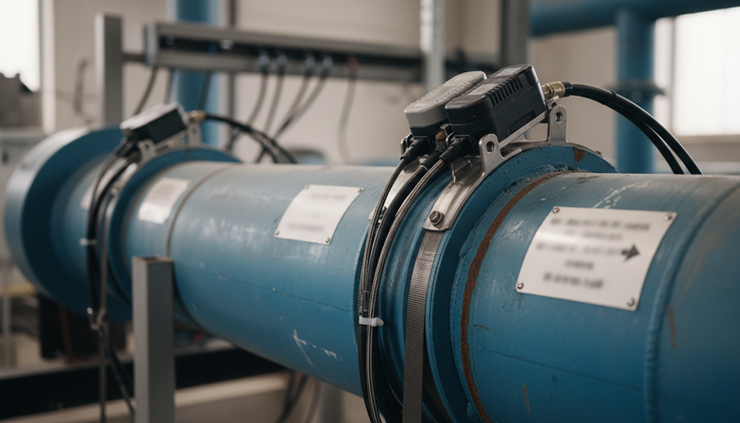
Ultrasonic flow meters are often chosen when access, downtime, or pipe modification is a concern. Clamp-on ultrasonic meters can measure from outside the pipe in suitable applications, so the pipe does not need to be cut.
That can be useful for:
Temporary flow checks
Commissioning and troubleshooting
Existing water lines where shutdown is difficult
Metering points where a permanent inline meter is not practical
Cross-checking another flow instrument
Clamp-on measurement still needs the right conditions. Pipe material, wall thickness, liner condition, liquid quality, pipe fullness, and straight pipe runs can all affect performance. The best results come from matching the meter and transducers to the pipe and fluid, then installing them carefully.
Inline ultrasonic meters may also suit permanent applications where the process conditions support ultrasonic measurement. The main advantage is flexibility. For operations that need data without major pipework changes, ultrasonic technology can provide a practical path.
Gas, steam, fuel, and oil measurement need different methods
Not every process is water or wastewater. Many sites also need to measure compressed air, industrial gases, steam, fuel, oil, and specialty liquids. These services often require a different measurement principle.
Thermal mass flow meters help track compressed air and gas use
Compressed air is expensive to generate and easy to waste. Thermal mass flow meters are commonly used for compressed air and industrial gas measurement because they can measure mass flow directly.
This makes them useful for:
Air compressor output monitoring
Department-level compressed air tracking
Gas consumption monitoring
Leak detection programs
Energy management projects
A thermal mass meter needs the correct gas type, pressure, temperature range, and installation conditions. It also needs clean enough gas for the sensing elements and a location that gives representative flow.
Vortex flow meters fit many gas, steam, and liquid duties
Vortex meters measure the vortices created by a bluff body in the flow stream. They are often used for steam, gas, and liquid applications when the flow profile and process conditions are suitable.
They can be a good choice where a single technology needs to cover a range of industrial services. Still, correct sizing is important. Low flow, pulsation, vibration, and poor straight pipe conditions can all affect performance.
Turbine and positive displacement meters suit clean fuels, oils, and process liquids
Turbine meters and positive displacement meters are often used for fuels, oils, and clean process liquids. They can provide repeatable measurement when the liquid is compatible and the installation is correct.
Positive displacement meters are often selected for viscous liquids or batching duties. Turbine meters are common where clean, lower-viscosity liquids flow at suitable rates.
These meters include mechanical measuring elements, so filtration, liquid cleanliness, pressure drop, and service access should be part of the selection process.
Gas mass flow meters and controllers support precision gas handling
Some applications need more than measurement. They need gas control. Gas mass flow meters and controllers are used where accurate gas flow measurement, dosing, or control is required.
Typical areas include lab systems, test rigs, process gas control, and manufacturing processes that depend on repeatable gas flow. Selection depends on the gas, required flow range, accuracy needs, pressure conditions, materials, and control signal requirements.
Level measurement is about the tank, silo, and material
Level measurement is just as varied as flow measurement. A small water tank, a chemical storage vessel, a wastewater wet well, and a bulk-solid silo all ask different things from the sensor.
ProSight industrial level products include:
80 GHz radar level sensors
Ultrasonic level sensors
Submersible hydrostatic level transmitters
Tank level sensors
Silo and bulk-solid level measurement instruments
The right technology depends on what is being measured, the vessel shape, mounting position, surface movement, vapour, dust, foam, pressure, temperature, and the required output.
For water tanks, a hydrostatic transmitter or ultrasonic sensor may be a simple and effective choice. For larger tanks, vessels with vapour, or applications where the surface is difficult, radar may be more suitable. For silos and bulk solids, dust, filling patterns, cone angles, and material behaviour need attention.
The main goal is not to pick the most advanced sensor. The goal is to pick the one that can see the level clearly and keep doing it through normal process conditions.

Radar, ultrasonic, and hydrostatic sensors solve different level problems
A brief comparison helps show why several level technologies remain useful.
80 GHz radar level sensors measure without contact
Radar level sensors send a microwave signal toward the product surface and measure the return signal. The 80 GHz class is commonly associated with narrow beam angles, which can help in tanks with internal structures or limited mounting options.
Radar can be useful for liquids and some bulk solids, depending on the model and conditions. It is often selected where non-contact measurement is needed, or where vapour, temperature, pressure, or surface conditions make other methods less suitable.
Ultrasonic level sensors use sound for non-contact measurement
Ultrasonic sensors send sound pulses toward the material surface. They are widely used for water, wastewater, and tank level applications.
They can be cost-effective and easy to install, but they need a clear path to the surface. Foam, heavy vapour, dust, turbulence, or obstructions can reduce reliability. Temperature compensation and correct mounting are also important.
Submersible hydrostatic transmitters measure liquid head pressure
Hydrostatic level transmitters measure the pressure from the height of liquid above the sensor. They are commonly used in water tanks, wells, wet wells, and open vessels.
They are simple in concept and effective in many liquid applications. The density of the liquid matters, as does cable venting, sensor material, sludge, and the risk of buildup around the sensing element.
Outputs connect instruments to control and monitoring systems
Industrial measurement does not end at the sensor display. Most sites need the data somewhere else, such as a PLC, SCADA system, recorder, telemetry unit, or cloud-connected remote monitoring platform.
Depending on the model, ProSight instruments can support output options such as:
4-20 mA
RS485 Modbus
Pulse output
HART
Each output has a role.
A 4-20 mA signal remains common because it is simple, widely supported, and reliable over industrial cable runs when installed correctly. Pulse outputs are often used for totalising flow, especially where each pulse represents a defined volume. RS485 Modbus can carry digital values and device data across a network. HART can add digital communication over an analogue current loop for compatible systems.
For control engineers and maintenance teams, this matters during specification. The instrument must measure the process, but it also has to speak the language of the site control system.
Cable distances, power supply, earthing, hazardous-area rules, signal isolation, and environmental protection all need to be checked before installation. The best meter can still disappoint if the signal path is poorly planned.
Calibration and documentation support project confidence
Industrial projects often require more than hardware. They may also require calibration records, quality documentation, conformity information, and evidence that the selected instrument fits the environment.
ProSight instrumentation is supported by established manufacturing, testing, and calibration capabilities. Depending on the product and configuration, supporting documentation can include factory calibration reports, CE documentation, and CE Ex or explosion-protection certification for applicable models.
Manufacturing and quality systems are also supported by certifications including:
ISO 9001
ISO 14001
ISO 45001
Certification varies between products and configurations. That point is especially important for hazardous-area projects, regulated sites, export projects, and installations where project documentation must be approved before equipment is ordered.
The safest approach is to confirm the documentation requirements before selection is final. If a project needs specific certification, calibration format, pressure rating, material traceability, or hazardous-area documentation, that should be checked with ProSense prior to ordering.
The right instrument is not only the one that measures well. It is the one that fits the process, the control system, the installation, and the project documentation.

From measurement to remote monitoring
Many sites are moving from local readings to connected measurement. A flow meter that once fed only a local display may now report to a PLC, SCADA platform, data logger, or remote monitoring gateway. A tank level sensor may trigger alarms, feed inventory data, or help schedule deliveries.
This shift changes how instruments are selected.
Measurement range and accuracy still matter, but so do output type, update rate, diagnostics, enclosure rating, power supply, and ease of integration. A useful measurement point should help the site act sooner, not just collect numbers.
Examples include:
Monitoring pump station flow and tank level from a central control room
Tracking compressed air demand across production areas
Sending remote tank level alarms for agricultural or water storage sites
Measuring wastewater discharge flow for reporting
Watching silo level to reduce the risk of unexpected material shortages
This is where ProSight flow meters and level sensors for reliable industrial measurement can support a wider system. The instrument becomes the field source for decisions made elsewhere, whether that is a controller adjusting a process or an operator responding to an alarm.
A practical way to specify ProSight instruments
A clear specification saves time and reduces the risk of choosing the wrong technology. Before selecting a flow meter or level sensor, gather the key application details.
For flow measurement, define:
Medium name and composition
Liquid, gas, or steam state
Minimum, normal, and maximum flow rates
Pipe size, material, and pressure rating
Temperature and pressure range
Conductivity for liquid electromagnetic applications
Viscosity and cleanliness for oil, fuel, and process liquids
Installation length and available straight pipe
Required output signal and power supply
Area classification and certification needs
For level measurement, define:
Tank, vessel, well, or silo dimensions
Liquid or bulk-solid material
Level range and required accuracy
Mounting location and nozzle details
Foam, vapour, dust, turbulence, or buildup
Temperature and pressure
Chemical compatibility
Required output and alarm functions
Hazardous-area or documentation requirements
This information helps narrow the choice quickly. It also helps ProSense confirm whether a selected model and configuration can meet the technical and documentation requirements of the project.
Reliable measurement comes from a complete fit
Good industrial measurement is a chain. The sensor technology, process connection, wetted materials, signal output, installation, calibration, and documentation all need to match the job.
ProSight by ProSense offers a broad range of flow and level measurement technologies for water, wastewater, manufacturing, mining, agriculture, and process applications. The range covers electromagnetic, ultrasonic, thermal mass, vortex, turbine, positive displacement, and gas mass flow instruments, along with radar, ultrasonic, hydrostatic, tank, and silo level measurement options.
The practical next step is to define the application clearly before ordering. With the right process details and certification requirements confirmed, ProSense can help match the measurement technology and configuration to the job. That is what turns a sensor into a dependable measurement point.


Comments