
Multi Channel Temperature Loggers for K Type Thermocouples in Ovens Labs and Manufacturing
One temperature point rarely tells the full story. An oven may look stable at the controller, while the back corner runs cooler. A machine housing may stay within limits, while a bearing area climbs too fast. A concrete pour may cure evenly at the surface, while the core follows a different heat profile.
That is where multi-channel temperature loggers earn their place. Instead of recording one probe at a time, they record several thermocouple probes at the same time. Each probe sits in a different location, and the logger builds a time-stamped record for every channel.
For K-type thermocouples, this setup is especially useful. K-type probes are common, affordable, and suited to a wide temperature range. Paired with the right logger, they can monitor ovens, kilns, machinery tests, laboratory setups, process validation runs, concrete curing, and production equipment.
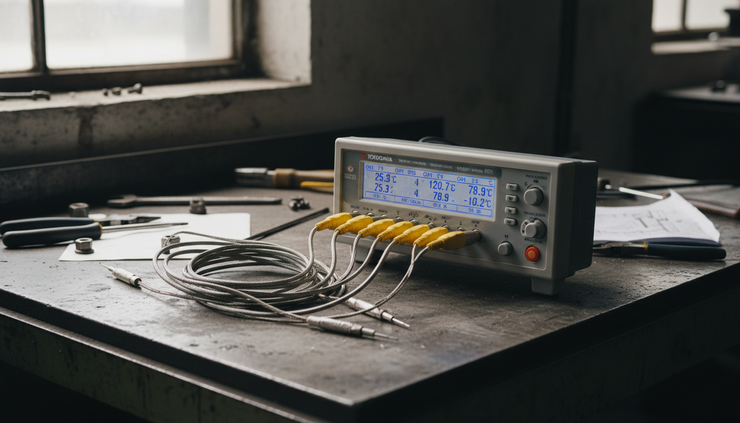
How multi-channel temperature logging works
A thermocouple produces a small voltage based on the temperature difference between its measuring junction and its reference point. The logger reads that signal, applies cold junction compensation, converts the reading into temperature, and stores it against a time stamp.
A single-channel logger does this for one probe. A multi-channel logger repeats the process across several inputs.
Common channel counts include:
Channel count | Typical use |
2 to 4 channels | Small comparison tests, inlet and outlet measurements, simple oven checks |
6 to 8 channels | Machinery testing, cabinet mapping, lab rigs, production line checks |
12 to 16 channels | Larger oven surveys, process validation, multi-point curing studies |
24 channels and above | Detailed thermal profiling, complex equipment, batch validation, research work |
The key benefit is timing. When several channels record together, the data shows what happened across the system at the same moment. That matters when heat rises quickly, when a process has short dwell periods, or when one area lags behind another.
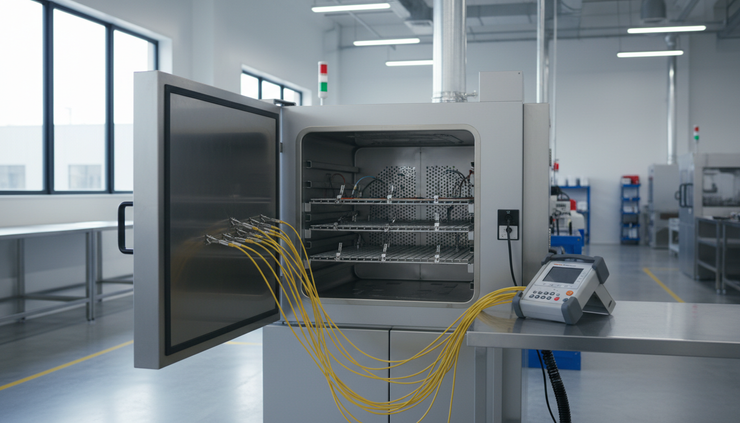
For example, a six-channel logger in an industrial oven can record:
Air temperature near the controller sensor
Product temperature at the front
Product temperature at the rear
Shelf temperature near the door
Exhaust-side air temperature
Ambient room temperature outside the oven
The result is more useful than six separate one-point tests. It shows the spread, the warm-up time, the peak, and the cool-down curve from one run.
Why K-type thermocouples are used so often
K-type thermocouples are among the most widely used temperature sensors in industry and laboratories. They are made from nickel-chromium and nickel-aluminium alloys, and they suit many general-purpose temperature logging jobs.
Their main strengths are simple:
Wide usable range K-type probes can cover very low temperatures and very high temperatures, depending on probe construction and insulation.
Good availability K-type probes, sockets, extension leads, and accessories are easy to source.
Fast response options Fine-wire exposed junction probes can respond quickly to air or surface changes.
Rugged probe designs Mineral insulated and stainless steel sheathed probes can handle demanding plant conditions.
Reasonable cost They are usually less expensive than some specialist sensor types.
The logger and the probe must both support the required temperature range. A K-type input may be rated for a broad range, but the probe insulation, sheath material, plug, cable, and junction style can limit what it can safely measure.
A glass fiber insulated probe may suit hot air work. A PTFE insulated probe may suit lower-temperature lab use. A stainless steel mineral insulated probe may suit ovens, machinery, and process equipment. The thermocouple type is only the starting point.
Channel count should match the question being answered
Choosing channel count is not about buying the largest unit possible. It is about having enough measuring points to answer the test question.
For a small benchtop oven, four channels may be enough to compare left, right, top, and bottom. For a walk-in oven, that would not show enough detail. A larger oven may need 9, 12, or 16 measurement points to understand temperature uniformity.
For machinery testing, the best channel count depends on the number of parts at risk. A motor and gearbox test may need readings from the motor housing, gearbox casing, bearing area, oil sump, ambient air, and exhaust or cooling path.
For process validation, extra channels often help build confidence. A validation run may need readings from product locations, chamber locations, control sensor location, and a reference point. If the process must prove that every part of a load reached a target condition, too few channels can leave gaps.
A useful way to plan channel count is to list the critical points before choosing the logger:
Where can the hottest point be?
Where can the coldest point be?
What location affects product quality or safety?
What location is controlled by the machine but may not reflect the load?
Is one run enough, or will the same logger be used for larger tests later?
Leaving one or two spare channels is often wise. A spare channel can support an ambient probe, a duplicate probe, or an extra point added during setup.
Sampling interval controls the shape of the record
The sampling interval is how often the logger records a reading. A one-second interval gives more detail than a one-minute interval, but it also creates larger files and may reduce total logging duration.
The right interval depends on the speed of the process.
Process type | Typical sampling approach |
Fast machinery warm-up | Short interval, often seconds |
Oven ramp and soak | Seconds to one minute, based on process speed |
Laboratory trial | Short enough to capture the expected change |
Concrete curing | Longer interval, often minutes, because changes are slow |
Long storage or stability monitoring | Longer interval to extend memory and battery life |
A fast test needs a short interval. If a bearing temperature rises and falls inside 30 seconds, a five-minute interval may miss the event. By contrast, concrete curing changes over hours and days, so a very short interval may only create data clutter.
Sampling intervals also affect how clearly the data shows important stages:
Start-up and warm-up
Ramp rate
Overshoot
Stabilisation time
Dwell period
Cool-down
Temperature spread between channels
For validation work, the interval should be short enough to prove that the process met the required condition for the required time. If the logger records too slowly, the data may not support the conclusion.
Temperature range is a system rating, not just a logger rating
A logger may display an impressive K-type temperature range, but the complete measurement chain sets the real limit.
The system includes:
The logger input rating
The thermocouple type
Probe sheath material
Probe insulation
Probe connector
Extension cable
Junction style
Environmental conditions around the cable and connector
A probe placed inside a hot oven may survive the air temperature, while its cable jacket fails near the door seal. A plug may sit close to radiant heat and exceed its own limit. A surface probe may read lower than expected because it loses heat to the surrounding air.
The probe’s rated temperature should match the actual exposure, not just the expected process temperature. In ovens and kilns, radiant heat and hot surfaces can stress probes more than air temperature alone suggests. In machinery tests, vibration, oil, sharp edges, and moving parts can be as important as temperature.
The logger itself should usually stay outside the harsh zone unless it is specifically rated for that environment. Thermocouple probes and extension leads can handle the measurement location while the instrument records from a safer position.
Probe selection changes the quality of the data
A K-type thermocouple is not one single product. It is a family of probes built for different jobs. The wrong probe can produce slow, noisy, or misleading readings.
Probe style | Best suited for | Practical note |
Exposed junction wire probe | Fast air temperature changes | Very quick response, less protection |
Grounded junction probe | Fast response in a metal sheath | Can be more affected by electrical noise |
Ungrounded junction probe | Electrical isolation | Slower than grounded designs |
Surface probe | Pipes, plates, housings, machinery | Needs firm contact and suitable attachment |
Penetration probe | Soft materials, powders, some products | Placement depth affects the reading |
Mineral insulated probe | Ovens, machinery, harsh process areas | Strong choice for higher temperatures and durability |
Embedded concrete probe | Concrete curing and mass pours | Should be placed before or during the pour |
Probe diameter matters. Thin probes usually respond faster. Thicker probes usually resist damage better. Cable length matters too, especially when the logger must sit away from heat, water, vibration, or moving parts.
Attachment also matters. A surface probe loosely taped to a curved metal housing may measure air more than metal. Better contact gives better data. Clamps, high-temperature tape, welded pads, magnets rated for the temperature, or purpose-made surface probes can improve repeatability.
For ovens, probe placement should avoid touching walls unless wall temperature is the target. For laboratories, probe placement should match the test method. For manufacturing, probes should not interfere with normal product flow or create a safety risk.

Data export turns readings into evidence
A logger screen is useful during setup, but the real value comes from the saved data. Multi-channel loggers usually let users export readings for review, reporting, and archiving.
Common export options include:
CSV files for spreadsheets
Excel-compatible files
PDF reports
Graph images
Manufacturer software project files
USB download
SD card removal
Bluetooth or Wi-Fi transfer on some models
CSV is one of the most flexible formats because it can be opened in spreadsheet software, imported into analysis tools, and archived with test records. For audits and validation, a PDF report can be useful because it captures graphs, channel names, device details, and time ranges in a readable format.
Good data export should make it easy to review:
Maximum, minimum, and average temperatures
Time above or below a threshold
Temperature difference between channels
Warm-up and cool-down times
Pass or fail limits
Sensor names and locations
Date, time, and sampling interval
Channel naming helps prevent confusion. `Channel 1` and `Channel 2` mean little after the test. Names such as `Top rear oven air`, `Product center`, or `Motor bearing drive end` make the record easier to understand months later.
For regulated or quality-controlled processes, calibration records also matter. The logger and probes should be checked or calibrated at suitable intervals for the process risk. The exported file should be stored with the test plan, probe placement notes, and any photos or diagrams that show where the probes were installed.
Common applications across ovens, labs, concrete, and production
Multi-channel K-type logging suits many jobs because heat problems rarely happen at one point only.
Oven temperature mapping
Ovens can have hot and cold zones caused by airflow, loading pattern, heater placement, door leakage, or control sensor position. A multi-channel logger helps show whether the chamber and product reach the needed temperature.
Typical oven checks include:
Temperature uniformity across shelves
Product core temperature during heating
Warm-up time before loading
Recovery time after door opening
Difference between controller display and measured load temperature
This is useful for curing, drying, coating, baking, heat treatment, and general manufacturing processes.
Machinery testing
Machinery often heats unevenly. A single surface reading may miss the part that matters. K-type probes can track bearings, housings, motors, gearboxes, hydraulic circuits, exhaust paths, and cooling systems.
A logger helps compare load conditions. For example, a test may record temperatures at idle, normal load, and high load. The data can show whether one component warms faster than the rest or whether a cooling change made a measurable difference.
Process validation
Validation needs records that show the process did what it was meant to do. In heat-based processes, that often means proving that enough of the load reached a target range for enough time.
Multi-channel logging supports this by recording several points in the load or process area. It can help document soak time, uniformity, and repeatability. The data can then form part of a batch record, qualification file, commissioning report, or internal quality review.
Concrete curing and mass pours
Concrete generates heat as it cures. In large pours, the core can become much warmer than the surface. Temperature differences matter because they can affect cracking risk and curing control.
Embedded thermocouple probes connected to a logger can track internal and surface temperatures over time. Longer sampling intervals are often suitable because curing is slow compared with oven or machinery tests. Multi-channel records help compare core, edge, surface, and ambient conditions.
Laboratories
Labs use multi-channel temperature loggers for experiments, equipment checks, environmental chambers, water baths, sample heating, and cooling studies. K-type probes are useful when the setup may change often, because many probe styles are available.
A lab may use one logger with different probes from week to week. One test may need fine-wire probes for fast air response. Another may need sheathed probes for liquids or heated blocks.
Manufacturing
Production equipment often needs periodic checks. Multi-channel logging can support preventive maintenance, troubleshooting, quality checks, and new product trials.
In a manufacturing setting, a logger can help answer practical questions:
Is the product seeing the same temperature across the batch?
Did a heater band fail or drift?
Does a machine run hotter after a tool change?
Are cooling fans working as expected?
Does a process stay inside its accepted temperature window?
The strength of the method is that it creates a record rather than a one-time reading.

What to check before starting a test
A good logging run starts before pressing record. Small setup errors can spoil the data.
Use this quick checklist:
Confirm the logger is set to K-type thermocouple input.
Check every probe for damage, loose plugs, or crushed cable.
Match probe ratings to expected temperature and environment.
Label each channel before or during connection.
Set the sampling interval to match the process speed.
Confirm the clock and time zone are correct.
Place probes where they answer the test question.
Keep the logger away from heat, moisture, and vibration.
Start recording before the process begins.
Save the exported file with clear test notes.
For critical work, run a short trial before the full test. A five-minute check can reveal reversed channels, poor contact, unstable readings, or a probe in the wrong location.
The main takeaway
A multi-channel temperature logger turns scattered temperature points into one clear thermal record. When used with suitable K-type thermocouples, it can show how heat moves through an oven, a machine, a concrete pour, a lab setup, or a manufacturing process.
The best results come from matching the logger, channel count, sampling interval, probe type, and export method to the job. More channels are useful only when they measure meaningful locations. Faster sampling helps only when the process changes quickly. A high temperature range matters only when every part of the probe system can handle it.
Plan the measurement points first, then choose the logger and probes. That simple order leads to cleaner data, better reports, and fewer repeat tests.


Comments