
Dragino LoRaWAN Sensors for Australian Farms and Remote Industrial Sites
A tank can run dry long before anyone has time to drive out and check it. A pump can trip overnight. A freezer, bore, irrigation line or remote weather station can fail quietly for hours, sometimes days, before the problem becomes obvious.
That is where LoRaWAN starts to make sense for Australian farms and remote industrial sites. It is built for small packets of sensor data sent over long distances, often from battery-powered devices. For properties, depots and assets beyond normal Wi-Fi or fixed internet, this can be the difference between guessing what is happening and knowing.
Dragino LoRaWAN sensors are a practical fit for this kind of work. They are used to monitor tanks, soil, pumps, gates, environmental conditions and other assets without running long signal cables or installing full-scale communications systems at every point. The setup still needs planning, but the idea is simple: place a sensor where the measurement happens, send the reading to a gateway, then view the data through a dashboard, alert system or control platform.
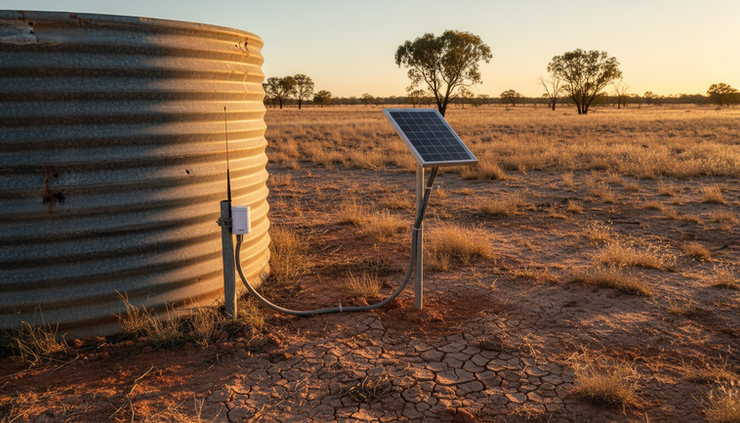
Why LoRaWAN suits Australian distances
Australia makes remote monitoring both harder and more valuable. Many assets sit well away from houses, sheds, control rooms and mobile reception. A useful monitoring system has to cover distance, run on little power and tolerate rough outdoor conditions.
LoRaWAN is designed for that problem. It is not a replacement for high-speed internet. It does not stream video or move large files. Instead, it sends small messages such as:
Tank level
Soil moisture
Temperature and humidity
Pump run status
Gate open or closed state
Rainfall or flood level
Battery voltage
Equipment fault input
That small-data approach is why LoRaWAN can work over long distances and support battery operation. A sensor may only need to send a reading every few minutes, every hour or a few times per day. For many farm and industrial assets, that is enough.
The coverage range varies with terrain, antenna placement, vegetation, buildings and interference. A gateway on a mast with clear line of sight will usually perform far better than one inside a metal shed. Hills, trees and tanks can block or weaken signals. The best results come from treating radio coverage as part of the site design, not as an afterthought.
For Australian deployments, the frequency plan also matters. Devices and gateways should be configured for the correct local LoRaWAN band, commonly AU915 or another legal regional plan selected for the network. This is one reason to buy through suppliers who understand Dragino Australia requirements rather than treating every LoRaWAN product as interchangeable.
What Dragino sensors can monitor on farms
Dragino devices are often chosen because the range covers many common rural sensing jobs. A farm may start with one tank sensor, then add soil, pump and weather monitoring as the value becomes clear.
Tank and water level monitoring
Water tanks are a natural starting point. A level sensor can help track household supply, livestock water, chemical storage, header tanks or irrigation reservoirs.
Common approaches include ultrasonic or pressure-based measurement, depending on the tank and liquid. The sensor sends the level at set intervals. The platform can then show a percentage, distance to surface or estimated volume.
Useful alerts include:
Low tank level
Rapid drop in level
No change when a pump should be filling
Sensor battery low
Device has stopped reporting
This is often more useful than a daily manual check, because the alert arrives when the problem starts.
Irrigation and soil monitoring
Irrigation systems often sit across wide areas, and problems may not show until crops or pasture are already stressed. LoRaWAN sensors can support decisions by reporting from the paddock rather than from the office.
Typical measurements include soil moisture, soil temperature, ambient temperature, humidity and rainfall. On their own, these readings do not replace local knowledge. They add evidence. A grower can compare paddocks, see how moisture changes after watering and identify areas that dry faster than expected.
LoRaWAN can also report the status of irrigation equipment. For example, a sensor can detect whether a pump is running, whether a valve is open, or whether a pressure switch has changed state. That helps confirm that scheduled irrigation actually happened.
Livestock and property infrastructure
Not every valuable sensor reading is about crops. Gates, troughs, sheds and remote yards can all benefit from simple status monitoring.
A door or contact sensor can report whether a gate has been left open. A water level sensor can watch a trough or header tank. A temperature sensor can monitor a cool room, feed storage area or animal housing. These are small data points, but they can prevent wasted trips and reduce the time between a fault and a response.
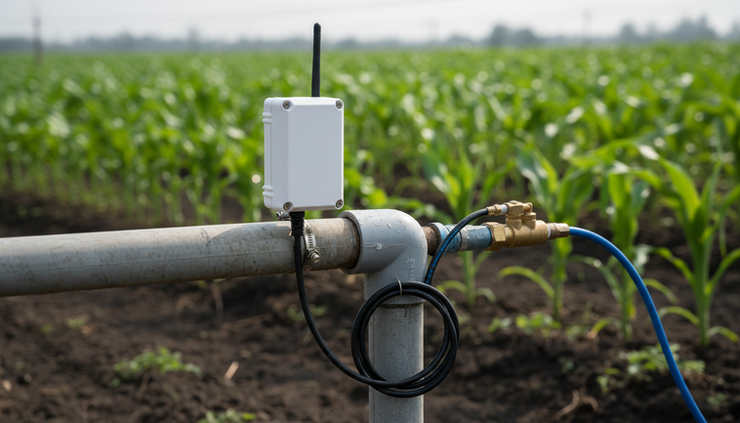
How remote industrial sites use LoRaWAN sensors
The same principles apply beyond agriculture. Remote industrial sites often have assets that are important but not worth connecting with expensive fixed communications.
Pump stations, mining support infrastructure, quarries, utilities, storage yards and environmental monitoring points all need basic visibility. A LoRaWAN sensor can report whether equipment is operating, whether a threshold has been crossed, or whether environmental conditions are changing.
Common industrial uses include:
Site asset | What a LoRaWAN sensor can report | Why it matters |
Pump station | Run status, fault contact, water level, vibration indicator | Detect stoppages before overflow or supply loss |
Remote tank | Level, refill rate, rapid loss | Reduce manual inspections and catch leaks |
Generator or power system | Run signal, battery voltage, enclosure temperature | Confirm backup equipment is ready |
Industrial yard | Gate state, door state, temperature, humidity | Improve awareness of remote assets |
Environmental site | Rainfall, water level, soil or air conditions | Build a record without frequent site visits |
Many Dragino LoRaWAN devices can work with existing industrial signals, such as digital inputs or analogue readings, depending on the model. This is useful when the asset already has a float switch, relay output, pressure sensor or fault contact. Rather than replace the whole system, the LoRaWAN device can report the signal remotely.
For critical plant control, LoRaWAN is usually better suited to monitoring and alerts than real-time control. It is a low-power wide-area network, not a hard-wired safety system. Use it to see what is going on, log history and trigger maintenance responses. Keep safety controls local and compliant with site requirements.
Gateways turn sensor messages into usable data
A LoRaWAN sensor does not normally connect directly to the internet. It sends its message by radio to a gateway. The gateway forwards the message to a network server, then the data can appear in a dashboard, app, database or alert system.
Think of the gateway as the local collection point. One well-placed gateway can receive messages from many sensors. For a large property or site with hills, more than one gateway may be needed.
Gateway backhaul is the next question. The gateway needs a way to send data onward. Depending on the location, that might be:
Fixed internet at a homestead, shed or office
4G or 5G where mobile coverage is available
A point-to-point link back to an internet-connected site
Satellite internet for very remote areas
Local network logging for sites that do not need live reporting
For many rural projects, the best gateway location is not the most convenient building. It may be a mast, hill, tank stand or shed roof. Height is valuable because LoRaWAN benefits from clear line of sight. A gateway inside a steel shed may be easy to power, but poor for coverage.
A practical site check should look at:
Distance between sensors and gateway
Terrain and obstructions
Antenna height and type
Availability of power
Backhaul options
Weather exposure
Future sensor locations
Good planning at this stage avoids many of the problems that get blamed on the sensor later.

Battery operation needs sensible reporting intervals
Battery life is one of the main reasons LoRaWAN is useful in remote sensing. Many sensors can operate for long periods because they sleep most of the time, wake up, take a measurement, send a small message, then go back to sleep.
The biggest influence on battery life is usually behaviour. A sensor sending every minute will use more energy than one sending every hour. A poor radio link can also increase power use because the device may need more transmit power or repeat attempts.
For a tank, an hourly reading may be enough. For a pump fault, a faster alert may be needed. For soil moisture, the best interval may depend on irrigation schedules and how quickly conditions change.
A sensible setup balances three things:
More frequent reporting
Less frequent reporting
Faster alerts and better detail, but higher battery use
Longer battery life, but slower fault detection
Battery planning should include access. If a sensor is mounted on a tank in a remote paddock, changing batteries during wet weather or peak workload may be inconvenient. Use reporting intervals that match the real risk, not just the desire to see more data.
Battery voltage alerts are also worth enabling. They turn battery replacement into planned maintenance rather than a surprise outage.
Solar power helps where sensors or gateways need more energy
Some field equipment needs more power than a small internal battery can provide. Gateways, frequent-reporting devices and sensors with power-hungry measurements may need an external supply. Solar power is often the practical answer.
A solar-powered LoRaWAN installation usually includes:
A solar panel
A charge controller
A battery
Weatherproof enclosure
Mounting hardware
Fusing and cable protection
For sensors, solar can support higher reporting rates or harder measurement conditions. For gateways, solar may be essential where there is no mains power at the best radio location.
Australian conditions can be helpful for solar, but the design still needs care. Dust, shade, heat, storms and short winter days all affect performance. A panel that works in summer may struggle if it is shaded by a tree line in winter or coated in dust after dry weather.
Mount solar gear where it can be inspected and cleaned. Protect cables from animals, machinery and UV exposure. Use enclosures suited to outdoor conditions, and avoid placing electronics where water can pool or heat can build up.
What a basic Dragino LoRaWAN setup looks like
A simple remote monitoring system has four parts.
The sensor
This is installed at the tank, pump, soil probe, gate or equipment cabinet. It measures the condition or reads a connected input.
The gateway
This receives radio messages from the sensors. It is placed for coverage and connected to the internet or another backhaul path.
The network and data platform
This decodes the LoRaWAN messages and sends the readings to a dashboard, database or alert service.
The alerts and reports
These turn raw readings into useful information. A low tank level alert is more useful than a long list of numbers that nobody checks.
The best systems keep the user experience simple. Field staff and managers usually need clear status, trends and alerts. They do not need to see every radio detail unless they are maintaining the network.
That practical focus is why LoRaWAN Sensors Australia projects should start with the operational question, not the hardware catalogue. Ask what decision the data will support. Then choose the sensor, reporting interval, gateway and alert rules to suit that decision.
Installation details that make a real difference
Remote sensing is not only about choosing the right device. Installation quality has a large effect on reliability.
Mount sensors where they can measure accurately and survive day-to-day conditions. A tank sensor needs a stable view of the water surface or a correct pressure reference. A soil sensor needs suitable placement in the root zone. A pump status device needs clean wiring from the signal it monitors.
Antenna placement matters too. Keep antennas clear of metal surfaces where possible. Avoid sealing a device inside a metal cabinet unless an external antenna is used. Mount equipment so water runs away from cable entries, not into them.
Label devices in the field and in the dashboard with names that make sense. “North bore tank” is better than a serial number when an alert arrives at 5 am. Record where each device is installed, what battery it uses and what it is meant to report.
Before calling an installation finished, test it under real conditions:
Confirm readings match the physical asset
Trigger the alert condition if safe to do so
Check signal strength from the installed location
Confirm the gateway backhaul is stable
Review the dashboard label and units
Make sure battery or solar status is visible
These steps are simple, but they prevent confusion later.

Start small, then expand with a clear plan
The most successful remote sensing projects often begin with one visible problem. A farm might start with tank monitoring because dry tanks cause immediate pain. An industrial site might start with pump station alerts because failures are costly. Once the first use case is working, it becomes easier to add more sensors.
A staged approach also helps prove coverage. Install the first gateway, test the hardest sensor locations and learn how the terrain behaves. Then build out from there.
A good first project should have:
A clear asset to monitor
A simple alert rule
A known person or team who responds
A dashboard that is easy to read
A maintenance plan for batteries, solar gear and enclosures
Dragino LoRaWAN sensors are useful because they can support many of these jobs without heavy infrastructure at each location. They do not remove the need for good site design, but they make remote visibility far more practical across long distances.
For Australian farms and remote industrial sites, that is the real value. Less driving just to check. Faster awareness when something changes. Better records of what happened over time. More confidence that important assets are still doing what they should.
Start with the asset that causes the most wasted trips or the highest risk when it fails. Put a sensor there, place the gateway properly and set one alert that someone will actually act on. That is enough to turn remote monitoring from a technical project into a useful daily tool.


Comments