
Why Pressure and Temperature Compensation Matters in Steam Flow Measurement
- 18 hours ago
- 10 min read
A steam flowmeter can report a steady volumetric flow while the real amount of steam moving through the pipe is changing. That is the trap. Volume alone does not tell the full story, because steam density changes with pressure and temperature.
For plant operators, energy managers, and maintenance teams, that gap matters. Steam is often used for heating, sterilization, drying, humidification, turbines, and process work. If the flow reading does not reflect the steam’s actual mass, then fuel use, process efficiency, batch records, and cost allocation can all drift away from reality.
This is why pressure and temperature compensation matters in steam flow measurement. It turns a raw volume reading into a more useful mass-flow or energy-flow value. In many steam systems, especially systems with changing loads, a compensated vortex flowmeter can provide a much clearer picture of what is really happening inside the pipe.
Volumetric steam flow is only part of the answer
Many flowmeters measure or infer volumetric flow. That means they report how much space the steam occupies as it moves through the pipe, often in units such as cubic feet per minute or cubic meters per hour.
That can be useful, but steam users often need a different value: mass flow.
Mass flow tells how much steam is moving through the pipe by weight, such as pounds per hour or kilograms per hour. This is usually the value that matters for:
Boiler load tracking
Energy accounting
Process heat balance
Cost allocation between departments or users
Detecting leaks or abnormal demand
Sizing and checking control valves
Verifying performance of heat exchangers and coils
The link between volume and mass is density.
`Mass flow = Volumetric flow × Density`
If density stays constant, volumetric flow can be a reliable stand-in for mass flow. But steam density does not stay constant in real systems. It changes when pressure changes. It changes when temperature changes. In saturated steam systems, pressure and temperature are tied together, but quality and condensate effects can still complicate the picture. In superheated steam systems, pressure and temperature need to be known separately.
A raw volumetric number answers one question: how much space is passing through the meter. A compensated mass-flow number answers a more useful question: how much steam is actually passing through the meter.
Steam density changes with pressure and temperature
Steam is compressible. That single fact drives the need for compensation.
For gases and vapors, density rises when pressure rises and falls when temperature rises, assuming other conditions are comparable. Steam is not always a perfect gas, and accurate calculations often rely on steam tables or built-in property algorithms. Still, the basic relationship is easy to understand.
At a higher pressure, the same pipe volume contains more steam mass. At a higher temperature, especially for superheated steam, the same pipe volume contains less steam mass than it would at a lower temperature and the same pressure.
This means two flow readings with the same volume can carry different amounts of usable energy.
Imagine a meter reports the same volumetric flow on Monday and Tuesday. On Monday, the system runs at a higher pressure. On Tuesday, the pressure drops during a heavy process demand. The volumetric reading may look unchanged, but less mass may be moving through the pipe on Tuesday. If the system records only volume, it may miss that reduction.
The reverse can also happen. A pressure increase can make a constant volumetric flow represent more steam mass than expected. A control system that assumes fixed density may then overfeed energy or misread process performance.
Saturated steam behaves differently from superheated steam
Steam systems are often described as either saturated or superheated.
Saturated steam exists at the temperature that matches its pressure. Raise the pressure, and the saturation temperature rises. Lower the pressure, and the saturation temperature falls. Because those two values are linked, some instruments can compensate saturated steam using pressure alone or temperature alone, depending on the design and assumptions.
Superheated steam has been heated above the saturation temperature for its pressure. In this case, pressure and temperature are independent enough that both values are needed for accurate density calculation.
That distinction matters when selecting instruments. A meter set up for saturated steam assumptions can give poor results if the line actually carries superheated steam. It can also mislead if steam quality is poor and the line carries a mixture of steam and entrained condensate.

Why uncompensated readings can mislead
An uncompensated steam flow reading often assumes a fixed density. That may be acceptable only if the process conditions are steady and close to the design point. Many steam systems do not behave that way.
Loads turn on and off. Control valves open and close. Boiler pressure floats. Pressure drops develop across strainers, valves, heat exchangers, and long pipe runs. Seasonal demand changes. Startups and shutdowns create wide swings. Even well-maintained systems move through different operating points during a normal day.
When a meter does not compensate for those changes, the error follows the density shift.
For example, if the actual steam density falls but the meter calculation still uses the old density, the reported mass flow can be too high. If the actual density rises and the assumed density stays low, the reported mass flow can be too low.
That becomes a practical problem in several ways.
Energy use can look better or worse than it is
Steam energy calculations often depend on mass flow and enthalpy. Enthalpy is the heat content per unit mass, usually found from steam properties at the measured pressure and temperature.
A simplified energy-flow calculation looks like this:
`Energy flow = Mass flow × Enthalpy difference`
If mass flow is wrong, the energy calculation is wrong. If pressure and temperature data are missing, the enthalpy value may also be wrong.
That can distort boiler efficiency checks, departmental billing, carbon reporting, and process cost estimates. A plant may appear to use more or less energy than it really does.
Process control can chase the wrong signal
Some systems use steam flow as a control input. For example, a process may adjust a valve based on a target steam rate. If the meter reports uncompensated volume as though it were mass, the control loop may respond to a misleading value.
The result can be slow heating, overheated product, unstable batch timing, or poor repeatability. The flow loop may look stable while the actual heat delivery is shifting.
Equipment problems can hide in plain sight
Flow trends can help detect fouled strainers, failed traps, leaking valves, and abnormal steam demand. But if the trend mixes true flow changes with density changes, the signal becomes harder to interpret.
A sudden pressure drop may look like a demand change. A temperature shift may look like a process issue. Without compensation, the meter cannot separate flow behavior from steam property changes.
How vortex meters measure steam flow
Vortex flowmeters are common in steam service because they have no moving parts in the flow stream and can handle many industrial steam conditions.
A vortex meter places a bluff body in the flow path. As steam passes the body, it sheds alternating vortices downstream. The shedding frequency relates to the velocity of the flowing steam. The meter detects that frequency and converts it into a volumetric flow rate.
That measurement principle is well suited to many steam applications, but the meter’s base signal is still tied to volume and velocity. To calculate mass flow, the instrument needs density.
Density comes from compensation.
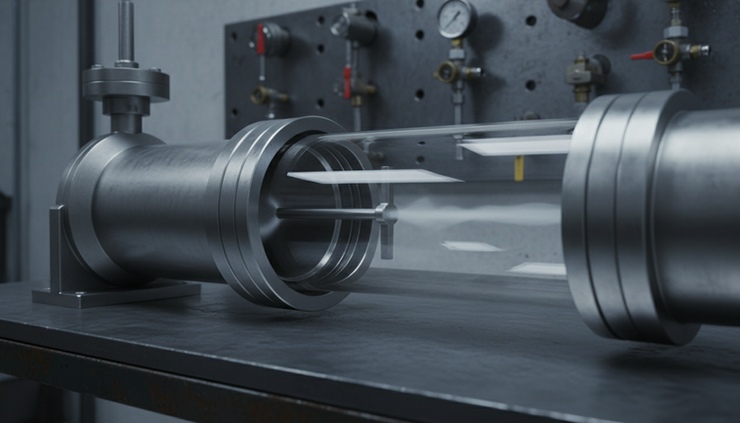
A compensated vortex instrument combines the vortex flow signal with pressure and temperature measurements. The transmitter or flow computer then calculates density using steam property data and converts volumetric flow into mass flow.
In many modern designs, this can happen inside the flowmeter transmitter. Some meters include integrated temperature measurement. Others accept signals from external pressure and temperature transmitters. In larger systems, a separate flow computer may perform the steam calculations.
The goal is the same: turn a measured velocity or volume into a corrected mass-flow value that reflects actual steam conditions.
What pressure compensation adds
Pressure compensation helps the meter account for changes in steam density caused by pressure shifts.
In saturated steam applications, pressure can also define the saturation temperature and steam properties, if the steam is dry and saturated. That makes accurate pressure measurement especially valuable.
For a vortex meter, pressure compensation can help when:
Boiler header pressure varies through the day
The meter sits far from the boiler and line pressure changes with demand
Control valves create changing downstream pressure
Steam users operate at different pressure levels
The plant records steam use for cost or energy tracking
Pressure should be measured close enough to the flowmeter to represent conditions at the meter. If a pressure tap is placed where the pressure does not match the flowing steam at the measurement point, the compensation may still be off.
Impulse lines also need proper installation. Steam pressure measurement often requires condensate legs, isolation valves, and correct orientation to protect the transmitter and maintain accuracy. Poor installation can create measurement errors no matter how good the transmitter is.
What temperature compensation adds
Temperature compensation is needed when temperature is not reliably defined by pressure alone. It is essential for superheated steam.
A temperature sensor lets the instrument calculate steam density more accurately. It also supports energy calculations, because enthalpy depends on steam conditions.
Temperature measurement is especially useful when:
Steam is superheated
Superheat varies with boiler operation or load
Steam is reduced through pressure-reducing valves
Long distribution lines create heat loss
The process needs energy flow, not just mass flow
Sensor placement matters. The temperature element should measure the steam at or near the same conditions as the flowmeter. If it sits too far away, after a pressure drop, or in a poorly mixed area, it may not represent actual flowing conditions.
The sensor also needs enough insertion depth and proper thermal contact with the process. A slow or poorly installed temperature sensor can lag during load changes, which affects compensated readings.
Compensation improves mass-flow and energy calculations
The main benefit of compensation is not a prettier display. It is a better calculation.
A compensated vortex flowmeter can report values such as:
Actual volumetric flow
Standard or normalized volumetric flow, when applicable
Mass flow
Totalized mass
Energy flow
Totalized energy
For steam users, mass and energy totals are often the most useful outputs. They connect flow measurement to fuel cost, production output, and equipment performance.
A simple comparison shows why this matters.
Reading type | What it tells you | What it can miss |
Uncompensated volumetric flow | How much pipe volume the steam occupies over time | Density changes caused by pressure and temperature |
Temperature compensated flow | Improved density estimate when temperature varies | Pressure effects if pressure is assumed |
Pressure compensated flow | Improved density estimate when pressure varies | Superheat effects if temperature is assumed |
Pressure and temperature compensated flow | A stronger mass-flow and energy-flow basis | Still depends on good installation and dry steam conditions |
Compensation does not fix every steam problem. It cannot make wet steam dry. It cannot correct a meter installed too close to a control valve if the flow profile is poor. It cannot rescue bad pressure taps or a temperature sensor mounted in the wrong place.
But when the installation is sound, compensation removes one of the biggest sources of error in steam measurement: changing density.
Where compensated vortex instruments make the most difference
Compensated vortex meters are useful anywhere steam conditions vary enough to affect the value of the measurement.
Common applications include boiler house monitoring, plant steam headers, process unit submetering, heat exchanger supply lines, sterilizers, dryers, and steam distribution networks.
They are especially helpful when the flow reading supports decisions, not just observation. A local indicator that shows rough flow may not need full compensation. A meter used for energy accounting, production cost, or process control usually does.
Boiler and header monitoring
At the boiler outlet or main header, compensated flow gives a clearer view of plant demand. Operators can compare steam generation against fuel use, condensate return, and makeup water. If pressure floats with load, uncompensated volume can make the demand profile harder to trust.
Process and departmental metering
Many plants allocate steam cost to production lines, buildings, or departments. If those meters use fixed density assumptions while pressures vary, one area may appear to use more or less steam than it really does. Compensation supports fairer allocation.
Heat exchanger and coil performance
Heat transfer depends on actual steam condensing and releasing energy. Mass and energy flow produce better performance checks than raw volume alone. When a coil underperforms, compensated data helps separate a steam supply problem from fouling, trap issues, or air binding.
Good compensation still depends on good installation
A compensated vortex meter is only as accurate as the full measurement setup. The flowmeter, pressure transmitter, temperature sensor, piping, and configuration all work together.
Several details deserve attention.
Straight pipe runs matter. Vortex meters need a stable flow profile. Elbows, reducers, valves, and control devices can disturb the flow. Follow the meter manufacturer’s upstream and downstream straight-run guidance.
Steam quality matters. Wet steam can affect both the flow signal and the energy calculation. If condensate slugs, poor trapping, or bad insulation allow water into the line, measurement may become unstable or biased.
Correct pipe sizing matters. Oversized steam lines can leave meters operating at low velocity. Undersized lines can create high pressure drop or noisy flow. The meter should be sized for the expected flow range, not simply matched to line size.
Configuration matters. The instrument must know whether the application is saturated or superheated steam. Units, reference conditions, pipe size, sensor inputs, and calculation settings must match the application.
Maintenance matters. Pressure taps can plug. Temperature sensors can drift. Insulation can be removed and not replaced. Trap failures can change steam quality. A good meter still needs periodic checks.
Compensation improves the calculation, but it is not magic. The best results come from a well-sized meter, correct sensor placement, accurate configuration, and a steam system that is maintained well enough to deliver dry, stable flow.
The real value is confidence in the number
Steam is too important to measure loosely. It carries energy, cost, and process risk through the plant. A raw volumetric reading can be useful for basic indication, but it can also hide large changes in actual steam mass when pressure and temperature move away from assumed values.
Pressure and temperature compensation closes that gap. It helps a vortex meter report mass flow and energy flow based on the steam’s actual condition, not a fixed assumption. That makes the reading more useful for control, accounting, troubleshooting, and efficiency work.
The takeaway is simple: if the steam flow number affects decisions, compensate it. A compensated vortex instrument gives the measurement a stronger foundation, and in a changing steam system, that can be the difference between seeing flow and understanding it.


Comments