
What Is an NB-IoT Analog Sensor and How Does It Work
Updated: 2 days ago
Factories, farms, water systems, tanks, pumps, and remote equipment often rely on analog sensors. These sensors are simple and reliable, but they have one big limit: their readings usually stay trapped at the site unless someone wires them into a control system or checks them manually.
An NB-IoT analog sensor solves that problem. It reads an analog signal, converts it into digital data, and sends it over a cellular NB-IoT network to an IoT platform.
The Dragino PS-NB-NA is a good example. It can read current and voltage signals from external analog sensors, power those sensors with 5 V or 12 V output, and report the readings through MQTT, MQTTs, UDP, TCP, or CoAP. It is built for low power use, outdoor installation, and long-term remote monitoring.

What an NB-IoT analog sensor does
An analog sensor measures a physical condition and expresses it as an electrical signal. Common examples include:
Water pressure
Tank level
Flow rate
Soil moisture
Temperature through a transmitter
Industrial process values
Battery or DC voltage
Equipment status from analog outputs
Many industrial analog sensors use current or voltage output. A pressure transmitter, for example, might output a current signal that changes as pressure rises or falls. A level probe might output a voltage signal that represents the height of liquid in a tank.
The NB-IoT analog sensor sits between that field sensor and the cloud. It performs three main jobs.
It powers the external sensor when needed.
The PS-NB-NA provides 5 V and 12 V output, which can supply compatible external sensors. This is useful in remote locations where there is no local power source for the sensor.
It measures the analog input.
The device reads signals through its analog input interfaces. In the PS-NB-NA, these include one 0 to 20 mA current input and one 0 to 30 V voltage input.
It sends the reading through NB-IoT.
After measuring the signal, it converts the analog value into digital data and sends it to an IoT server over the NB-IoT cellular network.
That makes it useful when wired Ethernet, Wi-Fi, or long RS485 cable runs are not practical.
Why NB-IoT is used for remote sensing
NB-IoT stands for Narrowband Internet of Things. It is a cellular technology designed for devices that send small amounts of data and need to run on low power.
It is not made for high-speed data. It is made for small, periodic messages such as:
A tank level reading every 30 minutes
A pressure value every hour
A flow rate report several times per day
A battery level update
An alarm when a threshold is crossed
This fits analog monitoring very well. Most analog sensors do not need to stream data every second. They often need to report stable operating values at planned intervals.
The PS-NB-NA supports NB-IoT bands including B1, B2, B3, B4, B5, B8, B12, B13, B17, B18, B19, B20, B25, B28, B66, B70, and B85 using H-FDD. Actual operation depends on the local carrier and SIM plan, but the broad band support helps the device fit many deployments.
NB-IoT also supports wide-area coverage through cellular infrastructure. That makes it useful for assets spread across a large service area, such as meter pits, irrigation lines, pump stations, storage tanks, and remote equipment cabinets.
How the PS-NB-NA works in the field
The working process is simple from the outside, but each step matters.
The external sensor measures the real-world condition
The field sensor does the physical measurement. For example, a pressure sensor on a pipe measures pressure. A level sensor in a tank measures liquid height. A transmitter converts that condition into a current or voltage signal.
Many field sensors are designed for industrial environments and output a standard analog signal. The PS-NB-NA reads that signal rather than replacing the sensor itself.
The PS-NB-NA supplies power to the sensor
Some external sensors need a power supply to operate. The PS-NB-NA can provide 5 V or 12 V output to power compatible analog sensors.
This helps reduce installation complexity. In many remote monitoring jobs, every extra power supply, enclosure, and cable introduces more failure points. A battery-powered NB-IoT device that also powers the sensor can make the system cleaner.
Because the device is battery powered, sensor power timing matters. In low-power designs, the unit may power the sensor only when it needs to take a reading, then turn the output off to save energy.

The device samples the analog value
The PS-NB-NA can take multiple samples and send one uplink. This is helpful because analog values can fluctuate.
Instead of sending every tiny change, the device can sample the input several times and package the final value for upload. Depending on configuration, this can reduce noise, save power, and reduce data use.
The device measures:
Measurement type | Range | Accuracy | Resolution |
Current input | 0 to 20 mA | 0.02 mA | 0.001 mA |
Voltage input | 0 to 30 V | 0.02 V | 0.001 V |
These values make it suitable for many analog transmitters and DC voltage monitoring tasks. The current input can also be used with sensors that operate in the common 4 to 20 mA range, as long as the signal stays within the device’s supported 0 to 20 mA measurement range.
It converts the reading into IoT data
The analog signal itself cannot travel directly to an IoT platform in a meaningful way. The device converts the electrical value into digital data.
For example, a current value may be reported as a measured mA reading. The server or application can then map that reading to a physical value, such as pressure, level, or flow.
A simple example:
Current reading | Meaning in a configured sensor system |
4 mA | Low end of the sensor range |
12 mA | Middle of the sensor range |
20 mA | High end of the sensor range |
The exact mapping depends on the external sensor. A 4 to 20 mA pressure transmitter rated for 0 to 10 bar would use a different calculation than a 4 to 20 mA level sensor rated for 0 to 5 meters.
It sends the data to an IoT platform
The PS-NB-NA supports several uplink methods:
MQTT
MQTTs
UDP
TCP
CoAP
MQTT is widely used for IoT because it is lightweight and works well for periodic sensor messages. MQTTs adds encryption through TLS, where supported by the server and network setup. UDP can be useful for simple low-overhead communication. TCP and CoAP support other types of IoT server requirements.
This flexibility matters because not every project uses the same backend. Some teams send data to a private MQTT broker. Others connect to a cloud IoT platform. Some use a gateway or custom server that expects UDP or TCP packets.
The PS-NB-NA also supports uplinks to various IoT servers, which gives system integrators more options when designing a monitoring system.
Key features of the Dragino PS-NB-NA
The PS-NB-NA combines analog input, NB-IoT communication, battery power, and outdoor protection in one device.
Here are the main features in practical terms.
Feature | What it means in use |
NB-IoT connectivity | Sends sensor data through a cellular NB-IoT network |
0 to 20 mA input | Reads current-output analog sensors |
0 to 30 V input | Reads voltage-output sensors or DC voltage values |
5 V and 12 V sensor output | Can power compatible external sensors |
Multiple sampling with one uplink | Reduces unnecessary transmissions and can improve reading quality |
Periodic uplink | Sends data on a set schedule |
Downlink configuration | Allows settings to be changed remotely |
Bluetooth 5.1 configuration | Supports local setup from a nearby device |
OTA firmware update | Allows firmware updates without opening the device |
8500 mAh Li-SOCI2 battery | Supports long-term remote operation |
IP66 enclosure | Protects against dust and strong water jets |
Nano SIM slot | Accepts an NB-IoT SIM card |
Optional built-in SIM and default server version | Can reduce setup work in supported deployments |
The device operates from a supply voltage range of 2.5 V to 3.6 V internally and supports an operating temperature range of -40 to 85 °C. That wide temperature rating makes it a fit for outdoor and industrial environments where seasonal temperature swings are expected.
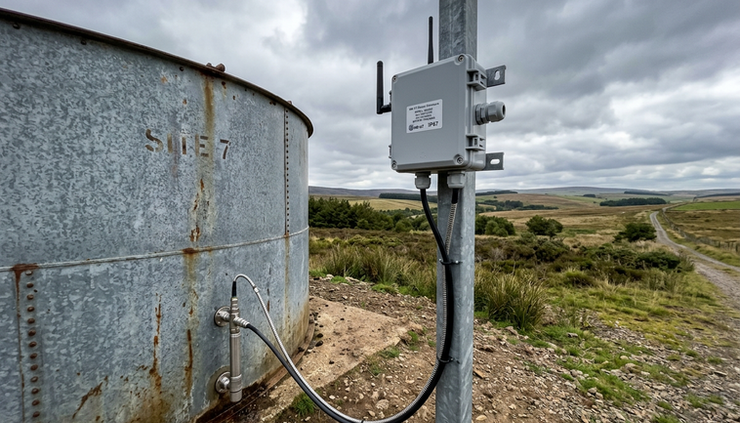
Common applications for NB-IoT analog monitoring
The value of an NB-IoT analog sensor is clearest when the measurement point is far from existing infrastructure.
Water and wastewater systems
Pump stations, pressure zones, reservoirs, tanks, and treatment equipment often use analog sensors. NB-IoT can send pressure, level, or flow values without installing long communication cables.
For example, a utility may monitor a remote tank level and receive periodic readings throughout the day. If the level drops too low, the IoT platform can trigger an alert.
Agriculture and irrigation
Farms often cover large areas where Wi-Fi is not realistic. Analog sensors can measure water pressure, soil-related values through transmitters, or tank levels. NB-IoT allows periodic reporting from field locations where power and networking are limited.
Industrial equipment
Many machines and process systems already have analog outputs. The PS-NB-NA can help bring those readings online without replacing the existing sensor.
This can be useful for monitoring compressors, pumps, hydraulic systems, fuel tanks, or process vessels.
Environmental and infrastructure monitoring
Remote monitoring systems may use analog transmitters for water level, weather-related measurements, or structural instrumentation. A waterproof NB-IoT node can send readings from sites that are hard to visit often.
Battery life and power design
The PS-NB-NA uses an 8500 mAh Li-SOCI2 battery and is designed for long-term use. Actual battery life depends on several factors.
The main ones are:
How often the device sends data
How long the external sensor is powered for each reading
NB-IoT signal quality at the site
Temperature conditions
Payload size and communication method
Use of downlinks or firmware updates
A device that reports once per day will usually use far less energy than one that reports every few minutes. A sensor that needs a long warm-up time will use more energy than one that can be powered briefly.
Signal quality also matters. If the device struggles to connect to the network, it may consume more power during transmission. Before installing many units, it is wise to test NB-IoT coverage at real mounting locations.
Configuration and maintenance
The PS-NB-NA supports Bluetooth 5.1 for remote local configuration. That means settings can be changed from nearby without opening the enclosure or connecting a programming cable.
It also supports over-the-air firmware updates. OTA update support is useful when a device is already installed outdoors or in a hard-to-access location.
Configuration can include items such as:
Uplink interval
Server address
Communication protocol
Sensor input type
Sampling behavior
Payload format
Downlink settings
The device also supports downlink commands, so some configuration changes can be sent from the server side. This is useful when field units are already deployed and need updated reporting intervals or other parameter changes.
What to check before choosing one
An NB-IoT analog sensor is not the right fit for every job. Before selecting the PS-NB-NA or a similar device, check a few basics.
Confirm the analog signal type.
Make sure the external sensor output matches the supported inputs. The PS-NB-NA supports 0 to 20 mA current input and 0 to 30 V voltage input.
Check sensor power needs.
The device offers 5 V and 12 V output. Confirm that the external sensor can run from one of those outputs and that its power draw fits the battery-powered design.
Check NB-IoT coverage.
NB-IoT requires carrier support in the installation area. A supported band list is helpful, but real site testing is still the best way to confirm performance.
Choose the right uplink protocol.
MQTT, MQTTs, UDP, TCP, and CoAP each fit different server designs. Pick the one your IoT platform supports cleanly.
Plan the reporting interval.
More frequent data gives more detail, but it also uses more battery and more network traffic. Match the interval to the process being measured.
Protect the installation.
The IP66 enclosure helps in outdoor environments, but cable glands, mounting position, sensor wiring, and water drainage still matter.

The main takeaway
An NB-IoT analog sensor connects traditional field measurements to modern IoT systems. It reads current or voltage signals, converts them into digital values, and sends them over an NB-IoT cellular network.
The Dragino PS-NB-NA adds useful field features around that core job: 0 to 20 mA and 0 to 30 V inputs, 5 V and 12 V sensor power, multiple uplink protocol options, Bluetooth configuration, OTA updates, an IP66 enclosure, and an 8500 mAh battery for long-term use.
For remote analog monitoring, the main design question is simple: match the sensor signal, power needs, network coverage, and reporting interval. Get those right, and a small battery-powered device can turn a hard-to-reach analog reading into useful data on an IoT platform.
Need help with your application?
ProSense Instruments — explore instruments, sensors, data loggers and test equipment.
ProSense Solutions — discuss complete monitoring and automation systems.
ProSight Software — explore cloud dashboards, alarms and reporting. Device integration must be confirmed for your application.
Instrument enquiries: sales@prosenseinstruments.com.au | 1800 560 854
Project enquiries: sales@prosense.com.au. Software enquiries: info@prosightsoftware.com.
Comments