
What Is a Hipot Test and Why It Matters for Electrical Safety and Reliability
A product can look perfect on the outside and still hide a dangerous electrical weakness inside. A tiny nick in wire insulation, a poorly spaced terminal, a trace of moisture, or a manufacturing defect can give electricity a path where it should never go. That is where hipot testing comes in.
A hipot test, short for high-potential test, checks whether electrical insulation can withstand a voltage higher than normal operating conditions. The goal is simple but critical: prove that current stays where it belongs.
This type of test is common in factories, repair facilities, labs, and quality control programs. It helps confirm that electrical equipment, cables, appliances, and finished products are safe before they reach users or enter service.

A hipot test checks insulation under stress
A hipot test applies a high voltage between conductive parts that should remain electrically separated. If the insulation is sound, only a very small amount of leakage current flows. If the insulation is weak, damaged, contaminated, or too thin, excessive current may leak through, or the insulation may break down.
The word “hipot” comes from “high potential.” In this context, potential means voltage. The test intentionally uses a voltage above normal use because everyday conditions do not always reveal hidden defects.
For example, a motor may run at its rated voltage during a quick power-on check. That does not prove the winding insulation can survive voltage spikes, moisture exposure, aging, vibration, or small flaws from manufacturing. A hipot test creates a controlled stress condition to catch problems before they become failures.
Most hipot tests focus on one main question:
Can the insulation safely separate live electrical parts from grounded metal, exposed surfaces, or other circuits?
If the answer is yes, the product passes the insulation withstand test. If the answer is no, the test may reveal a fault through high leakage current, arcing, or dielectric breakdown.
How high-potential testing works
The basic setup has three parts:
A high-voltage test instrument
The product, cable, appliance, or assembly being tested
Leads connected between the live circuit and the parts that should remain isolated
The tester raises voltage to a set level for a set amount of time. During that period, it monitors leakage current. If leakage stays within the allowed limit, the item passes. If leakage exceeds the limit or the insulation breaks down, the tester stops the test and reports a failure.
The exact test voltage, time, and leakage limit depend on the product type, its rated voltage, applicable safety standards, and the manufacturer’s procedure. A small household appliance, an industrial control panel, and a medium-voltage cable will not use the same settings.
AC and DC hipot tests serve different needs
Hipot testing can use alternating current or direct current.
AC testing is often used because many products operate on AC power. It stresses insulation in a way that can be similar to real operating conditions. It can also reveal certain weaknesses quickly.
DC testing is often used where charging current would make AC testing harder to interpret, such as with long cables or capacitive equipment. DC tests can be useful for insulation systems that store charge during testing.
Some test programs also include insulation resistance testing. That test uses a lower voltage and measures resistance through the insulation. It can help detect trends such as moisture absorption or aging, while a hipot withstand test checks whether insulation can survive a defined high-voltage stress.
These tests are related, but they are not the same. A product can show acceptable insulation resistance and still fail a high-voltage withstand test if it has a sharp defect, poor spacing, or weak insulation at one point.
What a hipot test can find
High-potential testing is valuable because many insulation problems are invisible. A product may pass visual inspection and basic function tests while still carrying a safety risk.
Common faults include:
Pinched insulation
A wire trapped under a cover, bracket, or screw may have a thin damaged spot.
Incorrect spacing
Live parts may sit too close to grounded metal or to low-voltage circuits.
Contamination
Dust, solder flux, oil, metal shavings, or moisture can create leakage paths.
Manufacturing variation
A connector, winding, cable jacket, or molded part may not match the intended design.
Aging or environmental damage
Heat, vibration, humidity, chemicals, and repeated flexing can weaken insulation over time.
Assembly errors
A wire may land on the wrong terminal, a strain relief may be missing, or a ground connection may be incomplete.
The value of the test comes from finding these faults while they are still controlled problems, not incidents in the field.

Why insulation weakness matters
Electrical insulation is a safety barrier. When it fails, electricity can move into places where it can injure people, damage equipment, or start fires.
The risks vary by product and environment, but the main hazards are consistent.
Electric shock
If internal live parts reach a metal enclosure, exposed connector, tool body, or appliance surface, a person could become part of the circuit. Grounding and protective devices help reduce this risk, but insulation remains a first line of defense.
Fire and overheating
Leakage current through insulation can generate heat. Arcing can ignite nearby materials, especially where dust, plastic, oil, or other combustibles are present.
Equipment failure
A breakdown inside a transformer, motor, cable, or power supply can stop production, damage connected devices, or create expensive downtime.
False confidence
A product that powers on during a functional test may still be unsafe. Without insulation testing, a hidden failure can remain unnoticed until shipping, installation, or customer use.
Reputation and compliance problems
Manufacturers that skip proper electrical safety checks risk recalls, warranty claims, failed audits, and customer trust issues. For regulated products, testing may also be part of a broader certification or production safety process.
Hipot testing electrical equipment
Electrical equipment covers a broad range of products, from control panels and motors to transformers, switchgear, power supplies, and industrial machinery. In each case, the insulation system must separate energized circuits from grounded structures, user-accessible surfaces, and other circuits.
A high-potential test may be used during:
Manufacturing
Equipment is tested before shipment to catch wiring or assembly defects.
Installation
Field teams may test certain systems before energizing them.
Maintenance
Technicians may test equipment after repair, rewinding, cleaning, or major service.
Quality audits
Random or routine testing helps verify that the production process remains stable.
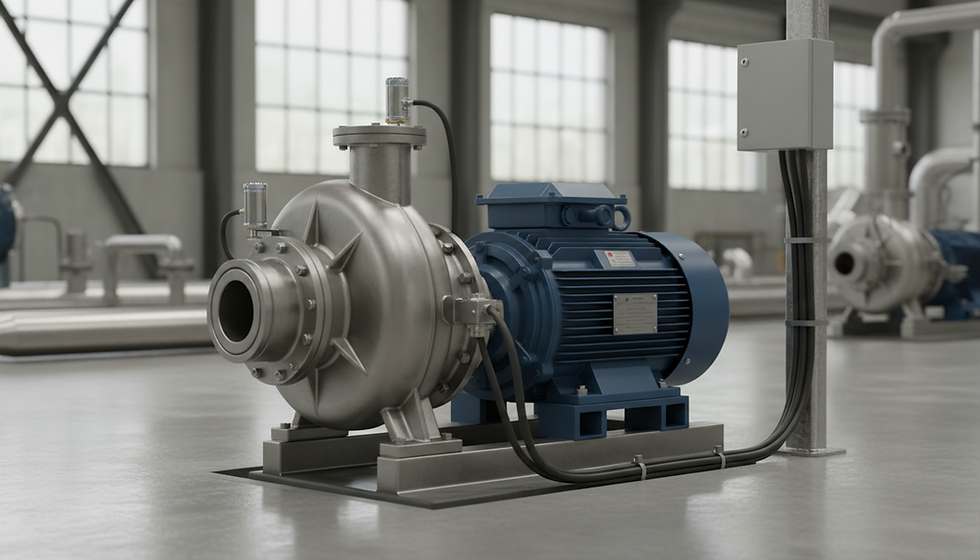
Consider an industrial motor. The windings are insulated from the motor frame. If that insulation breaks down, the frame can become energized. A hipot test can reveal winding-to-frame insulation weakness before the motor is installed on a production line.
For transformers, the test may check insulation between windings and from windings to the core or enclosure. For control panels, it may verify that line-voltage wiring is properly isolated from the enclosure and from low-voltage control circuits.
In industrial settings, reliability is not just about avoiding repair costs. A failure can stop a line, damage other equipment, and create unsafe conditions for workers nearby.
Hipot testing cables
Cables are one of the most common places insulation problems appear. They bend, flex, heat up, cool down, rub against surfaces, and often pass through tight spaces. Even when a cable looks intact, its insulation may have defects below the outer jacket.
High-potential testing can identify weaknesses in:
Power cables
Extension cords
Cable harnesses
Wire assemblies
Coaxial and specialty cables
Connectorized cable sets
Field-installed cable runs
In cable manufacturing, hipot tests help detect thin insulation, pinholes, conductor exposure, and defects from extrusion or handling. In cable assemblies, testing can catch wiring mistakes, crushed insulation near strain reliefs, or breakdown at connector pins.
Long cables create a special challenge because they have capacitance. The longer the cable, the more charging current may appear during testing. That does not automatically mean the cable is bad. It means the test method and limits must match the cable type and length.
A common example is a custom wiring harness for a machine. The harness may pass continuity testing, meaning each wire connects to the correct point. But continuity does not prove that adjacent conductors are safely insulated from each other. A hipot test can reveal a short risk between conductors before the harness is installed.

Hipot testing appliances
Household and commercial appliances place electrical systems close to users. That makes insulation testing especially important. Toasters, blenders, washing machines, space heaters, refrigerators, coffee makers, medical support appliances, and shop tools all rely on safe separation between live parts and touchable surfaces.
A hipot test can help verify insulation between:
Internal wiring and a metal chassis
Heating elements and exposed parts
Motor windings and appliance housings
Line-voltage circuits and user controls
Power circuits and low-voltage electronics
Appliances often combine heat, motion, vibration, and moisture. A washing machine may include motors, pumps, water valves, and metal parts. A coffee maker may combine heating elements, water, plastic housings, and user controls. A power tool may face vibration, dust, and frequent cord movement.
These conditions make small insulation defects more serious. A tiny assembly flaw near a heating element may grow worse after repeated thermal cycles. A pinched wire inside a metal housing may not fail during a short functional test, yet it could become dangerous after vibration or movement.
For appliance makers, high-potential testing is often part of end-of-line safety testing. Each finished unit may be tested before packaging, depending on the product and applicable requirements. This gives manufacturers a final check after all wiring, fasteners, covers, and internal parts are in place.
Hipot testing manufactured products
Many manufactured products contain electrical parts even if they are not thought of as “electrical equipment” first. Examples include lighting fixtures, vending machines, battery chargers, laboratory devices, HVAC components, exercise equipment, pumps, sensors, and electronic assemblies.
High-potential testing helps manufacturers confirm that design intent survived real production.
A design drawing may show proper spacing. A prototype may pass lab testing. But production introduces real-world variation:
Operators route wires slightly differently
Plastic parts shrink or warp
Solder joints leave sharp points
Adhesives or coatings apply unevenly
Metal brackets shift during assembly
Fasteners come too close to live parts
A hipot test gives production teams a way to catch these issues before products leave the facility.
For example, a lighting fixture may need insulation between line-voltage wiring and the metal housing. If a wire is scraped during assembly or a terminal sits too close to the housing, the fixture could pose a shock risk. A high-potential test can flag that unit before it ships.
The same logic applies to electronic products with power supplies. A device may have low-voltage circuits that users touch, such as buttons, ports, or sensor connections. The internal power section must remain properly isolated from those user-accessible circuits.

How hipot testing fits into a safety program
A hipot test is powerful, but it is not a complete safety program by itself. It works best as part of a wider set of checks.
A solid electrical safety process may include:
Test or check | What it helps verify |
Visual inspection | Wires, terminals, spacing, labels, and physical damage look correct |
Ground continuity test | Protective earth connections are present and low resistance |
Insulation resistance test | Insulation has high resistance under a defined test voltage |
Hipot withstand test | Insulation survives high-voltage stress without breakdown |
Functional test | The product operates as intended |
Documentation review | Test limits, procedures, and records are controlled |
Each check answers a different question. A visual inspection may catch a missing grommet. A ground continuity test may confirm a safe fault path. A functional test may prove the device turns on. A hipot test checks whether insulation can stand up to electrical stress.
That combination gives a much clearer picture than any single test alone.
The risks of skipping hipot testing
Skipping high-potential testing may save a little time during production, but it can create much larger risks later.
The most serious risk is harm to people. If a product with weak insulation reaches a user, electric shock becomes possible. In wet, grounded, or industrial environments, the danger can increase.
There are also practical business and operational risks:
Field failures
Hidden insulation defects can cause products to fail after installation or use.
Unexpected downtime
A failed cable, motor, or control panel can stop equipment at the worst time.
Damage to connected systems
An insulation breakdown can send fault current into nearby circuits or components.
Rework and recalls
Finding defects after shipping costs far more than catching them on the production line.
Loss of trust
Customers expect electrical products to be safe, reliable, and properly tested.
For critical systems, the stakes can be even higher. Hospitals, factories, public facilities, data centers, and transportation systems all depend on electrical reliability. A small insulation flaw can become a major service interruption or safety event.
Safe testing requires the right controls
Hipot testing uses high voltage, so the test itself must be handled with care. Only trained people should set up and run these tests, and they should follow approved procedures for the specific product and tester.
Safe test setups often include:
Barriers or guarded test areas
Warning lights or audible alerts
Interlocked fixtures when needed
Insulated test leads and proper connectors
Emergency stop controls
Clear discharge steps after DC testing
Regular verification of test equipment
The product under test can store electrical energy, especially during DC testing or when testing capacitive items such as long cables. Safe discharge is part of the procedure, not an optional step.
Good test programs also control test parameters. Turning voltage up “just to be safe” can damage good insulation or create misleading results. Using voltage that is too low can miss defects. The correct settings should come from product standards, engineering requirements, and validated procedures.
What a passing test really means
A passing hipot test means the insulation withstood the required high-voltage condition at the time of testing. That is valuable evidence, but it does not mean the product can never fail.
Insulation can still degrade over time due to heat, moisture, vibration, chemicals, mechanical wear, overloads, or improper use. That is why safety and reliability depend on both good design and good process control.
A strong approach includes:
Proper insulation materials
Adequate spacing and creepage distances
Good wire routing and strain relief
Clean assembly practices
Controlled production testing
Clear maintenance and inspection schedules
Hipot testing is one of the final gatekeepers. It helps confirm that these design and manufacturing choices came together correctly.

The main takeaway
A hipot test matters because insulation failures are often hidden until they become dangerous. By applying controlled high voltage, the test exposes weaknesses that normal operation, quick power checks, or visual inspection may miss.
For electrical equipment, it can reveal winding, enclosure, and circuit isolation problems. For cables, it can catch pinholes, crushed insulation, and conductor-to-conductor weaknesses. For appliances, it helps protect users from energized surfaces. For manufactured products, it confirms that the finished assembly meets basic electrical safety expectations.
Reliable electrical systems do not happen by accident. They come from sound design, careful assembly, proper inspection, and testing that challenges the parts most likely to fail. Hipot testing plays a central role in that process because it asks the right safety question before a product reaches the real world: will the insulation hold?


Comments