
Submersible Hydrostatic Level Sensors Applications Benefits and Challenges
A level reading that is off by a few centimetres can stop a pump too late, overflow a chemical tank, expose a bore pump, or distort a water balance report. In many plants and water networks, level measurement is not just an operator convenience. It protects assets, supports compliance, and keeps material moving.
Submersible hydrostatic level sensors solve a common problem: measuring liquid level from the bottom of a tank, bore, wet well, or reservoir without needing a clear line of sight from above. They sit below the liquid surface and measure the pressure created by the liquid column above them. From that pressure, the system calculates level.
These sensors are widely used because they are compact, accurate, and suitable for difficult installations where floats, ultrasonic instruments, or radar units may not be ideal. They are especially useful where foam, vapour, turbulence, tight access, or changing surface conditions make top-mounted instruments harder to apply.

How submersible hydrostatic level sensors work
A submersible hydrostatic level sensor measures the static pressure at a known point below the liquid surface. The deeper the sensor sits, the greater the pressure from the liquid above it.
The basic relationship is:
`Pressure = liquid density × gravity × liquid height`
In practical terms, the instrument measures pressure and converts it to a level output. If the liquid density is known and reasonably stable, the sensor can provide a continuous level reading.
Most units include:
A pressure-sensing element, often piezoresistive or ceramic capacitive
A sealed stainless steel, titanium, or plastic housing
A cable that carries both power and signal
A vent tube for gauge pressure measurement, or sealed compensation for absolute pressure designs
An electrical output such as 4-20 mA, 0-10 V, Modbus, or SDI-12
For many industrial control systems, the 4-20 mA output remains common. It is simple, noise-resistant over long cable runs, and easy to integrate with PLCs, RTUs, panel meters, and data loggers.
Gauge and absolute measurement matter
A vented gauge sensor compares the liquid pressure against atmospheric pressure. This arrangement helps cancel the effect of barometric pressure changes. It is common in tanks, boreholes, and reservoirs exposed to atmosphere.
An absolute sensor measures pressure against a sealed internal reference. It can be useful in sealed systems or remote data logging, but the system may need a separate barometric correction for accurate open-water level measurement.
This distinction matters in low-range applications. A small atmospheric shift can look like a level change if the pressure reference is not handled correctly.
Why accurate level measurement is critical
Accurate level measurement affects safety, process control, maintenance, and inventory. In water and wastewater, level readings control pumps, alarms, storage calculations, and reporting. In mining and agriculture, they help protect pumps and track water use. In chemical processing, they support batching, stock management, and spill prevention.
Poor level data can create several problems:
Pumps short-cycle because control points are wrong
Tanks overflow before high-level alarms activate
Operators cannot trust inventory records
Bore pumps run dry and overheat
Reservoir releases or abstractions are based on bad data
Chemical dosing systems feed from tanks at unexpected volumes
The cost of one failed pump, overflow event, or contaminated batch can greatly exceed the cost of selecting the right level sensor at the start.
A level sensor is often treated as a small instrument, but its signal may control the largest moving equipment in the system.
Hydrostatic measurement is valuable because it measures the liquid column directly. It does not need a reflected signal from the surface, and it is not affected by tank height in the same way as many top-mounted instruments.

Key features that define sensor performance
Submersible hydrostatic sensors are not all the same. The right specification depends on the liquid, the level range, the environment, and the control system.
Feature | Why it matters |
Measuring range | The range should match the maximum liquid depth without sacrificing low-level resolution. |
Accuracy | Higher accuracy supports better control, inventory, and reporting. |
Housing material | Stainless steel suits many water and light industrial uses. Titanium or compatible plastics may be needed for corrosive fluids. |
Cable jacket material | Polyurethane, polyethylene, FEP, or other jackets are selected based on chemical exposure, abrasion, and water quality. |
Ingress protection | The body and cable entry must withstand continuous submersion. |
Temperature rating | Process and ambient temperature affect sensor life and signal stability. |
Output signal | The signal must match the PLC, RTU, telemetry unit, or display. |
Venting method | Vented sensors need protection from moisture ingress through the cable vent. |
Lightning and surge protection | Remote bores and reservoirs often face electrical surges from storms and long cable runs. |
Accuracy is more than the sensor datasheet
A datasheet accuracy figure usually describes the sensor under defined test conditions. Field accuracy depends on installation and application details.
Common influences include:
Liquid density changes
Sediment covering the diaphragm
Cable movement in turbulent water
Temperature shifts
Incorrect zero reference
Moisture entering a vent tube
Electrical noise from pumps and variable speed drives
Good design looks at the full measurement loop, not only the pressure element.
Applications in tanks
Tanks are one of the most common uses for submersible hydrostatic level sensors. The sensor can be suspended near the bottom or mounted through a fitting, depending on tank geometry and maintenance access.
Typical tank applications include:
Raw water and treated water storage
Chemical feed tanks
Diesel, oil, or process liquid tanks when materials are compatible
Food and beverage ingredient tanks
Fire water tanks
Rainwater harvesting and reuse tanks
Wastewater balance tanks
In open tanks, a vented sensor is often used because atmospheric pressure changes affect the surface and the sensor at the same time. The output can feed a display, PLC, pump controller, or telemetry system.
Example use case in chemical storage
A site stores a dilute chemical in a vertical tank. Operators need continuous level measurement for reorder planning and low-level pump protection. A top-mounted ultrasonic sensor struggles because vapour and internal pipework create false echoes.
A submersible hydrostatic sensor offers a simpler path. It sits near the tank bottom, away from the vapour space. The 4-20 mA signal reports level to the control system, and the PLC triggers alarms at defined setpoints.
The main design checks are chemical compatibility, correct range, cable jacket material, and whether the tank is vented or sealed.
Example use case in wastewater wet wells
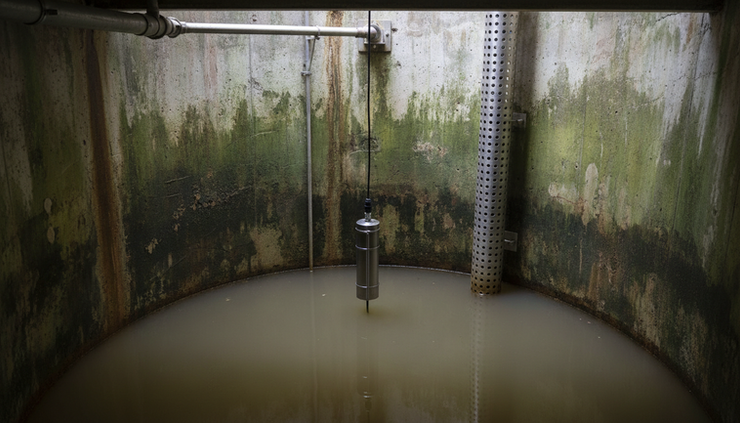
Wet wells often contain turbulence, fats, rags, foam, and sediment. A hydrostatic sensor can provide stable pump control when mounted in a stilling tube or protective cage. The stilling tube reduces turbulence and prevents debris from striking the sensor.
For wastewater, maintenance access matters. Sensors should be installed so technicians can lift and clean them safely without entering the confined space.
Applications in bores and wells
Bores and wells are demanding applications. The sensor may sit deep underground, connected by a long cable, and operate for years with limited access. Accurate level data helps track groundwater behaviour and protect submersible pumps.
Common bore and well uses include:
Static groundwater level monitoring
Pump drawdown measurement
Pump protection
Aquifer testing
Irrigation supply monitoring
Mine dewatering
Environmental monitoring around industrial sites
A submersible hydrostatic level sensor can be installed below the expected minimum water level. It reports the pressure above the sensor, allowing the system to calculate water level relative to a reference point such as casing top or ground level.
Example use case in irrigation
An irrigation operator runs a bore pump during dry periods. Without continuous level data, the pump may draw the water level down close to the intake. That can increase wear, reduce flow, and risk dry running.
A hydrostatic sensor installed in the bore tracks drawdown during pumping and recovery after shutdown. The controller can stop the pump if the level drops below a set limit. Over time, the data also shows whether the bore is recovering normally between cycles.
Bore installation challenges
Bores often require more planning than tanks. Long cable runs can be affected by voltage drop and electrical noise. Lightning and surge exposure can damage instruments. Narrow casing can make it hard to install the sensor without rubbing against pump pipework or cables.
The vent tube on a gauge sensor also needs care. If moisture blocks the vent or enters the cable, readings can drift. Many systems use desiccant vent filters or junction boxes designed to keep the vent path dry.
Applications in reservoirs and open water
Reservoirs, dams, ponds, lakes, and open channels often need continuous level monitoring for operations, reporting, and safety. Hydrostatic sensors are useful because they can be mounted below the surface, away from wind, waves, and floating debris.
Typical applications include:
Raw water reservoir monitoring
Dam level measurement
Stormwater detention basins
Flood warning stations
Canal and channel monitoring
Hydropower intake monitoring
Environmental water level logging
In open water, the installation often uses a stilling well, protective conduit, or weighted mounting system. This protects the sensor and reduces short-term fluctuations caused by waves.
Example use case in stormwater detention
A stormwater detention basin needs to report water level during heavy rain. A sensor mounted in a stilling well records the rising level and sends data to a telemetry unit. The system can trigger high-level alarms or support flood modelling.
This application needs careful range selection. The sensor must cover normal low levels and peak storm levels. The cable and housing must also tolerate silt, immersion, and outdoor exposure.

Benefits of submersible hydrostatic sensors
Hydrostatic sensors remain widely used because they solve practical field problems with a relatively simple measuring principle.
Key benefits include:
Direct level measurement
The sensor reads pressure from the liquid column itself. Foam, vapour, and surface reflectivity have little effect compared with many non-contact methods.
Simple mechanical installation
Many applications only require the sensor to be suspended at the correct depth. This helps when tank roofs are crowded or when a top-mounted sensor is difficult to align.
Continuous output
The sensor provides a live level signal, not just a high or low switch point. This supports pump control, trending, inventory, and alarms.
Good performance in deep applications
Bores, wells, and reservoirs can be difficult for non-contact instruments. A pressure-based sensor can measure large depths with suitable range selection.
Compatibility with control systems
Common outputs such as 4-20 mA make integration practical across many industrial systems.
Low power options
Some models suit solar-powered telemetry sites and remote environmental monitoring, especially where data is logged at intervals rather than transmitted continuously.
Potential challenges and how to manage them
The technology is reliable when applied correctly, but several issues can affect performance.
Liquid density changes
Hydrostatic measurement assumes a relationship between pressure and liquid height. If density changes, the level calculation changes. This can happen with temperature shifts, suspended solids, brine concentration changes, or mixed chemicals.
For high-accuracy inventory, density compensation may be needed.
Sediment and fouling
Sludge, scale, biological growth, or crystallised chemicals can block the pressure port or load the diaphragm. Protective cages, correct mounting height, and planned cleaning help reduce the risk.
Turbulence and hydraulic effects
A sensor placed near an inlet, mixer, pump suction, or aeration zone may see unstable pressure. Stilling tubes, damping settings, or better sensor placement can improve readings.
Vent tube moisture
Vented cables need a dry reference path to atmosphere. Moisture can cause drift or failure. Desiccant breathers, sealed junction boxes, and correct cable termination are simple but critical details.
Chemical compatibility
The housing, seals, diaphragm, and cable must match the liquid. A compatible body with the wrong cable jacket can still fail. Sensor selection should review the whole wetted assembly.
Mechanical damage
Cables can be stretched, crushed, or cut during installation. In reservoirs and wet wells, debris can strike the sensor. Strain relief, conduit, stilling wells, and protective guards reduce this risk.
Calibration and reference errors
The sensor must be referenced to a known point. In tanks, that may be the tank floor or pump cut-out level. In bores, it may be casing top. In reservoirs, it may be a survey datum. Poor reference setup can make a good sensor report the wrong level.
Practical selection checklist
Before selecting a sensor, define the application in engineering terms rather than only by vessel name.
Useful questions include:
What is the maximum liquid depth?
What is the minimum level that must be measured?
Is the tank, bore, or reservoir open to atmosphere?
What liquid will contact the sensor and cable?
What temperature range will the sensor see?
Is there sludge, grit, foam, vapour, or chemical attack?
How long is the cable run to the control system?
Is surge protection needed?
What signal does the PLC, RTU, or logger accept?
How will technicians inspect, clean, and replace the sensor?
This front-end work reduces false readings, premature failures, and installation changes after commissioning.
Accurate level measurement supports safe storage, reliable pumping, environmental monitoring, and better operational decisions. Submersible hydrostatic sensors earn their place because they combine a proven measuring principle with practical installation in tanks, bores, and reservoirs.
The best results come from matching the sensor to the liquid, depth, installation conditions, and control system. When those details are handled well, a small instrument at the bottom of the water column can provide the signal that keeps the whole process under control.


Comments