
Pressure Transducers vs Pressure Switches vs Pressure Gauges Which One Do You Need
Choosing the wrong pressure device can turn a simple job into a frustrating one. A gauge may show pressure clearly at the machine, but it cannot send live readings to a controller. A switch can start a pump at the right moment, but it will not tell you the pressure trend. A transducer can feed exact pressure data into a system, but it may be more than you need for a quick visual check.
That is the core difference between pressure transducers vs pressure switches vs pressure gauges. They all deal with pressure, but they solve different problems.
If you need local indication, use a pressure gauge. If you need continuous measurement, use a pressure transducer. If you need automatic switching, use a pressure switch.
The right choice depends on what you want the device to do after it senses pressure.

A pressure gauge gives local pressure indication
A pressure gauge is the simplest of the three devices. It shows pressure where it is installed. A technician, operator, or maintenance person looks at the dial or display and reads the pressure directly.
Most traditional gauges use a mechanical sensing element, often a Bourdon tube. As pressure rises, the element moves, and that movement turns the needle on the dial. Digital gauges use an electronic sensor and display the reading on a screen, but the purpose is the same. They provide a local reading.
Pressure gauges are common on:
Air compressors
Boiler systems
Hydraulic power units
Water pumps
Filtration systems
Gas cylinders and regulators
Process pipework
A gauge is a good fit when someone needs to check pressure during setup, inspection, operation, or maintenance. It is also useful as a visual backup for a more automated system.
When a pressure gauge is the right choice
Use a pressure gauge when the main need is to see the pressure at the equipment.
Common examples include:
Checking whether a pump is producing the expected pressure
Confirming that a filter is becoming clogged
Reading tank or line pressure during service
Giving maintenance staff a quick visual reference
Adding a simple pressure check point to a system
A gauge is often the most direct and cost-effective answer for manual checks.
Where a pressure gauge falls short
A standard pressure gauge does not send continuous readings to a control system. It does not trigger an alarm by itself. It does not record data unless it is part of a separate logging setup.
It also depends on visibility. If the gauge is in a hard-to-access area, someone still needs to physically inspect it. Vibration, pressure spikes, temperature, or poor installation can also shorten gauge life or make readings harder to trust.
For pressure that must be tracked, logged, controlled, or sent to another device, a gauge alone is usually not enough.
A pressure transducer provides continuous measurement
A pressure transducer converts pressure into an electrical signal. A control system, display, data logger, or machine controller can then use that signal.
This makes it the best choice when pressure needs to be measured continuously rather than checked by eye.
A typical pressure transducer has a sensing element and electronics inside the body. When pressure changes, the sensor produces a proportional output signal. Common outputs include voltage or current signals, such as 0 to 10 V or 4 to 20 mA, depending on the system design.
Pressure transducers are widely used in:
Industrial automation
Hydraulic presses
Pneumatic systems
Water treatment equipment
HVAC systems
Mobile machinery
Test rigs
Process control systems
The key point is that a transducer does not just show pressure. It turns pressure into usable data.

When a pressure transducer is the right choice
Use a pressure transducer when a machine or system needs to know the pressure all the time.
Common examples include:
Sending live pressure readings to a PLC
Displaying pressure on a remote panel
Recording pressure trends over time
Controlling pump speed based on pressure
Monitoring hydraulic force in a press
Detecting gradual pressure loss before failure
A transducer is also useful when pressure changes quickly. A gauge may show a rough reading, but a transducer can send rapid changes to a controller or monitoring system, if the electronics and sampling speed support it.
Why output signal matters
The output signal must match the device receiving it. A transducer with the wrong output may be accurate, but still unusable in the system.
Common signal types include:
4 to 20 mA
Often used in industrial systems because it works well over longer cable runs and is less sensitive to electrical noise.
0 to 10 V
Common in control panels, test equipment, and shorter cable runs.
Ratiometric voltage
Often used in mobile equipment or systems where the output follows the supply voltage.
Digital outputs
Used when the system needs digital communication rather than an analog signal.
Before choosing a transducer, check the controller input, supply voltage, connector type, pressure range, media compatibility, and environmental conditions.
Where a pressure transducer falls short
A transducer usually needs power and a receiving device. It may not provide a local reading unless it includes a display or connects to one.
It may also cost more than a simple gauge or switch. That cost is easy to justify when data matters, but not when the only requirement is an occasional visual check.
A transducer is best for measurement. It can support control, alarming, and logging, but those actions usually happen in the connected controller or monitoring system.
A pressure switch triggers an action at a set pressure
A pressure switch reacts when pressure reaches a set point. Instead of providing a full range of live readings, it changes state. That change can turn equipment on or off, open or close a circuit, or send a simple signal to a control panel.
In plain terms, a pressure switch answers a yes-or-no question.
Has the pressure reached the set point? If yes, switch.
Pressure switches are common in:
Air compressors
Pump control systems
Hydraulic safety circuits
Pneumatic machinery
Refrigeration systems
Lubrication systems
Water pressure boosting systems
Some pressure switches are mechanical. Others are electronic and may include displays, adjustable settings, or more than one output. The main job stays the same. A pressure switch makes or breaks a signal when pressure crosses a defined value.
When a pressure switch is the right choice
Use a pressure switch when pressure needs to trigger an automatic action.
Common examples include:
Starting a compressor when pressure drops too low
Stopping a pump when pressure reaches a limit
Activating an alarm when pressure rises too high
Confirming that enough pressure exists before a machine starts
Shutting down equipment during a low-pressure condition
A pressure switch is often ideal for protection and simple control. It does not need to report every pressure value. It only needs to act at the right point.
What set point and reset point mean
A pressure switch usually has a set point and a reset point.
The set point is the pressure where the switch changes state. The reset point is the pressure where it changes back.
The difference between these two points is called hysteresis or differential. This prevents rapid on-off cycling when pressure hovers near the set point.
For example, a pump system might switch off at a higher pressure and switch back on only after pressure drops by a set amount. Without that gap, the pump could chatter on and off, which can damage equipment.
Where a pressure switch falls short
A pressure switch does not provide a full pressure profile. It may tell you that pressure crossed a limit, but it will not show whether pressure is rising slowly, falling quickly, or pulsing.
If you need to see exact pressure values across a range, choose a transducer or gauge. If you need pressure to trigger an action, choose a switch.

The main differences are easier to see side by side
The three devices overlap in appearance, but not in purpose. The easiest way to choose is to start with the job the device must perform.
Device | Main job | Best for | Typical output |
Pressure gauge | Shows pressure locally | Manual checks and visual indication | Dial, pointer, or digital display |
Pressure transducer | Measures pressure continuously | Control systems, monitoring, and data logging | Electrical signal |
Pressure switch | Changes state at a set pressure | Alarms, interlocks, and on-off control | Open or closed contact, or switched electronic output |
A useful rule is this:
Choose a gauge to see pressure, a transducer to measure pressure, and a switch to act on pressure.
That rule covers most applications. The details come from the pressure range, media, environment, accuracy needs, electrical system, and installation limits.
How to choose the right pressure device
Start with the function, then work through the technical requirements. This prevents overbuying, under-specifying, or choosing a device that cannot do the job.
Decide what the system needs to do
Ask one simple question first.
What should happen when pressure changes?
If someone only needs to look at the pressure, choose a gauge. If a controller needs live pressure values, choose a transducer. If equipment needs to turn on, turn off, alarm, or lock out at a pressure point, choose a switch.
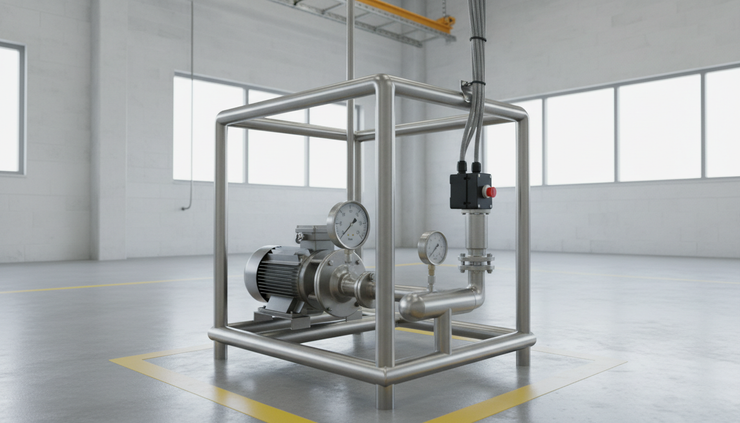
Some systems need more than one device. A hydraulic unit may use a transducer for control, a switch for safety shutdown, and a gauge for local service checks. That is normal. These devices are not always substitutes for one another.
Match the pressure range
Every pressure device has a rated range. Choose a range that covers normal operating pressure and expected pressure peaks.
A gauge used near the top of its scale all the time may wear faster and be harder to read. A transducer with too wide a range may give less useful resolution. A switch with the wrong set point range may be difficult or impossible to adjust correctly.
For systems with pressure spikes, pulsation, or vibration, protective accessories may help. Examples include snubbers, dampers, isolation valves, or remote mounting.
Check the pressure type
Pressure can be measured in different ways.
Gauge pressure is measured relative to atmosphere. This is common for hydraulic, pneumatic, and water systems.
Absolute pressure is measured relative to a vacuum. This is common in vacuum systems and some process applications.
Differential pressure measures the difference between two points. This is common across filters, pumps, flow elements, and heat exchangers.
The device must match the pressure type. A gauge pressure transducer will not behave the same as an absolute pressure transducer in applications where atmospheric pressure changes matter.
Confirm media compatibility
The wetted parts of the device must be compatible with the fluid or gas in the system. Air, clean water, oil, steam, refrigerants, chemicals, and food-grade media can all require different materials.
Key material points include:
Connection material
Diaphragm or sensing element material
Seals and O-rings
Fill fluid, if present
Case material in harsh areas
Media compatibility matters for safety, service life, and reading accuracy. Corrosion or seal damage can lead to leaks or false readings.
Consider accuracy and readability
Not every application needs high accuracy. A gauge used for a quick compressor check may not need the same performance as a transducer used in a test bench.
For gauges, readability matters as much as accuracy. The dial size, scale range, units, lighting, and mounting position all affect how useful the gauge is.
For transducers, check accuracy, response time, repeatability, temperature effect, and output type. For switches, check set point accuracy, repeatability, and the expected number of operating cycles.
Think about the environment
Pressure devices often live in harsh places. Temperature, vibration, washdown, dust, weather, and electrical noise can all affect performance.
A device mounted on a vibrating pump may need liquid filling, a snubber, or remote mounting. A device used outdoors may need a suitable enclosure rating and weather-resistant materials. A transducer near motors or drives may need proper shielding and grounding.
The device should fit the real environment, not just the pressure number on the datasheet.
Common examples make the choice clearer
A few everyday examples show how the decision works.
An air compressor often needs a switch and a gauge
The pressure switch starts and stops the compressor based on tank pressure. The gauge lets the operator see tank pressure at a glance.
A transducer is only needed if the compressor connects to a monitoring system or needs more advanced control.
A hydraulic press often needs a transducer
A hydraulic press may need continuous pressure measurement to control force, display values, or log each cycle. A transducer is usually the best fit.
A gauge may still help maintenance staff. A switch may add a safety limit or confirm minimum pressure before operation.
A water filter often needs a differential gauge or transmitter
A filter can be monitored by measuring the pressure drop across it. A local differential gauge can show when the filter is clogging. A differential pressure transducer can send that information to a control system. A switch can trigger an alarm when the pressure drop reaches a set limit.
The right option depends on whether the goal is visual inspection, live monitoring, or automatic warning.
A pump protection circuit often needs a switch
If the only requirement is to stop a pump when inlet pressure falls too low, a pressure switch may be enough. It can break the control circuit or send a shutdown signal.
If the system also needs to trend inlet pressure over time, add a transducer.
Quick decision guide
Use this simple guide when narrowing the choice.
Need | Best choice |
Someone must read pressure at the machine | Pressure gauge |
A controller needs live pressure values | Pressure transducer |
Pressure must trigger an alarm | Pressure switch |
Pressure must start or stop equipment | Pressure switch |
Pressure trends need to be recorded | Pressure transducer |
Maintenance needs a simple visual backup | Pressure gauge |
A system needs both data and local reading | Transducer plus gauge, or transducer with display |
A system needs control and safety shutdown | Transducer plus switch |
Many poor choices happen when one device is expected to do another device’s job. A gauge is not a control signal. A basic switch is not a measuring instrument. A transducer is not always the simplest tool for a local check.
The best choice starts with the task
Pressure gauges, transducers, and switches all have a clear place.
A pressure gauge is the right choice when you need local indication. It is simple, visible, and easy to understand.
A pressure transducer is the right choice when you need continuous measurement. It sends pressure data to displays, controllers, and monitoring systems.
A pressure switch is the right choice when you need automatic switching. It reacts at a set pressure and starts, stops, alarms, or protects equipment.
If the system has more than one need, use more than one device. A well-designed pressure setup may include a gauge for service, a transducer for control, and a switch for protection. The goal is not to pick the most complex device. The goal is to pick the device that matches the job.


Comments