
Insulation Resistance Tester vs Hipot Tester Difference and Applications
A motor can pass one electrical safety test and fail another for a good reason. Insulation resistance testing and Hipot testing both apply high voltage to insulation, but they answer different questions. One looks for leakage and insulation condition. The other proves that insulation can withstand a specified voltage without breakdown.
That distinction matters in maintenance, production testing, cable commissioning, and electrical safety work. Choosing the wrong test can miss a fault, stress equipment unnecessarily, or create a serious hazard.
High-voltage testing should be performed only by appropriately qualified personnel, using approved procedures, calibrated equipment, proper barriers, discharge methods, and the applicable standards for the asset being tested.
The short answer
An insulation resistance tester measures how much resistance the insulation provides against leakage current. It usually reports results in megohms or gigohms.
A Hipot tester, also called a dielectric withstand tester or high potential tester, checks whether insulation can withstand a higher applied voltage for a set time without arcing, breaking down, or exceeding a leakage current limit.
Test type | Main question it answers | Usual result | Common use |
Insulation resistance test | Is the insulation clean, dry, and in acceptable condition? | Resistance in MΩ, GΩ, or TΩ | Maintenance, troubleshooting, commissioning |
Hipot test | Can the insulation withstand a specified high voltage stress? | Pass or fail, often with leakage current | Manufacturing QA, type testing, safety compliance |
Earth resistance test | Is the grounding system low enough in resistance? | Resistance in Ω | Ground grids, rods, lightning protection |
VLF test | Can medium-voltage cable insulation withstand an AC test at very low frequency? | Pass or fail, often with diagnostics | MV cable commissioning and maintenance |
The two tests are related, but they are not interchangeable. Insulation resistance testing is generally a diagnostic condition check. Hipot testing is generally a withstand proof test.
What an insulation resistance tester measures
An insulation resistance tester applies a DC voltage between conductors, or between a conductor and ground, then measures the tiny current that leaks through or across the insulation. From that current, it calculates resistance using Ohm’s law.
Good insulation has very high resistance. Poor insulation allows more leakage current. Moisture, dirt, chemical contamination, thermal aging, mechanical damage, and carbon tracking can all lower the reading.
Most insulation resistance testers display readings such as:
Megohms, shown as MΩ
Gigohms, shown as GΩ
Sometimes teraohms, shown as TΩ on higher-end instruments
A low reading does not always mean the equipment is unsafe, but it is a warning sign. A trend that falls over time often matters more than one isolated value.
Typical insulation resistance test voltages
Common DC test voltages include:
Equipment or circuit type | Typical insulation resistance test voltage |
Low-voltage control circuits | 250 V DC or 500 V DC |
Low-voltage power circuits | 500 V DC or 1,000 V DC |
Motors and generators | 500 V DC, 1,000 V DC, or higher depending on rating |
Medium-voltage cables and equipment | 2.5 kV DC, 5 kV DC, 10 kV DC, or higher as specified |
The correct test voltage depends on the equipment rating, insulation system, manufacturer instructions, and the applicable test standard. Sensitive electronics, surge protective devices, variable frequency drives, sensors, and control modules may need to be isolated before testing.
Common insulation resistance test methods
Basic insulation resistance testing often uses a one-minute reading. A technician records the resistance after the voltage has been applied for 60 seconds.
For larger machines and cables, longer tests can provide more information. Two common diagnostic methods are:
Polarization index
This compares a 10-minute reading with a 1-minute reading. It is often used on rotating machines. A healthy dry insulation system often shows a rising resistance over time as absorption current decreases.
Dielectric absorption ratio
This compares shorter time-based readings, such as 60 seconds and 30 seconds. It can help assess insulation absorption behavior without running a full 10-minute test.
These methods are useful because insulation is not a simple resistor. It behaves partly like a capacitor. Current is higher at the start of a DC test, then usually falls as the insulation charges.

What a Hipot tester measures
A Hipot tester applies a high voltage between live parts and exposed conductive parts, or between conductors, for a defined duration. The goal is to confirm that the insulation can withstand the stress without breakdown.
Hipot is short for high potential. The test is also called a dielectric withstand test.
Unlike an insulation resistance test, a Hipot test is usually evaluated against a leakage current limit and a breakdown condition. The instrument may show leakage current in milliamps or microamps, but the main result is often pass or fail.
A failure may occur when:
Leakage current exceeds the set limit
The tester detects arcing
The insulation punctures or flashes over
The test voltage cannot be maintained
Hipot testing can uncover defects that a lower-voltage resistance test may not expose. Examples include thin insulation, pinholes, sharp conductor strands, crushed cable jackets, incorrect spacing, poor assembly, or contamination inside a finished product.
AC Hipot and DC Hipot
Hipot testers may use AC or DC output.
AC Hipot testing applies alternating voltage, usually at line frequency. It stresses insulation in both polarities and is common for product safety testing. AC testing includes capacitive current, so leakage readings can be higher on long cables or equipment with high capacitance.
DC Hipot testing applies direct voltage. It charges the insulation capacitance, then leakage current should settle. DC testing can be useful for some equipment, but it can leave a stored charge after the test. The device under test must be safely discharged.
Some standards and manufacturers prefer one method over the other. DC Hipot testing on certain aged cables, for example, may not be recommended because it can stress insulation in a way that does not match normal service.
Typical Hipot test voltages
Hipot voltage depends on the product, rated voltage, insulation class, and standard. Common examples include:
Application | Typical Hipot range |
Low-voltage electrical products | Around 1,000 V AC to several kV AC |
Double-insulated or reinforced-insulation products | Often higher than basic insulation tests |
Motors and coils | Commonly above normal operating voltage, per winding and standard requirements |
Cables | Varies widely by voltage class, insulation type, and test method |
Medium-voltage equipment | Several kV to tens of kV, based on rating and procedure |
A common product safety formula seen in some contexts is based on twice the rated voltage plus 1,000 V, but that is not universal. The governing standard, product category, and manufacturer instructions decide the correct value.
The practical difference between the two tests
The easiest way to separate the two is to look at intent.
An insulation resistance tester asks, how much does this insulation resist leakage right now?
A Hipot tester asks, will this insulation survive the required test voltage without breakdown?
That leads to different use cases.
Comparison point | Insulation resistance tester | Hipot tester |
Main purpose | Condition assessment | Dielectric withstand proof |
Output | Resistance value | Pass or fail, plus leakage current |
Typical voltage type | DC | AC or DC |
Stress level | Moderate to high | Often higher and more severe |
Best for | Maintenance trends and fault finding | Production QA and compliance tests |
Risk to weak insulation | Lower, but still hazardous | Higher, because the test is designed to stress insulation |
In simple terms, insulation resistance testing is often a health check. Hipot testing is closer to a pressure test.
Both can damage equipment if applied incorrectly. Both can injure or kill a person if handled carelessly.

Where insulation resistance testing is used
Insulation resistance testing is common in preventive maintenance because it is fast, portable, and repeatable.
Motors and generators
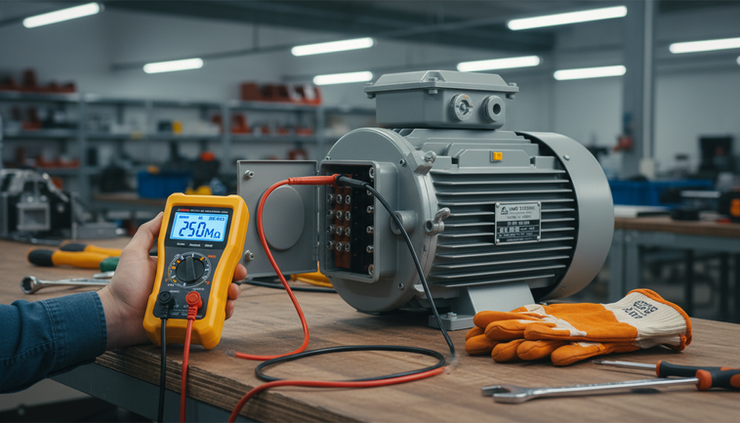
Motor windings can absorb moisture during storage or shutdown. Dust, oil, and heat also degrade insulation over time. An insulation resistance tester helps maintenance teams check winding-to-ground and phase-to-phase insulation before startup.
For larger machines, trend records are valuable. A single reading can be affected by temperature and humidity. Repeated readings taken under similar conditions show whether insulation is improving, stable, or declining.
Cables
On low-voltage and medium-voltage cables, insulation resistance testing can help find water ingress, sheath damage, contamination, or installation damage. Tests may be made conductor-to-conductor and conductor-to-ground.
Long cables have capacitance, so readings can take time to settle. After testing, cables must be discharged safely before anyone touches the conductors.
Switchgear and electrical equipment
Panels, busbars, transformers, heaters, and other electrical assemblies often receive insulation resistance checks after installation, cleaning, or repair. The test can reveal moisture, misplaced wiring, damaged insulation, or conductive debris.
Technicians often use insulation resistance testing before re-energizing equipment that has been exposed to water, dust, vibration, or long storage.
Where Hipot testing is used
Hipot testing is widely used when a product or assembly must prove dielectric strength before it is shipped, energized, or certified.
Manufacturing quality assurance
Manufacturing QA often uses Hipot testers on appliances, power supplies, cables, transformers, motors, medical equipment, and industrial controls. The test helps catch assembly defects before a product reaches the field.
A production Hipot station may include:
A fixture that prevents contact with energized parts
Interlocked covers or guards
Automatic test timing
Leakage current limits
Data logging
Clear pass and fail indication
The goal is repeatable testing without exposing operators to live high-voltage parts.
Electrical products and safety compliance
Many product safety standards require dielectric withstand testing between mains circuits and accessible conductive parts. The exact test voltage, duration, and leakage current limit depend on the product standard.
A Hipot test can verify spacing, insulation barriers, transformer isolation, sleeving, and assembly quality. It is not a substitute for good design, but it helps confirm the design was built correctly.
Motors, coils, and transformers
Windings may receive Hipot tests during manufacture, rewind, or repair. The test checks whether insulation can withstand the specified voltage from winding to ground, and sometimes between windings.
Care is needed with older machines. A severe overvoltage test can push weakened insulation into failure. That may be acceptable in a proof test after repair, but it may be inappropriate for routine condition monitoring.
Safety comes before the reading
Both instruments can produce hazardous voltage. A small handheld insulation resistance tester can deliver 1,000 V DC or more. A Hipot tester may produce several kilovolts with enough energy to be dangerous.
Safe high-voltage testing includes more than wearing gloves. Procedures should cover the whole job:
Confirm the correct test for the asset and standard
De-energize, isolate, lock out, and verify absence of voltage
Disconnect sensitive devices that could be damaged
Use rated leads, probes, clips, barriers, and warning signs
Keep unqualified people away from the test area
Apply voltage only for the required time
Watch for unexpected current, noise, odor, or flashover
Discharge the equipment after DC testing
Prove the circuit is discharged before touching it
Record results clearly, including voltage, duration, temperature, and conditions
Stored energy is a major hazard. Motors, long cables, capacitors, and shielded cables can remain charged after the test voltage is removed. Many testers include automatic discharge, but qualified personnel still verify discharge with suitable equipment.
Do not rely on assumptions. Follow the written procedure, equipment manual, site safety rules, and applicable standards.
How to choose the right tester
Start with the purpose of the test.
Choose an insulation resistance tester when the goal is to check insulation condition, compare readings over time, troubleshoot moisture or contamination, or verify equipment before energizing.
Choose a Hipot tester when the goal is to perform a dielectric withstand test required by a standard, production process, repair procedure, or acceptance test.
Key selection factors include:
Voltage range
The tester must cover the required voltage without operating at the edge of its capability.
Measurement range
For insulation resistance, the instrument should measure high enough resistance for the asset being tested. Modern equipment may need GΩ range or higher.
Leakage current control
For Hipot testing, current limit settings and trip response matter. Production work often needs repeatable leakage thresholds.
AC or DC output
Match the output type to the standard and asset. Do not substitute DC for AC, or AC for DC, unless the procedure allows it.
Test timing
Timed tests help keep results consistent. They also reduce the chance that voltage stays applied longer than intended.
Data recording
For maintenance, stored readings support trend analysis. For manufacturing QA, records may be needed for traceability.
Safety features
Look for interlock support, warning outputs, automatic discharge, lead checks, and clear indicators.
Related equipment that often gets confused
Electrical test equipment overlaps, but each tool has a specific job.
Earth resistance testers
An earth resistance tester measures the resistance of a grounding electrode system, such as rods, grids, mats, and lightning protection grounds. Results are usually in ohms, not megohms.
The test does not evaluate cable insulation or dielectric strength. It checks whether fault current and lightning energy have an effective path to earth, subject to the required design criteria.
Common methods include fall-of-potential testing and clamp-on ground resistance testing, depending on the installation and access.
VLF testers
A VLF tester applies AC voltage at a very low frequency, often used for medium-voltage cable testing. VLF stands for very low frequency.
Long power cables have high capacitance. Testing them at normal power frequency can require large, heavy test sets. VLF equipment reduces the power needed while still applying an AC-type stress.
VLF testing is common for cable commissioning, maintenance, and acceptance testing. Some VLF systems also support diagnostic methods such as tan delta testing or partial discharge measurements, depending on the equipment.
Continuity and low-resistance testers
Continuity testers and micro-ohmmeters measure conductor paths, bonds, contacts, and joints. They are not insulation testers. A circuit can have excellent continuity and poor insulation, or strong insulation and a loose connection.
Multimeters
A standard digital multimeter does not replace an insulation resistance tester. Its resistance range uses low voltage, so it may not reveal insulation defects that appear only under higher test voltage.

A simple way to remember the difference
Think of insulation resistance testing as measuring leakage through insulation under controlled DC voltage. It gives a number that can be trended and compared.
Think of Hipot testing as proving insulation strength under a specified high-voltage stress. It gives a pass or fail result based on breakdown behavior and leakage current limits.
Use insulation resistance testing for condition checks on motors, cables, switchgear, and electrical equipment. Use Hipot testing for dielectric withstand proof testing, especially in manufacturing QA, repair validation, and standards-based acceptance work.
Both tests are valuable. Neither is casual. The right instrument, the right voltage, the right procedure, and the right qualifications make the difference between a useful result and a dangerous mistake.


Comments