
How FRESVUE Solves Pharma Cold Chain Compliance Challenges
- 2 days ago
- 8 min read
A vaccine can look perfectly normal and still be unusable. If it spends too long outside the required temperature range, its potency may be reduced, its safety may be questioned, and its release may be blocked. In pharmaceutical logistics, the product does not only need to arrive. It needs to arrive with proof that it stayed within the right conditions every step of the way.
Some industry estimates suggest that a meaningful share of vaccines can reach their destination in a degraded state because of cold chain failures. Even when the exact percentage varies by route, product type, and handling process, the risk is clear. Temperature control is not a back-office detail. It protects patient safety, product value, and regulatory trust.
For many vaccines, biologics, and sensitive medicines, the required range is narrow, often +2°C to +8°C. A single uncontrolled temperature excursion can trigger a quarantine, investigation, rejection, or disposal. The cost is not only financial. Delays can limit access to critical therapies.
That is why the right temperature logger must do more than record numbers. It must protect the integrity of the data, support audit readiness, and keep pace with changing logistics requirements. The FRESVUE ZTAGPRO-EUS Single Use Temperature Logger is designed for that reality.

Pharma cold chain risk begins with a very narrow temperature window
Many temperature-sensitive medicines need consistent storage and transport between +2°C and +8°C. That range may sound simple, but global distribution makes it hard to maintain.
A shipment can move through refrigerated warehouses, airport cold rooms, delivery trucks, customs holds, and last-mile handoffs. Each transfer adds risk. Doors open. Pallets wait. Packaging is exposed to heat or freezing conditions. A route delay can turn a safe shipment into a questionable one.
The problem is that cold chain failures are not always obvious from the outside. A box can arrive sealed. The packaging can look intact. The delivery can appear successful. Without trustworthy temperature data, the receiver cannot know whether the product remained suitable for use.
That uncertainty creates several business and compliance problems:
Product may need to be held in quarantine while teams investigate.
Quality teams may need to review incomplete or scattered records.
Distributors may face disputes over where the excursion happened.
Healthcare providers may experience delays in receiving usable stock.
Manufacturers may absorb replacement, reshipment, and disposal costs.
A temperature logger reduces that uncertainty only when the data is complete, secure, and easy to verify.
Data integrity is the center of cold chain compliance
In pharmaceutical distribution, a simple rule applies: if it is not documented compliantly, it did not happen.
That is why temperature logging cannot be treated as a basic sensor function. The logger becomes part of the quality record. It supports release decisions, deviation reviews, customer claims, and regulatory inspections.
FDA 21 CFR Part 11 focuses on electronic records and electronic signatures. For cold chain operations, that means data must be trustworthy, traceable, and protected from improper changes. If a record can be altered without detection, the value of the record drops sharply.
A compliant cold chain record should answer practical questions:
Compliance question | Why it matters |
Who accessed or handled the data? | Teams need a traceable chain of responsibility. |
Was any record changed after collection? | Auditors need confidence that records are authentic. |
Is the temperature history complete? | Missing data can create release risk. |
Can the report be reviewed quickly? | Delays can hold up product availability. |
Does the logger support secure records? | Weak controls can lead to audit findings. |
The FRESVUE ZTAGPRO-EUS Single Use Temperature Logger is built to support 21 CFR Part 11 compliant workflows, with tamper-evident data logging and protected records that help teams pass quality and audit checks with less friction.
This matters because having a temperature logger is not enough. A logger that produces files without strong data controls can still leave teams exposed. A shipment record must stand up to review long after the shipment ends.

FRESVUE ZTAGPRO-EUS addresses the hardest failure points
Cold chain compliance problems often trace back to three weak points: temperature exposure, incomplete records, and devices that cannot adapt fast enough. FRESVUE designed the ZTAGPRO-EUS logger around those real distribution challenges.
It supports long and complex routes with 180-day battery life
Pharmaceutical shipments do not always move in a straight line. International distribution can involve manufacturing release, storage, freight consolidation, customs clearance, inland transit, and delivery to regional depots or clinical sites.
Short battery life can force teams into uncomfortable compromises. They may need to change devices mid-route, reduce monitoring time, or accept gaps in tracking. Each gap adds risk.
The FRESVUE ZTAGPRO-EUS provides 180-day extended battery life, giving teams longer monitoring coverage for complex global journeys. That is especially valuable for:
International lanes with unpredictable customs timing
Clinical trial supply distribution
Biologics moving through multiple depots
Buffer stock held in controlled environments
Long-haul shipments where delays are possible
Longer battery life does not remove the need for strong logistics planning. It does reduce one preventable weak point in the monitoring setup.
It protects data from end to end
Cold chain investigations often become difficult when data is fragmented. A file may be missing. A report may be overwritten. A device may be handled by several parties with no clear accountability. In tightly regulated environments, that creates real risk.
FRESVUE’s ALL DATA Protection is designed to keep temperature records secure from collection through reporting. The goal is simple: protect the original data and make it easier for quality teams to trust what they see.
Good data protection helps teams answer key questions after delivery:
Did the product stay within the required range?
When did an excursion start and end?
How severe was the exposure?
Was the record preserved without improper edits?
Can the data be shared with quality, regulatory, and customer teams?
When those answers are available quickly, release decisions become clearer. When they are not, teams may have to quarantine valuable product while they reconstruct the route.
It helps prevent audit friction
Regulatory reviews often focus less on whether a company intended to control the cold chain and more on whether it can prove control. The proof lives in records.
A cold chain logger that supports secure, traceable reports can reduce the chance of avoidable audit questions. It can also make internal reviews faster. Quality teams do not want to spend hours confirming whether a file is complete, original, or tied to the correct shipment.
With tamper-evident logging and compliance-ready records, the FRESVUE ZTAGPRO-EUS helps make the temperature history easier to defend.
Remote firmware updates reduce operational bottlenecks
Pharmaceutical logistics networks keep changing. Routes shift. Compliance expectations evolve. Regional requirements may differ. Internal standard operating procedures get updated. A logger that cannot adapt can become a bottleneck.
Traditional firmware updates often require manual handling, physical access, or time-consuming device processes. That can slow down operations, especially across distributed warehouses and global shipping networks.
FRESVUE addresses this with OTA remote firmware update capability. OTA means over the air, allowing teams to update device firmware or configurations remotely instead of relying on complex manual hardware operations.
That capability matters for several reasons.
Regional settings can be updated more easily
Pharmaceutical shipments may move across markets with different operating rules, reporting preferences, or route conditions. Remote updates can help keep devices aligned with those needs without pulling hardware out of circulation.
Compliance changes can be handled faster
When standards, customer requirements, or internal procedures change, teams need devices that can keep up. OTA capability helps reduce the delay between a required change and a working field update.
Field teams spend less time on device handling
Manual device updates can create workload, training needs, and handling errors. Remote updates help reduce those pressure points. That is useful in busy distribution settings where accuracy and speed both matter.

Single-use logging fits high-control pharmaceutical distribution
Reusable loggers can work in some settings, but they also introduce return logistics, cleaning, calibration tracking, and device recovery steps. In high-volume or global pharmaceutical distribution, those steps can add complexity.
A single-use temperature logger can be a better fit when the priority is simple deployment, clear chain-of-custody, and reliable trip-level records. The receiver can review the shipment data without needing to return the device for the next shipment.
For pharmaceutical cold chain operations, single-use logging supports:
Clear assignment to one shipment
Reduced return logistics
Lower risk of device mix-ups
Easier use across one-way distribution lanes
Practical monitoring for export shipments and last-mile delivery
The FRESVUE ZTAGPRO-EUS combines that single-use format with the controls needed for regulated products. That balance matters. A basic disposable logger may be simple, but it may not provide the compliance support required for pharmaceutical use. A high-control logger may produce strong records, but if it is hard to manage in the field, adoption suffers.
The best fit is a device that works for both quality teams and logistics teams.
What better cold chain compliance looks like in practice
Strong cold chain control does not rely on one action. It comes from repeatable steps that protect the product and the record.
A typical compliance-ready workflow may look like this:
Prepare the shipment under approved temperature conditions.
Place the logger with the product according to the packing procedure.
Start monitoring before the shipment leaves controlled storage.
Maintain +2°C to +8°C conditions through each transport leg.
Review the secure temperature record at delivery.
Investigate any excursion using complete time and temperature data.
Attach the compliant report to the batch, shipment, or release file.
Each step needs discipline. The logger supports that discipline by making the invisible visible. It turns temperature exposure into a reviewable record.
The value is not limited to audits. Better data can help logistics teams improve lane qualification, packaging selection, carrier performance, and exception management. If the same route shows repeated temperature excursions, teams can act before the next shipment is at risk.
Why FRESVUE is built for compliance, not just monitoring
There is a real difference between monitoring and compliance-ready monitoring. Monitoring tells teams what happened. Compliance-ready monitoring helps teams prove what happened with records that can be trusted.
That is the gap FRESVUE aims to close.
The FRESVUE ZTAGPRO-EUS Single Use Temperature Logger is built around the pressures of pharmaceutical distribution:
180-day battery life for long and complex shipments
OTA remote firmware updates for flexible device management
21 CFR Part 11 support for secure electronic records
Tamper-evident data logging for stronger audit confidence
ALL DATA Protection for end-to-end data security
Single-use deployment for practical shipment-level tracking
Together, these features help reduce the most common sources of cold chain compliance failure: temperature uncertainty, weak data integrity, and slow device adaptation.
This article is informational only and does not replace legal, regulatory, quality, or medical advice. Pharmaceutical companies should validate cold chain processes according to their own quality systems and applicable regulations.
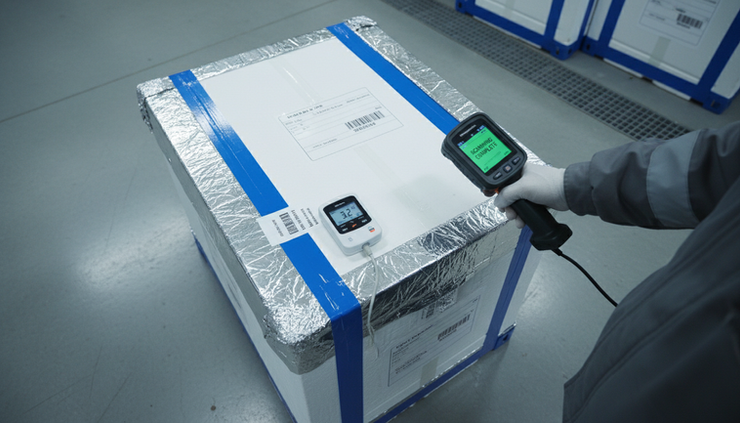
The takeaway for pharma cold chain teams
Pharmaceutical cold chain failures are costly because they attack both sides of distribution: the product and the proof. A shipment outside +2°C to +8°C may no longer be suitable for use. A shipment with incomplete or questionable data may not be releasable, even if the product appears fine.
FRESVUE solves pharma cold chain compliance challenges by treating temperature data as a regulated record, not a casual reading. The ZTAGPRO-EUS logger supports long-duration monitoring, secure data handling, audit-ready records, and remote firmware updates that help logistics operations stay current.
For temperature-sensitive medicines, compliance is not a final report created at the end. It is built into every leg of the journey. FRESVUE helps make that journey safer, clearer, and easier to defend.


Comments