
Farm Tank Level Monitoring Australia Without Cables
A farm with one tank beside the shed is easy to check. A farm with four tanks spread across several hundred metres is a different job altogether.
That was the shape of a recent ProSense Instruments enquiry. The site had four 25,000-litre water tanks, each installed away from the others. Running cable between them would have meant trenching, conduit, labour, risk of damage, and a lot of cost before a single level reading appeared on a screen.
This is a common Australian problem. Tanks may sit near troughs, pumps, sheds, bores, header tanks, or remote paddocks. The distance is often too far for simple wiring, yet too important to leave to guesswork.
The practical answer is remote tank-level monitoring. The choice comes down to two parts:
How the level is measured inside or above the tank
How that measurement is sent back without a cable
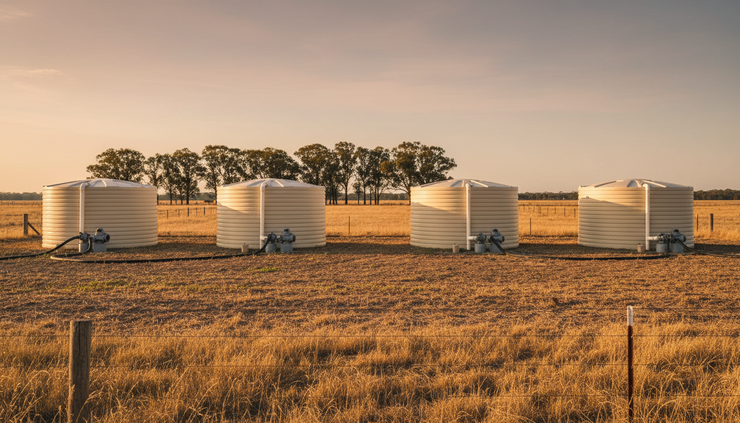
The problem with running cables between farm tanks
Cable works well in factories, sheds, and short-distance installations. On a farm, distance changes the equation.
A few hundred metres of cable may need trenching through hard ground, driveways, rocky sections, grazing areas, or places where machinery turns. Once the cable is in the ground, it still needs protection from water ingress, rodents, UV exposure at entry points, and accidental cuts during future works.
For four tanks, the job also becomes more complex. Each tank needs a sensor. Each sensor needs power or a signal path. The system needs a way to collect the readings and show them in one place.
Wireless monitoring avoids most of that civil work. It does not remove the need for good installation, but it changes the job from “run cable across the farm” to “fit the right sensor and transmitter at each tank”.
For Farm Tank Level Monitoring Australia, that often means choosing between hydrostatic, ultrasonic, and radar measurement, then sending the reading by LoRaWAN or cellular technology.
Start with the tank and the measurement conditions
Before choosing a sensor, the tank itself needs a quick assessment. A 25,000-litre round poly tank is not measured the same way as a small chemical tank, an open concrete reservoir, or a steel header tank.
The key questions are simple:
Is the tank vented to atmosphere?
Is it enclosed, or open at the top?
Can a sensor be installed through the roof?
Is there a bottom outlet or fitting available?
Is the water clean, dirty, or likely to contain sediment?
Does the surface foam, ripple, or splash during filling?
Is there power nearby?
Is mobile coverage available at the tank location?
How often does the level need to update?
For stock water, irrigation storage, and general farm supply, readings every 15 minutes, 30 minutes, or a few times per day may be enough. Pump control or leak detection may need faster readings.
The right answer is rarely the most expensive sensor by default. It is the sensor that gives stable readings in the real conditions on site.
Hydrostatic sensors measure the weight of water above them
A hydrostatic level sensor sits near the bottom of the tank and measures pressure. The deeper the water above the sensor, the higher the pressure. That pressure is converted into a level reading.
For a vented water tank, this is a proven method. It is especially useful where the top of the tank is awkward to access or where dust, insects, rain, or sunlight make top-mounted sensing less appealing.
A typical hydrostatic installation uses a submersible probe lowered into the tank, or a pressure transmitter fitted to a bottom outlet. The system then converts the pressure into litres, percentage full, or metres of water.
Strengths of hydrostatic measurement
Works well in enclosed tanks
Not affected by foam or surface ripples
Can be very stable in windy or exposed sites
Suits many clean water applications
Does not need a clear air path from the tank roof to the water surface
Limitations to allow for
The sensor or pressure port contacts the water
Sediment can be an issue if the probe sits in sludge
Cable glands and fittings must be installed carefully
The reading depends on liquid density, although this is usually predictable for water
For farm water tanks, hydrostatic sensing is often the practical choice when the tank is tall, enclosed, and used for relatively clean water. It also suits sites where a top-mounted sensor may be exposed to birds, branches, or physical damage.

Ultrasonic sensors measure distance to the water surface
An ultrasonic sensor mounts above the water and sends a sound pulse down to the surface. The device measures how long the echo takes to return, then calculates the empty space above the water. From there, the system works out the tank level.
Ultrasonic sensors are popular because they are non-contact. Nothing sits in the water. That can be useful where access through the top of the tank is easy and the water surface is reasonably calm.
They can work well on many farm tanks, but the installation details matter. The sensor needs a clear path to the water surface. It should not point at ladders, internal ribs, inlet streams, or tank walls. It also needs to be mounted at the right height and angle.
Strengths of ultrasonic measurement
No contact with the water
Easy to inspect from the top of the tank
No pressure fitting at the base of the tank
Good for many standard water storage tanks
Often a cost-effective option
Limitations to allow for
Foam, turbulence, and filling streams can disturb readings
Condensation may affect the sensor face
Internal obstructions can cause false echoes
Very narrow or awkward tank openings can make alignment harder
Temperature changes can affect sound speed, although many sensors compensate for this
On an exposed Australian farm, condensation, insects, dust, and tank roof heat should all be considered. A correctly mounted ultrasonic sensor can perform well, but it should not be treated as a “fit anywhere” device.
Radar sensors are strong in difficult tank conditions
Radar level sensors also mount above the liquid, but they use radio waves rather than sound. They measure the distance to the water surface by reading the reflected signal.
Radar is often chosen when ultrasonic sensing is likely to struggle. It is less affected by vapour, temperature change, wind across an open surface, and some forms of condensation. Modern radar sensors can be compact and accurate, making them useful for remote tank applications where reliability matters.
Strengths of radar measurement
Non-contact measurement
Handles changing temperature better than ultrasonic
Less affected by vapour and some surface movement
Good for enclosed tanks and harder applications
Often more stable where ultrasonic echoes are unreliable
Limitations to allow for
Usually costs more than ultrasonic
Still needs correct mounting and a clear view of the surface
Some tank shapes and internal fittings need careful setup
Metal structures and nearby obstructions can affect signal behaviour
For a farm with four 25,000-litre tanks, radar may be the right choice if the tanks are hard to access later, if readings must be highly reliable, or if conditions are known to be difficult. It may not be necessary for every clean, calm water tank, but it is a strong option when the site justifies it.

Comparing hydrostatic, ultrasonic, and radar sensors
There is no single best sensor for every farm tank. The comparison below gives a practical starting point.
Sensor type | How it measures | Best suited to | Main caution |
Hydrostatic | Pressure from water depth | Enclosed tanks, stable water, bottom access or submersible probe installations | Sensor contacts water and must avoid sediment problems |
Ultrasonic | Sound echo from water surface | Clean tanks with calm surfaces and clear top access | Foam, turbulence, condensation, and obstructions can affect readings |
Radar | Radio wave reflection from water surface | More difficult sites, non-contact measurement, higher reliability needs | Higher cost and still needs correct mounting |
For many farm tanks, the decision comes down to access and risk.
If the tank has a suitable top opening, a calm surface, and a clear path, ultrasonic may be enough. If the tank environment is harder or the site owner wants a stronger non-contact method, radar is often preferred. If top access is poor or surface conditions are unreliable, hydrostatic may be the simpler and steadier option.
The ProSense Instruments enquiry with four separated tanks shows why this matters. A site like that does not just need four level readings. It needs four readings that can be trusted without constant manual checking.
Sending readings without cables
Once each tank has a sensor, the reading has to travel somewhere useful. That might be a phone, a web dashboard, a pump controller, an alarm system, or a local display at the homestead.
Two common wireless options are LoRaWAN and cellular.
LoRaWAN works well across farm distances
LoRaWAN is a low-power wireless technology designed to send small amounts of data over long distances. Tank level is a good fit because the message is small. The device does not need to stream video or carry heavy data. It only needs to send values such as level, battery status, signal strength, and alarms.
A LoRaWAN system usually includes:
A sensor at each tank
A LoRaWAN transmitter or node
A gateway that receives data from the nodes
A platform or system that displays the readings
On a farm with several tanks within radio range, one gateway may receive all four tank readings. The gateway then sends the data onward, often through an internet connection.
LoRaWAN can be attractive when the tanks are separated by hundreds of metres, or more, but still belong to the same property. It also suits battery-powered installations because the transmitters can sleep between readings.
The real question is radio path. Hills, sheds, dense trees, and tank placement can reduce range. A site check helps decide gateway location and antenna height.
LoRaWAN is often a good fit when:
Several tanks are spread around one property
Readings do not need to update every few seconds
Battery life matters
A gateway can be installed in a sensible location
The farm wants to avoid SIM cards at every tank
Cellular sends each tank directly to the network
Cellular monitoring uses the mobile network. Each tank device can send its reading directly through a modem, depending on the hardware design and available coverage.
This can be useful when tanks are very remote from each other, or when there is no practical place for a shared gateway. In some cases, cellular is simpler because it avoids setting up a local radio network.
The main requirement is coverage at the tank. Coverage at the house or shed does not always mean coverage near a tank in a dip, behind a hill, or beside dense trees. Antenna selection and mounting height can make a large difference.
Cellular systems also need power planning. Some devices can run from battery and solar, especially if they send readings only a few times per day. More frequent updates need more energy.
Cellular is often a good fit when:
Tanks are spread across different areas or properties
Mobile coverage is reliable at each tank
A gateway is not practical
Direct cloud reporting is preferred
Solar power can be added where needed
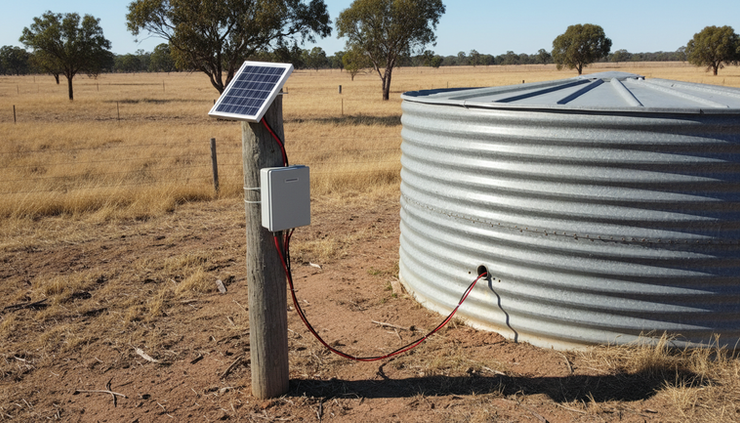
Choosing the right wireless setup for four 25,000-litre tanks
For the four-tank ProSense Instruments enquiry, the decision process would usually follow a clear path.
Start with the tank measurement method. If the tanks are similar, the same sensor type may suit all four. If one tank has different access or harsher conditions, it may need a different sensor. Mixed systems are possible, as long as the output signals and telemetry devices match.
Next, decide how the readings should be viewed. A basic system may show percentage full, litres remaining, and low-level alarms. A more detailed system may include trends, pump run confirmation, refill history, and alerts for sudden drops.
Then choose the communications method.
A practical design may look like this:
Four level sensors, one per tank
Four wireless transmitters, one per tank
Battery or solar power at each tank
LoRaWAN gateway at a shed, mast, or high point
Dashboard access for tank levels and alarms
If the tanks are too far apart for one gateway, or the land does not suit radio coverage, then cellular devices at each tank may be cleaner.
The best design is the one with the fewest weak points. Long cable runs introduce physical weak points. Poor sensor mounting creates measurement weak points. Bad antenna placement creates communication weak points. Good planning removes most of these before installation begins.
What a practical specification should include
A remote tank monitoring quote should be more than a sensor part number. It should describe how the full system will work.
Useful details include:
Tank height, diameter, and capacity
Sensor type and measurement range
Mounting method and fittings
Power source, such as battery, solar, or mains
Communication method, either LoRaWAN or cellular
Expected reporting interval
Local display requirements, if any
Alarm levels, such as low, high, or rapid fall
Dashboard or data access requirements
Installation environment, including heat, rain, dust, livestock, and machinery risk
For Australian farms, enclosure quality and cable protection matter. Sun, storms, insects, and animals are all part of the installation environment. A neat bench test is helpful, but the system must survive where the tanks actually are.
The main takeaway
Remote tank monitoring is not just about avoiding the drive out to check a water level. It helps protect stock water, reduce wasted trips, detect problems earlier, and give a clearer picture of how water is being used across the property.
For four 25,000-litre tanks spread over several hundred metres, running cable is often the least attractive part of the job. A wireless system using hydrostatic, ultrasonic, or radar sensors can provide reliable level data without trenching across the farm.
Choose the sensor based on the tank conditions. Choose LoRaWAN when several tanks can report through a shared farm gateway. Choose cellular when tanks need to report directly and mobile coverage is suitable.
Get those two choices right, and farm water tank monitoring becomes a practical tool rather than another maintenance headache.

Comments