
Dragino LoRaWAN vs Monnit ALTA: Choosing the Right IoT Platform
Picking an IoT platform is rarely just a radio choice. The harder question is what kind of system you want to own after the sensors are installed.
Dragino and Monnit ALTA can both move small sensor readings from the physical world into software. Both can serve real monitoring jobs in buildings, farms, utilities, storage areas, equipment rooms, and light industrial sites. But they come from different design philosophies.
Dragino LoRaWAN fits an open, standards-based approach. You choose gateways, sensors, network servers, dashboards, and integrations with more freedom. That freedom can be valuable, but it also means more design and management work.
Monnit ALTA fits a more contained private wireless ecosystem. You select from Monnit sensors, connect them through Monnit gateways, and manage them through Monnit’s software stack. That can reduce setup friction, but it also narrows your hardware and integration choices.
The right answer depends on scale, sensor needs, internal skills, data ownership, and how much control you want over the system.

The core difference is openness versus a managed ecosystem
Dragino is best understood as part of the broader LoRaWAN world. LoRaWAN is an open wireless protocol designed for low-power, long-range sensor communication. A Dragino deployment may use Dragino gateways and Dragino end devices, but it does not have to stop there. In many cases, LoRaWAN sensors from different vendors can share the same network if they follow the same regional frequency rules and device profiles.
That gives Dragino-based projects a modular feel. You can build a network with:
Dragino gateways
Dragino or third-party LoRaWAN sensors
A public or private LoRaWAN network server
A dashboard, database, or custom application
Integrations through MQTT, HTTP, webhooks, or APIs, depending on the server and software used
Monnit ALTA works differently. ALTA is Monnit’s own wireless sensor ecosystem. The expected path is clear: ALTA sensors communicate with ALTA gateways, and the data is managed through Monnit’s platform and supported integrations.
That structure is not a weakness by itself. For many deployments, it is the main reason to choose Monnit. A controlled ecosystem can make procurement, setup, support, sensor replacement, and daily management easier.
The tradeoff is flexibility. With Monnit ALTA, you are buying into a more defined set of hardware and software choices. With Dragino LoRaWAN, you are building from a wider parts bin.
Gateways shape how much control you have
Gateways are the bridge between field devices and the internet. They also reveal a lot about each platform’s character.
With Dragino, gateways usually sit inside a larger LoRaWAN architecture. A Dragino gateway may forward packets to a network server such as a self-hosted LoRaWAN server, a cloud-hosted LoRaWAN platform, or a community or commercial network. This separation matters because the gateway is not the whole system. It is one layer.
That gives teams more options. A deployment can start small with one gateway and later add gateways from the same or different vendors. It can also move data handling to a different network server if requirements change.
The downside is that someone must understand the pieces. Gateway configuration, packet forwarding, network server setup, device activation, payload decoding, and application integration all need attention. None of this is impossible, but it is real work.
Monnit ALTA gateways take a more appliance-like role. They are designed to connect ALTA sensors to Monnit’s ecosystem with fewer architectural choices. For a facility manager or operations team that wants alerts, trends, and device status without building an IoT backend, that simplicity can be a major advantage.
A good way to frame the gateway decision is this:
Dragino LoRaWAN | Monnit ALTA |
Better when you want control over the network stack | Better when you want a packaged sensor-to-cloud path |
Works well for teams comfortable with LoRaWAN concepts | Works well for teams that prefer vendor-managed setup |
Easier to mix with other LoRaWAN infrastructure | Easier to standardize around one supplier |
More flexible over time | More predictable from day one |
Neither model wins everywhere. The gateway choice should match how much system ownership you want.

Sensor choice depends on how specialized the application is
Sensor selection is often where platform differences become most visible.
Dragino offers LoRaWAN devices for common measurement types such as temperature, humidity, soil conditions, water metering, distance sensing, inputs, outputs, and environmental monitoring. Because it sits in the LoRaWAN ecosystem, Dragino can also be paired with third-party LoRaWAN sensors when a project needs something outside Dragino’s catalog.
That matters for unusual applications. If you need a specific probe type, a rugged enclosure, a special input, or a sensor already certified for a certain environment, an open LoRaWAN design may give you more paths forward. You can also build custom devices around LoRaWAN modules if the project justifies it.
Monnit ALTA’s strength is catalog consistency. Monnit offers a wide range of ready-to-use sensors for common facility and equipment monitoring tasks. These may include temperature, humidity, water detection, open and closed status, vibration, current, voltage, pressure, motion, and other practical conditions. The value is not just the device. It is the fact that the sensor, gateway, and software are meant to work together.
This helps when the goal is fast deployment across familiar use cases, such as:
Refrigerator and freezer monitoring
Room temperature and humidity alerts
Leak detection
Door and access monitoring
Equipment runtime checks
Basic condition monitoring
Facility maintenance alerts
Dragino becomes more attractive when sensor variety and system openness matter more than a single-vendor experience. Monnit ALTA becomes more attractive when the needed sensors already exist in its catalog and the main goal is reliable monitoring with less setup effort.
Configuration is where simplicity and flexibility trade places
Every IoT project has two setup phases. The first is physical installation. The second is logical configuration. The second phase is where many projects slow down.
A Dragino LoRaWAN deployment typically involves several setup tasks:
Register the gateway with the network server.
Configure packet forwarding and connectivity.
Add end devices with their LoRaWAN credentials.
Choose activation settings.
Decode payloads into usable values.
Route data to dashboards, databases, or external systems.
Set alerts or application logic.
For a technical team, this process gives useful control. You can inspect packets, adjust data flows, choose where data lives, and integrate with existing systems in a clean way. You can also separate the radio network from the application layer, which becomes helpful at larger scale.
For a nontechnical team, those same steps can feel like unnecessary friction. A sensor that physically installs in five minutes can still take longer to make useful if the payload decoder, integration, or alert path is not ready.
Monnit ALTA favors a guided path. The setup process is generally built around adding sensors to a Monnit account, connecting them to a gateway, naming devices, setting alert conditions, and viewing readings in Monnit’s software. The platform hides more of the radio and backend detail.
That is a clear advantage when the people managing the system are maintenance staff, operations staff, property teams, or small business owners rather than IoT engineers. The cost is that advanced customization may be limited by what the ecosystem supports.
If configuration time is the biggest risk, Monnit ALTA has the edge. If system control is the bigger priority, Dragino LoRaWAN has the edge.

Integrations decide what happens after the alert
A sensor platform is only useful if the data reaches the people and systems that need it.
Dragino LoRaWAN deployments can support many integration patterns because the application layer is not fixed to one vendor. Depending on the network server and tools used, data can flow into:
MQTT brokers
HTTP endpoints
Webhooks
Time-series databases
Custom dashboards
SCADA or building systems through middleware
Cloud IoT services
This makes Dragino a good fit when sensor data is part of a larger digital system. For example, a water meter reading may need to feed billing software. A soil moisture sensor may need to feed an irrigation controller. A machine status sensor may need to join a maintenance data platform.
The key phrase is “depending on the network server and tools used.” Dragino hardware does not magically provide every integration by itself. The surrounding LoRaWAN stack determines what is easy, what is hard, and what needs custom work.
Monnit ALTA is more direct. It offers software for viewing data, setting alerts, and managing devices. It may also support integrations through available platform features, exports, notifications, APIs, or partner paths, depending on the plan and system configuration.
For stand-alone monitoring, that can be enough. If the main need is “tell me when the freezer is too warm” or “alert me when water is detected,” Monnit’s built-in management layer can reduce the need for extra tools.
For complex integration, the evaluation should be more detailed. Before choosing ALTA, confirm that the platform can send data where it needs to go, in the format and timing the application requires. Before choosing Dragino, confirm that the network server and application stack have the integrations your team can maintain.
Deployment scale changes the best choice
A single-site deployment and a multi-site deployment have different risks.
For a small site with a limited number of sensors, Monnit ALTA often looks attractive. The setup is contained. The sensor catalog is easy to browse. Support comes from one ecosystem. Daily users can focus on alerts and battery status rather than network architecture.
This is useful for:
Restaurants and cold storage rooms
Small warehouses
Schools and public buildings
Rental properties
Clinics and labs with basic environmental monitoring
Remote equipment rooms
Dragino LoRaWAN can also serve small sites well, especially when someone already understands LoRaWAN. But the extra flexibility may not matter if the use case is simple.
At larger scale, the comparison gets more nuanced. Dragino LoRaWAN can become stronger when a team wants to standardize a network layer across many sensor types, sites, and applications. An organization might use the same LoRaWAN coverage for utility metering, environmental sensing, asset status, and outdoor monitoring. The open ecosystem gives room to adapt.
Monnit ALTA can also scale across many sensors and locations, especially when the use cases fit its catalog. The advantage is consistent administration. Teams can repeat the same setup pattern from site to site without designing a custom architecture each time.
The best question is not only “How many sensors will we install this month?” It is also “How different will our use cases be next year?”
If future use cases are likely to vary, open LoRaWAN deserves a close look. If future use cases are mostly repeats of the same monitoring patterns, ALTA’s consistency may save time.
Ongoing management is where hidden costs appear
A platform that is easy to install can still become hard to manage. The reverse is also true.
Dragino LoRaWAN gives you more control over long-term management. You can choose where data is stored, how devices are named, how users access dashboards, how integrations are built, and how gateways are monitored. You can also adjust vendors over time.
That control brings responsibilities:
Tracking firmware and configuration changes
Maintaining the network server or cloud account
Managing device keys and security practices
Documenting payload decoders
Monitoring gateway uptime
Supporting integrations when APIs or software change
Training staff on tools that may come from different vendors
For engineering-led teams, these are normal system management tasks. For lean operations teams, they can become a burden.
Monnit ALTA reduces the number of moving parts. Device management, alerts, and sensor views live inside a more unified environment. That can make handoff easier when staff change. It also simplifies support because there is one main vendor path for the core system.
The tradeoff is dependence on that ecosystem. If you need a sensor Monnit does not offer, a feature outside the platform’s design, or a data workflow that requires more openness, you may have less room to maneuver.
Ownership has a cost either way. With Dragino, you may spend more time designing and maintaining the system. With Monnit ALTA, you accept more boundaries in exchange for a simpler operating model.
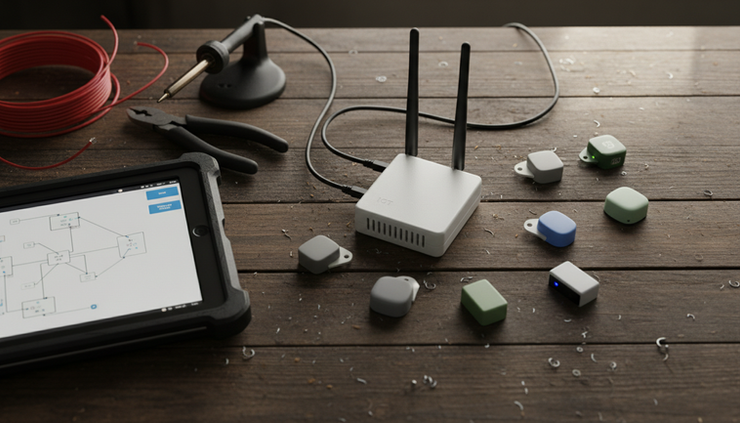
Choose Dragino LoRaWAN when control matters most
Dragino is the better fit when the project needs openness, custom integration, or long-term flexibility. It is especially useful when the IoT network may grow beyond one use case.
Choose Dragino LoRaWAN if you want to:
Mix sensors from different LoRaWAN vendors
Use a private LoRaWAN network server
Connect data to custom applications
Build dashboards around your own database
Support specialized or unusual sensors
Separate gateway, network, and application decisions
Avoid being tied to one sensor ecosystem
Dragino also fits teams that enjoy hands-on system design. If there is internal skill in networking, cloud tools, embedded systems, or industrial integration, an open LoRaWAN deployment can be shaped around the application instead of the other way around.
The main caution is complexity. A Dragino project needs clear ownership. Someone must design the architecture, document the configuration, and maintain the parts after installation. Without that owner, open systems can become messy.
Choose Monnit ALTA when fast deployment and simple management matter most
Monnit ALTA is the better fit when the needed sensors are available in the ALTA catalog and the main goal is dependable monitoring without building a custom IoT stack.
Choose Monnit ALTA if you want to:
Deploy common sensors quickly
Manage devices in one platform
Set alerts without custom software
Reduce network design work
Standardize monitoring across similar sites
Keep support tied to one ecosystem
Give nontechnical staff a simpler daily tool
ALTA is especially strong for practical monitoring jobs where the value comes from alerts and records, not from complex integration. If a facility needs to know when a door opens, a room is too humid, or water appears under equipment, a packaged ecosystem can be the fastest path to useful data.
The main caution is flexibility. Before committing, verify sensor availability, integration options, data access, gateway coverage, and long-term platform fit. A simple system is only simple if it covers the full application.
A practical decision framework
For many projects, the best choice becomes clear after a few direct questions.
Question | Better fit if the answer is yes |
Do you need sensors from multiple vendors? | Dragino LoRaWAN |
Do you want a packaged sensor and software experience? | Monnit ALTA |
Will data feed a custom app or database? | Dragino LoRaWAN |
Is fast setup more important than architecture control? | Monnit ALTA |
Do you have staff who can manage LoRaWAN infrastructure? | Dragino LoRaWAN |
Will nontechnical users manage most of the system? | Monnit ALTA |
Are future use cases uncertain or likely to expand? | Dragino LoRaWAN |
Are use cases common and repeatable across sites? | Monnit ALTA |
A proof of concept can also prevent a poor fit. Test one gateway, a small group of sensors, the alert process, and the integration path before buying at scale. Measure the boring things: signal quality, battery reporting, device naming, alert timing, user access, and how quickly a new sensor can be added.
Those details matter more than a feature list.
The best platform is the one your team can live with
Dragino and Monnit ALTA solve different versions of the same problem. Dragino LoRaWAN gives you an open foundation with room to customize, integrate, and expand. Monnit ALTA gives you a more complete private wireless ecosystem that is easier to deploy and operate for common monitoring needs.
Choose Dragino when control, interoperability, and custom data flow matter most. Choose Monnit ALTA when speed, simplicity, and single-ecosystem management matter most.
The best IoT platform is not the one with the longest specification sheet. It is the one that fits the sensors you need, the people who will manage it, and the systems that must use the data after the reading arrives.


Comments