
Dragino LoRaWAN and Cellular Sensors Now in Australia for Industry Solutions
Industrial monitoring is only useful when it reaches the places where work actually happens: tanks, sheds, pump stations, cold rooms, paddocks, warehouses, switchboards and remote sites. Dragino sensors are built for exactly that kind of job.
ProSense Solutions is now stocking Dragino’s range of LoRaWAN and cellular sensors in Australia, supplying direct to industry and helping teams build the right kit for each site. Whether the job is as simple as checking a water level or as broad as rolling out monitoring across multiple assets, Dragino gives you a practical way to collect field data without running long cables or waiting for a full control system upgrade.
The range covers environmental sensing, water and tank monitoring, agriculture, energy, tracking, industrial input monitoring and gateway connectivity. Better still, the products can be matched into complete kits, so sensors, gateways, antennas, power options and setup support all work together from the start.

Why Dragino is a strong fit for Australian industry
Australia makes wireless sensing work hard. Sites can be spread across long distances. Assets may sit far from mains power. Pump sheds, tanks, yards and plant rooms are often difficult to reach with data cable. Some locations have Wi-Fi. Others have only mobile coverage. Some have no easy backhaul at all without adding a gateway.
That is where Dragino fits well.
Dragino designs a wide range of LoRaWAN and cellular devices for low-power sensing. Many models are made for field use, with battery operation, external antenna options and support for common industrial signals. The range gives businesses a way to start small, then grow into a larger monitoring network.
For many sites, LoRaWAN is the best fit. It allows sensors to send small packets of data over long distances to a gateway. The gateway then sends that data to a server or platform using Ethernet, Wi-Fi or mobile backhaul, depending on the model and site layout.
For other jobs, cellular sensors make more sense. A cellular sensor can send data directly over a mobile network, so it may not need a local LoRaWAN gateway. This can suit isolated assets, single-site monitoring or locations where installing a gateway is not practical.
The result is a flexible set of options:
Use LoRaWAN sensors when several devices need to report through one gateway.
Use cellular sensors when a sensor needs its own direct connection.
Use industrial interface devices when existing equipment already has outputs worth capturing.
Use gateway kits when a site needs a complete wireless network, not just a sensor.
ProSense Solutions can help match these choices to the job, instead of leaving the buyer to piece together parts one by one.
The Dragino sensor range covers real field applications
Dragino is not limited to one type of sensor. Its catalogue supports many common monitoring tasks across utilities, agriculture, facilities, food storage, manufacturing and remote infrastructure.
The best starting point is to think by application.
Water, tanks and fluid monitoring
Water assets are a natural fit for wireless sensing. Tanks, troughs, dams, sumps, rainwater systems and chemical storage points are often spread across a site. Checking them manually costs time, and missed issues can lead to downtime or waste.
Dragino devices can support applications such as:
Tank level monitoring using ultrasonic or distance sensing
Water leak detection in plant rooms or storage areas
Flow and pulse counting from compatible meters
Pressure monitoring for pumps, pipelines and irrigation systems
Valve, float switch or contact status reporting
For agriculture, councils, commercial sites and industrial plants, these readings help spot problems earlier. A tank that is not filling, a pump that is cycling too often or a leak that starts after hours can be detected without waiting for the next manual check.
Temperature, humidity and cold chain monitoring
Temperature and humidity monitoring is one of the most common entry points for wireless sensors. It applies to cool rooms, freezers, warehouses, workshops, greenhouses, storage rooms and equipment spaces.
Dragino sensors can help track:
Ambient temperature
Relative humidity
Probe-based temperature readings
Cold storage conditions
Plant room conditions
Greenhouse and shed environments
For food storage and temperature-sensitive goods, wireless alerts and trend records can help teams respond before a small issue becomes a spoiled stock event. In equipment rooms, temperature and humidity data can also point to ventilation problems or failing air movement.
Agriculture and environmental sensing
Australian farms and growing operations need data from open, rough and remote areas. Dragino’s low-power sensor approach suits many of these uses.
Typical applications include:
Soil moisture monitoring
Soil temperature checks
Weather station data
Rainfall and wind monitoring through compatible devices
Greenhouse climate monitoring
Irrigation support
Water source and tank visibility
Soil and climate readings do not replace local knowledge, but they add useful evidence. Over time, trends can help guide irrigation timing, protect crops from stress and reduce wasted site visits.
Distance, level and object detection
Distance sensors are useful whenever a site needs to know whether something is present, full, empty, open, closed or moving outside the expected range.
Common examples include:
Bin fill level monitoring
Silo, tank or hopper level checks where suitable
Parking or bay occupancy
Open channel or sump level indication
Door, hatch or gate position
Object presence detection
These sensors are valuable because they turn simple status checks into remote data. Instead of sending someone to look, the system reports the condition.
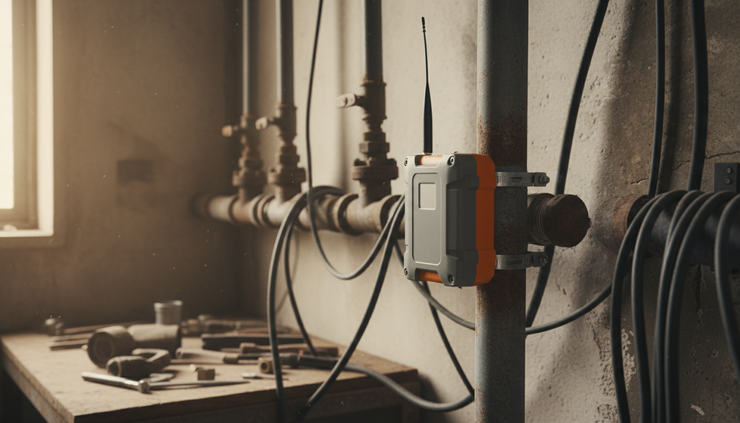
Industrial input and equipment monitoring
Many industrial sites already have usable signals. A machine may provide a dry contact, a meter may provide pulses, or a controller may expose data through RS485 or Modbus. Dragino has devices that can help bring these signals into a LoRaWAN or cellular monitoring setup.
This can include:
Digital input monitoring
Analogue signal monitoring where supported
Pulse counting for meters
Relay output control on compatible devices
RS485 and Modbus data collection
Current sensing and equipment run status
Alarm contact reporting
This is where Dragino becomes more than a range of environmental sensors. It can act as a bridge between older site equipment and modern remote monitoring.
For example, a business may not need to replace a working meter or controller. It may only need to capture the readings and send them to a dashboard. A suitable Dragino interface device can often make that possible with far less disruption than a full system replacement.
Tracking, location and asset visibility
Dragino also offers devices across GPS and tracking-style applications. These can suit equipment, vehicles, mobile assets or field activity where location data is useful.
Depending on the device and network design, these tools can support:
Asset location checks
Movement reporting
Geofence-style monitoring through the connected platform
Fleet or equipment visibility
Field service asset tracking
For mobile applications, connectivity choice matters. Some projects suit LoRaWAN coverage across a defined site. Others suit cellular devices that can report across wider mobile network areas.
LoRaWAN and cellular each solve a different problem
Choosing between LoRaWAN and cellular is one of the most important design decisions in a sensor project.
LoRaWAN is excellent when a site needs many low-power sensors sending small data messages across a local or regional area. A single gateway can receive messages from multiple sensors, depending on distance, antenna placement, terrain, buildings and interference. It works well for tank levels, soil moisture, temperature, meter pulses and status signals.
Cellular is useful when a sensor must send data directly to the internet through the mobile network. This can reduce the need for local infrastructure, especially where there are only one or two sensors at a remote location.
LoRaWAN is a good fit when
Multiple sensors sit across one site, long battery life matters, data messages are small, and a gateway can be installed in a good location.
Cellular is a good fit when
A sensor is isolated, mobile coverage is available, gateway installation is not practical, or each asset needs a direct connection.
A well-designed project may use both. A depot, farm, plant or facility might use LoRaWAN for fixed assets, then cellular sensors for remote tanks or mobile equipment outside gateway range.
Gateways turn sensors into a connected system
Sensors collect the data. Gateways move it where it needs to go.
In a LoRaWAN setup, the gateway is the central link between field sensors and the software platform. It receives wireless messages from Dragino sensors, then forwards those messages through Ethernet, Wi-Fi or cellular backhaul, depending on the gateway model and site needs.
Dragino offers different gateway types for different environments.
Indoor gateways for workshops, facilities and small sites
Indoor LoRaWAN gateways are suited to areas where the gateway can sit in a protected space with access to power and network connectivity. They can be used in warehouses, workshops, plant rooms, cool rooms, schools, laboratories and small industrial sites.
They are often the right choice when:
Sensors sit within or around buildings
Ethernet or Wi-Fi is available
The gateway does not need a weatherproof enclosure
A low-cost entry point is preferred
The site wants to trial LoRaWAN before expanding
An indoor gateway can be a simple way to prove the system. Once the data is flowing and the value is clear, more sensors or outdoor coverage can be added.
Outdoor gateways for farms, yards and remote assets
Outdoor gateways are built for harsher locations. They are generally used when sensors are spread across open ground, yards, utilities sites, agricultural blocks or industrial areas.
Important features may include:
Weather-resistant housing
External antenna support
Pole or wall mounting
Power options suited to the site
Long-range coverage when placed well
Cellular backhaul on selected models
Gateway placement has a major effect on performance. Height, line of sight, antenna selection and local obstructions all matter. A gateway mounted high on a shed or pole will usually perform better than one hidden behind metal walls or machinery.
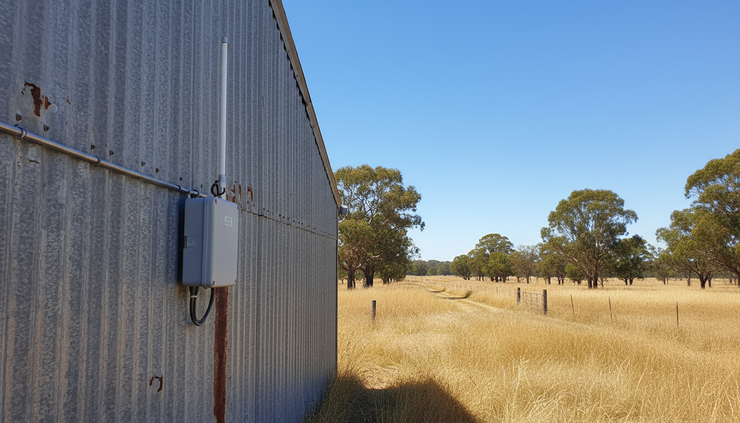
Gateways with cellular backhaul
Some locations have no fixed internet connection. A cellular-backhaul gateway can solve that problem by using the mobile network to send LoRaWAN sensor data onward.
This is useful for:
Pump stations
Irrigation sites
Temporary monitoring projects
Remote sheds
Utilities and council assets
Quarries and industrial yards
Farms without fixed internet at the gateway point
In this layout, LoRaWAN handles the local sensor network, while cellular handles the link back to the platform. That gives the site the benefit of low-power LoRaWAN sensors without needing fixed broadband at the gateway.
Gateway choice affects the whole kit
The gateway is not an afterthought. It affects range, reliability, installation cost and future expansion.
A good kit needs the right match between:
Sensor type
Number of sensors
Site size
Expected reporting interval
Power availability
Antenna location
Mobile or fixed internet access
Environmental conditions
Platform requirements
ProSense Solutions can put these pieces together as a working kit, rather than leaving the installer to discover gaps on site.
What a complete Dragino kit can include
A practical kit is more than a box of sensors. The right mix depends on the application, but it may include:
Dragino LoRaWAN or cellular sensors
A suitable LoRaWAN gateway where required
Antennas and mounting accessories
Power supplies or battery options
SIM requirements for cellular devices or gateways
Configuration support
Data platform guidance
Advice on sensor placement and gateway location
For simple projects, one cellular sensor may be enough. For larger sites, a kit may include one or more gateways plus many LoRaWAN sensors.
Here are some example kit styles.
Application | Possible Dragino kit |
Farm water monitoring | Tank level sensors, gateway with suitable backhaul, antennas and setup support |
Cold room monitoring | Temperature sensors, indoor gateway and alert platform connection |
Pump station monitoring | Pressure or digital input sensors, outdoor gateway and cellular backhaul where needed |
Soil and irrigation monitoring | Soil moisture sensors, weather inputs, outdoor gateway and mounting hardware |
Industrial meter reading | Pulse or RS485 interface devices, gateway and data forwarding setup |
Yard or gate monitoring | Contact sensors, gateway and alert configuration |
These examples are not one-size-fits-all. A tank monitoring kit for a rural property will look different from a plant room kit in a manufacturing site. The value is in matching the hardware to the site conditions before installation begins.
Benefits that matter beyond the sensor datasheet
The appeal of Dragino is not just the product count. It is the way the range supports practical monitoring across many types of assets.
Less manual checking
Manual checks are still needed, but they should not be the only way to know what is happening. Wireless sensors reduce unnecessary site visits and help staff focus on problems that need action.
Earlier fault detection
A level dropping too fast, a temperature moving out of range or a pump signal changing unexpectedly can all point to issues. Sensor data gives teams a better chance of responding early.
Easier retrofit projects
Many Dragino devices suit existing assets. That matters when a site has working infrastructure but no easy way to collect data from it. Wireless retrofit options can be faster and less disruptive than cable runs.
Scalable site monitoring
A site can begin with a small number of sensors, then expand. Once a LoRaWAN gateway is in place, more compatible sensors can often be added as needs grow.
Flexible connectivity
LoRaWAN, cellular devices and cellular-backhaul gateways give different paths to the same goal: getting field data to the people or systems that need it.
Australian stock and direct industry supply
Having Dragino products available locally makes projects easier to move from idea to installation. ProSense Solutions is now stocking Dragino sensors and gateways in Australia, with direct supply to industry nationwide.
That local access helps with:
Faster project planning
More practical product selection
Easier kit building
Support for Australian site conditions
Reduced guesswork when choosing gateways and sensors
For industry customers, the biggest benefit is the ability to describe the problem and get a practical set of parts matched to it. That might be a single cellular sensor for a remote asset, or a full LoRaWAN kit with sensors, gateway and accessories.

Getting started with the right Dragino solution
The best Dragino setup starts with a clear picture of the site.
Before choosing products, define:
What needs to be measured
Where each sensor will be installed
How often readings are needed
Whether power is available
Whether mobile coverage is available
Whether fixed internet is available for a gateway
How far sensors are from the likely gateway location
What alerts or reports are needed
Whether existing meters or controllers already provide signals
From there, ProSense Solutions can help put together a kit that suits the application. That may include LoRaWAN sensors and a gateway, cellular sensors for standalone assets, or a mixed setup for sites with different coverage needs.
Dragino gives Australian industry a practical path into remote monitoring without overcomplicating the job. Start with the asset that causes the most manual checking, missed faults or uncertainty. Add the right sensor, choose the right connectivity, and build from there.


Comments