
Understanding the Types and Principles of Flowmeters for Accurate Measurement
Accurate flow measurement plays a crucial role in many industries, from water treatment to chemical processing. Choosing the right flowmeter depends on understanding the different types and the principles behind their operation. This post breaks down the main categories of flowmeters based on their measurement principles and structural design, helping you make informed decisions for precise flow monitoring.
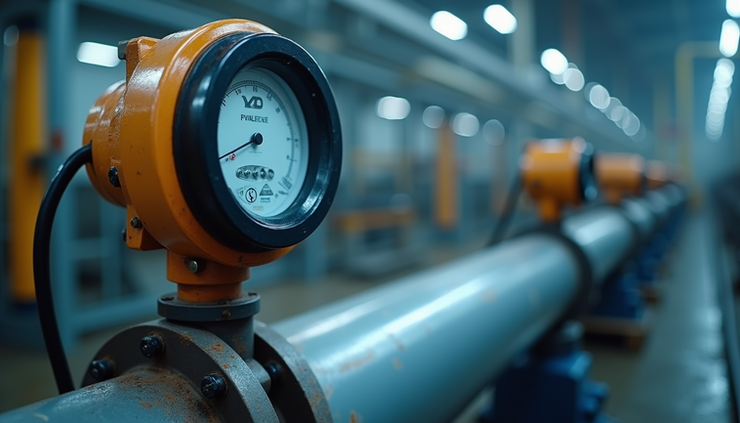
Ⅰ. Flowmeters Classified by Measurement Principle
Flowmeters operate based on various physical principles. These principles determine how the device measures the flow of liquids or gases. Here are the main categories:
1. Mechanical Principles
Mechanical flowmeters rely on the physical movement or forces within the fluid. Examples include:
Differential Pressure Type: Uses Bernoulli's theorem to measure pressure differences caused by flow restrictions.
Rotor Type: Measures flow by the rotation of a rotor driven by the fluid.
Impulse and Movable Tube Types: Use the momentum theorem to detect flow changes.
Direct Mass Type: Applies Newton's second law to measure mass flow directly.
Turbine Type: Uses angular momentum to determine flow rate by the speed of a turbine.
Vortex and Vortex Street Types: Detect fluid oscillations created by obstacles in the flow path.
These mechanical methods are widely used due to their reliability and simplicity in many industrial applications.
2. Electrical Principles
Flowmeters based on electrical principles measure flow by detecting changes in electrical properties caused by fluid movement:
Electromagnetic Flowmeters: Measure voltage generated by conductive fluids moving through a magnetic field.
Differential Capacitive Types: Detect changes in capacitance related to fluid flow.
Inductive Types: Use electromagnetic induction to sense flow.
Strain Resistance Types: Measure deformation caused by flow forces.
Electromagnetic flowmeters are especially popular for measuring conductive liquids with high accuracy and no moving parts.
3. Acoustic Principles
Acoustic flowmeters use sound waves to determine flow velocity:
Ultrasonic Flowmeters: Send ultrasonic pulses through the fluid and measure the time difference or frequency shift caused by flow.
Shock Wave Types: Detect flow by analyzing acoustic shock waves generated in the fluid.
These meters are non-intrusive and suitable for clean or dirty fluids where contact with the sensor is limited.
4. Thermal Principles
Thermal flowmeters measure flow based on heat transfer:
Thermal Types: Detect changes in temperature caused by fluid flow.
Direct Thermal Types: Measure heat loss directly from a heated element.
Indirect Thermal Types: Use temperature sensors placed around the flow path.
These are often used for gas flow measurement where thermal properties change with velocity.
5. Optical Principles
Optical flowmeters use light to measure flow characteristics:
Laser Types: Use laser Doppler techniques to detect particle velocity in the fluid.
Photoelectric Types: Measure changes in light intensity or scattering caused by flow.
These are useful in applications requiring non-contact measurement and high precision.
6. Physical Principles
Some flowmeters use advanced physical phenomena:
Nuclear Magnetic Resonance (NMR): Measures flow by detecting magnetic properties of fluid molecules.
Nuclear Radiation: Uses radioactive tracers to track flow.
These methods are specialized and used in research or highly controlled environments.
7. Other Principles
Additional principles include:
Marking or Tracer Principle: Introduces a tracer substance and measures its movement.
Related Principles: Various hybrid or emerging technologies.
These are less common but valuable in specific scenarios.
Ⅱ. Flowmeters Classified by Structural Principle
Flowmeters can also be grouped by their structural design, which affects installation, maintenance, and suitability for different fluids.
Electromagnetic Flowmeters
Used primarily for conductive liquids and slurries, electromagnetic flowmeters measure volume flow by detecting voltage induced by fluid movement in a magnetic field. They have no moving parts, reducing wear and maintenance. These meters are ideal for water treatment plants, chemical industries, and food processing.
Vortex Flowmeters
Vortex flowmeters measure flow by detecting vortices shed by a bluff body placed in the flow path. The frequency of these vortices correlates with flow velocity. They work well with liquids, gases, and steam, offering good accuracy and low pressure loss. Industries like HVAC, power generation, and petrochemicals often use vortex meters.
Turbine Flowmeters
Turbine flowmeters use a rotor that spins with the fluid flow. The rotational speed is proportional to the flow rate. These meters provide high accuracy and fast response but require clean fluids to avoid damage. They are common in oil and gas, water distribution, and chemical processing.

Practical Considerations for Choosing a Flowmeter
Selecting the right flowmeter depends on several factors:
Fluid Type: Conductive liquids suit electromagnetic meters; clean fluids fit turbine meters.
Flow Range and Accuracy: Mechanical meters offer high accuracy; ultrasonic meters provide non-intrusive options.
Installation Environment: Space constraints and pipeline conditions affect meter choice.
Maintenance Needs: Meters with no moving parts require less upkeep.
Cost and Budget: Balance between initial investment and long-term operation costs.
For example, a wastewater treatment plant might choose an electromagnetic flowmeter for its durability and accuracy with conductive fluids. A steam system could benefit from a vortex flowmeter due to its ability to handle high temperatures and pressure.
Summary
Understanding the different types and principles of flowmeters helps ensure accurate and reliable flow measurement. Mechanical, electrical, acoustic, thermal, optical, and physical principles each offer unique advantages depending on the application. Structural designs like electromagnetic, vortex, and turbine flowmeters provide practical solutions tailored to specific fluids and environments.


Comments