
Standard Flow vs Actual Flow in Industrial Gas Measurement Understanding Pressure Temperature and Applications
A flowmeter can report the same gas movement as 500 ACFM or 1,200 SCFM, and both readings can be correct. The difference is not the meter losing accuracy. It is the reference frame.
Industrial gas measurement becomes complicated because gases are compressible. A cubic foot of nitrogen in a low-pressure vent line does not contain the same amount of gas as a cubic foot of nitrogen in a high-pressure header. Temperature changes the picture again. Heat the gas, and the same number of molecules takes up more space. Cool it, and the volume contracts.
That is why actual volumetric flow and standardized flow are both used in plants, pipelines, laboratories, and process systems. Each answers a different question. Actual flow tells what is moving through the pipe under operating conditions. Standard flow tells how much gas is being moved in terms of a fixed pressure and temperature reference.

Actual flow measures gas volume at line conditions
Actual volumetric flow is the volume of gas passing through a point in a given time at the actual pressure and temperature in the pipe or duct.
Common units include:
ACFM
Actual cubic feet per minute
Am³/h
Actual cubic meters per hour
ft³/min or m³/h
Sometimes used when the operating basis is already clear
If a meter reads 800 ACFM, it means 800 cubic feet of gas, at the current line pressure and line temperature, pass through the meter each minute.
Actual flow is tied directly to pipe velocity. This makes it important for equipment sizing and mechanical design. Ducts, pipe diameters, control valves, filter housings, burners, heat exchangers, and blowers all interact with the gas as it exists in the system.
For example, a combustion air fan does not “feel” standard cubic feet. It moves actual cubic feet at the fan inlet. If inlet air temperature rises, the air becomes less dense. The fan may still move a similar actual volume, but the mass of oxygen delivered can fall. That distinction matters in furnace control and emissions performance.
Actual flow is also central in low-pressure systems such as:
Ventilation and exhaust ducts
Flare headers
Aeration air systems
Baghouse and dust collector lines
Combustion air supply
Process off-gas handling
In these systems, velocity and pressure drop often matter as much as the amount of gas. Actual flow gives the operating volume needed to evaluate those effects.
Standard flow measures gas volume at fixed reference conditions
Standardized flow converts the gas volume to a defined set of pressure and temperature conditions. It represents the volume the gas would occupy if brought to those reference conditions.
Common units include:
SCFM
Standard cubic feet per minute
Nm³/h
Normal cubic meters per hour
Sm³/h
Standard cubic meters per hour
The reference conditions are not universal. In many US industrial settings, standard conditions are often near 14.7 psia and 60 °F, but this is not guaranteed. Some contracts, instruments, and industries use different temperature bases, pressure bases, humidity assumptions, or gas compressibility corrections.
A standard flow value is only complete when the standard pressure, standard temperature, and gas composition basis are defined.
Standard flow is useful because it normalizes gas measurement. A process engineer in one plant and a supplier at another location can compare gas consumption without needing both systems to operate at the same pressure and temperature.
Standard flow is commonly used for:
Gas purchasing and allocation
Compressed air accounting
Fuel gas consumption
Nitrogen and oxygen supply contracts
Burner fuel-air ratio calculations
Emissions and environmental reporting
Mass balance calculations
Process control where gas composition is stable
Standardized flow is closely related to molar flow and mass flow. For a given gas composition, standard volume can be converted to mass because density at the standard condition is defined or calculable.
The main difference is operating volume versus equivalent volume
Actual and standard flow are not competing measurements. They are two ways to describe the same gas movement. One describes the gas in the pipe. The other describes an equivalent amount of gas at a fixed reference state.
Measurement type | What it represents | Best used for |
Actual volumetric flow | Volume at operating pressure and temperature | Pipe velocity, fan sizing, duct design, pressure drop |
Standardized flow | Equivalent volume at reference pressure and temperature | Gas usage, supply contracts, mass balance, process comparison |
Mass flow | Actual amount of material per time | Chemical reaction control, custody transfer, emissions calculations |
A simple way to think about it is this: actual flow is tied to space in the pipe, while standard flow is tied to amount of gas.
That difference becomes critical when line pressure changes. A compressed gas line can carry a large amount of gas through a relatively small actual volume. Once expanded to standard pressure, that same gas occupies a much larger equivalent volume.

Pressure changes have the largest effect on gas volume
For gases, pressure and volume move in opposite directions when temperature and gas quantity stay constant. Increase pressure, and the same amount of gas occupies less actual volume. Decrease pressure, and it expands.
The ideal gas relationship provides the basic framework:
`PV = nRT`
Where:
`P` is absolute pressure
`V` is volume
`n` is the amount of gas
`R` is the gas constant
`T` is absolute temperature
For flow conversion, the same idea can be written in practical form:
`Qstd = Qact × (Pact / Pstd) × (Tstd / Tact)`
This simple equation assumes ideal gas behavior and dry gas. Real gas calculations may include compressibility:
`Qstd = Qact × (Pact / Pstd) × (Tstd / Tact) × (Zstd / Zact)`
Where `Z` is the compressibility factor.
The pressure must be absolute, not gauge pressure. This is a common source of error. A line pressure of 100 psig is about 114.7 psia at sea-level atmospheric pressure. Using 100 instead of 114.7 creates a significant conversion error.
A pressure example with compressed air
Consider dry compressed air flowing at:
Actual flow
100 ACFM
Line pressure
100 psig, about 114.7 psia
Line temperature
60 °F
Standard condition
14.7 psia and 60 °F
Since temperature is the same, the temperature ratio is 1.
`Qstd = 100 × (114.7 / 14.7)`
`Qstd ≈ 780 SCFM`
The actual volume in the pipe is 100 cubic feet per minute, but the equivalent standard volume is about 780 cubic feet per minute. That is why compressed air systems often show high SCFM values even when pipe velocities are moderate.
If the same gas expands downstream to near atmospheric pressure, its actual volume rises sharply. This affects downstream pipe sizing, vent capacity, silencer selection, and relief discharge calculations.
Temperature changes alter density and corrected flow
Temperature affects gas volume because hotter gas expands. At the same pressure, a hotter gas has lower density. A colder gas has higher density.
For flow conversion, temperature must be expressed on an absolute scale:
Degrees Rankine for Fahrenheit-based calculations
`°R = °F + 459.67`
Kelvin for Celsius-based calculations
`K = °C + 273.15`
Using Fahrenheit or Celsius directly in the gas law produces incorrect results.
A temperature example in a natural gas line
Assume a natural gas stream has:
Actual flow
1,000 ACFM
Line pressure
50 psia
Standard pressure
14.7 psia
Line temperature
120 °F, or 579.67 °R
Standard temperature
60 °F, or 519.67 °R
Using the simplified equation:
`Qstd = 1,000 × (50 / 14.7) × (519.67 / 579.67)`
`Qstd ≈ 3,050 SCFM`
If the line temperature were 60 °F instead of 120 °F, the standardized flow would be higher:
`Qstd = 1,000 × (50 / 14.7)`
`Qstd ≈ 3,400 SCFM`
The hotter gas contains fewer molecules per actual cubic foot, so the standard flow is lower for the same actual volumetric flow and pressure.
Measurement technology determines what must be corrected
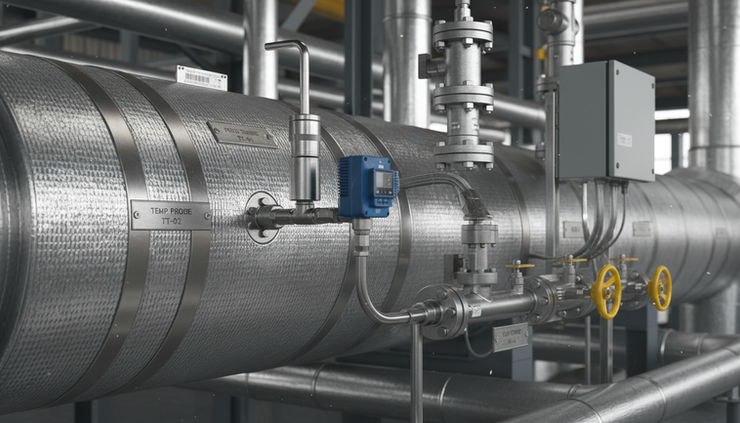
Different flowmeter types respond to gas conditions in different ways. Some measure actual velocity or differential pressure and need pressure and temperature compensation. Others infer or measure mass flow more directly.
Meter type | Primary measurement | Typical correction need |
Orifice plate | Differential pressure across a restriction | Pressure, temperature, gas composition, discharge coefficient |
Venturi meter | Differential pressure with lower permanent pressure loss | Pressure, temperature, gas composition |
Turbine meter | Gas velocity through a rotor | Pressure and temperature correction for standard flow |
Vortex meter | Vortex shedding frequency related to velocity | Pressure and temperature correction for gas standard flow |
Thermal mass meter | Heat transfer related to mass flow | Gas composition and calibration basis |
Coriolis meter | Mass flow from tube motion | Density and gas application limits still matter |
A differential pressure meter, such as an orifice plate, does not simply measure volume. It creates a pressure drop related to flow rate, density, and meter geometry. Gas density changes with pressure, temperature, and composition, so the flow computer must correct for those variables.
A turbine meter produces pulses related to actual volume through the meter body. To report SCFM, the system needs live pressure and temperature data, or fixed values if conditions are stable enough. Fixed compensation may be acceptable for rough utility monitoring, but it can cause error when line conditions vary.
A thermal mass meter often reports in standard units directly, but it still relies on calibration assumptions. Gas composition matters because thermal properties vary. A meter calibrated for air may not read nitrogen, argon, methane, or hydrogen accurately without the right gas correction or calibration.
Real gases require compressibility and composition awareness
The ideal gas law is useful, but industrial gases do not always behave ideally. At higher pressures, lower temperatures, or with heavier hydrocarbon mixtures, real gas behavior becomes more important.
The compressibility factor `Z` adjusts the ideal gas calculation. When `Z` differs from 1, the gas occupies a different volume than the ideal gas law predicts.
Compressibility matters in applications such as:
Natural gas transmission and distribution
High-pressure nitrogen supply
Hydrogen systems
Carbon dioxide service
Refinery fuel gas
Mixed hydrocarbon gas streams
Custody transfer measurement
Gas composition also affects molecular weight, density, heating value, sound velocity, and thermal properties. A change from methane-rich natural gas to a heavier refinery fuel gas can change the relationship between actual volume, standard volume, and energy content.
For billing and custody transfer, standards and contracts often define the calculation method, reference conditions, gas composition input, and acceptable instrumentation. For internal process work, engineering teams should still document the assumptions. A standard flow number without a stated basis can be misleading.
Practical applications show why both values matter
Compressed air systems
Compressed air is often tracked in SCFM because plant teams need to quantify air production and consumption. Compressors may be rated in standard flow, and leak estimates are often expressed in SCFM.
Actual flow still matters in headers and branches. A 2-inch line at high pressure may carry enough standard air for a tool bank, but the velocity and pressure drop depend on actual conditions. When air expands at end use, the actual volume increases and can affect nozzles, blow-off devices, and exhaust noise.
Combustion and burner management
Fuel gas control often uses standard flow because combustion chemistry depends on the amount of fuel and oxygen, not the actual volume in the pipe. Fuel-air ratio systems may calculate flow in SCFH or standard cubic meters per hour.
At the same time, burner tips, valves, and supply piping experience actual pressure, temperature, and density. If gas temperature rises, density falls. The same valve position may pass a different fuel mass unless the control system compensates.
Inerting and blanketing
Nitrogen blanketing systems frequently use standard flow to estimate gas consumption and cylinder or bulk tank demand. This helps size vaporizers, regulators, and supply contracts.
Actual flow affects the blanketing valve and vent path. During a rapid tank drawdown, the system must pass enough actual volume to prevent vacuum conditions. Pressure control depends on the gas behavior at the tank and valve, not just the standard flow total.
Environmental and flare systems
Flare and vent systems often see large pressure and temperature swings. Actual flow is central to velocity, backpressure, and relief network design. Standard or mass flow is needed for emissions estimates and reporting.
A hot relief stream may have a high actual volume because of expansion. If it cools or mixes with other gases, both density and volumetric flow change. Accurate measurement often needs pressure, temperature, and composition inputs at the meter location.
Gas blending and process control
In chemical processing, standard flow supports ratio control. A reactor feed may require a fixed molar ratio of hydrogen to another gas. Standard flow is a practical way to control that when composition is known.
Actual flow still affects residence time, pressure drop, and equipment limits. For high-pressure reactors, a small actual volumetric flow can represent a large standard flow and a significant molar feed rate.
Common errors when comparing actual and standard flow
Several recurring mistakes cause confusion in gas measurement.
Using gauge pressure in gas flow correction
Gas equations require absolute pressure. Add atmospheric pressure to gauge pressure before converting.
Leaving standard conditions undefined
SCFM, Sm³/h, and Nm³/h can use different reference conditions. State the pressure, temperature, and humidity basis.
Assuming all meters measure standard flow directly
Many meters measure actual volume or velocity. Standard flow may be a calculated output.
Ignoring temperature variation
A fixed temperature assumption can work in stable indoor utility systems. It is risky for outdoor lines, heated gases, compressor discharge, and cryogenic-related systems.
Applying air calibrations to other gases without review
Thermal mass meters, variable area meters, and some flow switches can be sensitive to gas properties.
Treating standard flow as pipe capacity
Pipe pressure drop depends on actual flow, density, viscosity, and line conditions. Standard flow must be converted before hydraulic checks.
Neglecting compressibility at high pressure
At elevated pressures, real gas corrections can materially change the result.
How to choose the right flow basis
Use actual flow when the question involves physical movement through equipment. Use standard flow when the question involves quantity of gas.
A practical selection guide:
Engineering question | Better flow basis |
What is the gas velocity in this pipe? | Actual flow |
What pressure drop will this line have? | Actual flow with density and viscosity |
How much nitrogen did the process consume? | Standard or mass flow |
What is the compressor capacity requirement? | Often standard flow, with inlet actual conditions checked |
What size duct does the exhaust system need? | Actual flow |
How much fuel energy entered the furnace? | Standard flow plus heating value, or mass flow |
What is the molar feed ratio to a reactor? | Standard or mass flow |
Will a control valve pass enough gas? | Both, with actual inlet and outlet conditions |
The strongest measurement systems report both when needed. A flow computer can display actual volumetric flow, standard flow, mass flow, pressure, and temperature from the same meter run. That gives operations teams the values needed for control and gives engineering teams the values needed for analysis.
A final takeaway for gas measurement decisions
Standard and actual flow describe the same gas from different viewpoints. Actual flow tells how much space the gas occupies at line conditions. Standard flow tells how much gas is present when converted to a defined pressure and temperature basis.
Pressure usually creates the largest difference between the two. Temperature can also shift values enough to affect control, reporting, and equipment sizing. At high pressure or with non-ideal gases, compressibility and composition need attention.
The best practice is simple: state the flow basis, state the reference conditions, use absolute pressure and absolute temperature, and match the measurement basis to the engineering question. That prevents costly misunderstandings and gives every flow number a clear physical meaning.


Comments