
Magflow Selection Guide What Info to Provide ProSense Instruments
A magnetic flowmeter is only as good as the application data behind it. Choose one from pipe size alone, and it may read poorly, wear early, or arrive with the wrong liner, electrodes, power, or connection type.
A magflow, also called an electromagnetic flowmeter, measures flow in conductive liquids. It has no moving parts in the flow stream, which makes it a strong choice for water, wastewater, chemicals, slurries, dosing lines, and many process liquids. But it is not a universal meter. The liquid must be conductive, the pipe must stay full, and wetted materials must suit the process.
This guide explains the information to provide ProSense Instruments when requesting a magflow. The more complete the data, the faster the team can select a meter that fits the process, not just the pipe.

Start with the liquid and its conductivity
Magnetic flowmeters work by applying Faraday’s law of electromagnetic induction. In simple terms, a conductive liquid moving through a magnetic field creates a voltage signal. The meter uses that signal to calculate flow.
That means conductivity is not a side detail. It is one of the first selection points.
Provide ProSense Instruments with:
The name of the liquid
The minimum conductivity, preferably in µS/cm
The normal conductivity range, if it changes
Whether the liquid is clean, dirty, corrosive, abrasive, or contains solids
Whether air bubbles, foam, or gas pockets are present
Whether the liquid can coat the liner or electrodes
The liquid’s pH, if chemical compatibility matters
Any cleaning fluids used in the same line
Many water-based liquids work well with magflows. Examples include potable water, wastewater, cooling water, caustic solutions, acids, and many slurries. Hydrocarbons, oils, solvents with low conductivity, and gases are usually not suitable.
If conductivity is unknown, send a liquid data sheet or tell ProSense Instruments the exact product name and concentration. This is especially useful for chemical feeds, blended liquids, or demineralised water applications where conductivity may sit near the meter’s lower operating limit.
Give the pipe diameter and installation details
Pipe diameter affects meter size, velocity, pressure drop expectations, and installation method. Do not only provide the nominal line size if the actual pipe may be different. A DN50 line, a 2-inch schedule 40 pipe, and a lined pipe section can have different internal dimensions.
Provide:
Nominal pipe size, such as DN, NPS, or inches
Pipe outside diameter and schedule, if known
Internal diameter, especially for non-standard or lined pipe
Pipe material
Whether the pipe is horizontal, vertical, or inclined
Whether the pipe stays full at all times
Available straight pipe length upstream and downstream
Nearby bends, valves, pumps, reducers, or dosing points
Whether the meter will be installed indoors, outdoors, underground, or in a panel skid
A magflow tube must be full to read correctly. A partly filled pipe can cause unstable readings or false flow. For vertical installations, upward flow is often preferred because it helps keep the pipe full and reduces air pocket issues.
Straight run matters as well. Magnetic meters are less sensitive to flow profile than some technologies, but poor installation can still affect accuracy. A control valve directly before the meter, a pump discharge, or a chemical injection point may create turbulence, bubbles, or uneven flow.
If space is tight, say so early. ProSense Instruments can then check whether a shorter meter body, remote-mounted transmitter, different connection, or installation change is needed.
Define minimum, normal, and maximum flow
Flow range is one of the most common places where applications go wrong. A pipe may be 100 mm, but the actual flow may be far lower than expected. In that case, a full-bore magflow sized to the pipe may run at a very low velocity and lose measurement quality.
Provide flow in clear units:
Flow condition | What to send | Why it matters |
Minimum flow | The lowest flow that must be measured accurately | Confirms low-end performance |
Normal flow | The usual operating flow | Helps size the meter for best day-to-day reading |
Maximum flow | Peak process flow, not just pump rating | Checks upper velocity and output scaling |
Start-up or flush flow | Any short high-flow condition | Prevents undersizing |
Batch volume | Required batch amount, if used | Helps choose pulse outputs or batch functions |
Use one set of units, such as m³/h, L/min, GPM, or L/s. If you use several units in your plant, state the preferred display and output units as well.
Also say whether the flow is continuous, intermittent, pulsing, or bidirectional. Pump type matters here. A centrifugal pump usually produces smoother flow than a diaphragm pump or piston pump. Pulsing flow may require damping, different output settings, or extra care with meter location.

Check flow velocity before choosing the size
Flow velocity links flow rate and pipe diameter. It is one of the best ways to check whether the selected magflow size makes sense.
For many magnetic flow applications, stable measurement is easier when velocity sits within a practical middle range. Very low velocity can make the signal weak. Very high velocity can increase wear, noise, and pressure effects, especially with abrasive liquids.
Provide velocity if you already know it. If not, ProSense Instruments can calculate it from:
Pipe internal diameter
Minimum flow
Normal flow
Maximum flow
For clean water, the meter may perform well across a broad velocity range. For slurry, wastewater with grit, or abrasive chemicals, velocity becomes more critical. Too slow and solids may settle. Too fast and liners or electrodes may wear faster.
This is why ProSense Instruments should not be asked to select a magflow based on pipe size alone. The right meter may match the pipe size, or it may need a reducer to keep the flow velocity in a better range. If reducers are allowed, provide the available space and pressure limits.
Match the liner material to the liquid
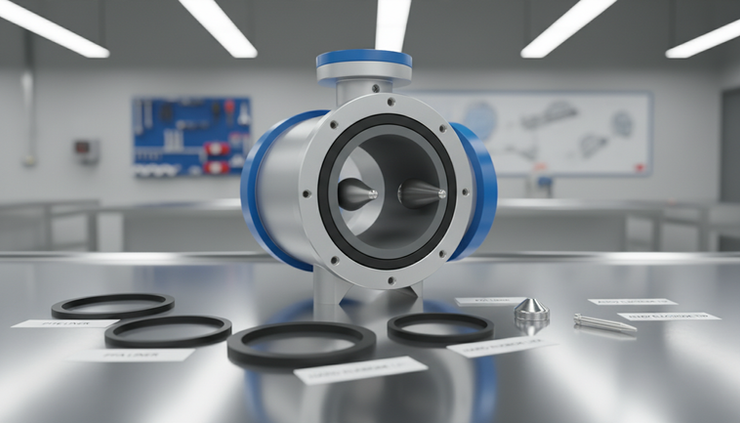
The liner is the non-conductive material inside the meter tube. It insulates the electrodes from the metal body and protects the meter from the process liquid. Liner choice affects chemical resistance, abrasion resistance, temperature limits, and cost.
Common liner families include fluoropolymers, rubber-based liners, polyurethane, and ceramic options. Exact availability depends on the meter type and size.
When requesting a meter, provide:
Liquid name and concentration
Normal and maximum temperature
Whether solids or grit are present
Whether the process is abrasive
Whether the line is under vacuum
Cleaning method and cleaning chemicals
Food, sanitary, or potable water requirements, if any
A chemical process may need a fluoropolymer liner for corrosion resistance. A mining or wastewater slurry may need a liner chosen for abrasion. A potable water line may need materials that meet the relevant water approval requirements.
Do not assume the most chemically resistant liner is always the best choice. Some materials have limits with vacuum, temperature cycling, abrasion, or mechanical stress. The application data lets ProSense Instruments narrow the options safely.
Choose electrodes for chemical compatibility and signal quality
Electrodes contact the liquid and pick up the induced voltage signal. If the electrode material is wrong, corrosion, coating, noise, or premature failure can follow.
Common electrode materials used in magnetic flow measurement include stainless steel, Hastelloy-type alloys, titanium, tantalum, platinum alloys, and other application-specific metals. The right choice depends on the liquid chemistry.
Provide:
The liquid and concentration
pH range
Chloride content, if known
Presence of acids, caustics, or oxidising chemicals
Solids content
Whether the liquid coats or plates onto metal
Grounding conditions and pipe material
Electrode selection matters in both clean and harsh applications. For example, a mild water service may be suitable for stainless steel electrodes, while a strong acid or chloride-rich liquid may require a more resistant material. Abrasive slurries may need electrodes that handle wear as well as corrosion.
If your plant already uses a known electrode material successfully in the same liquid, include that detail. If a previous meter failed, share the failure mode. Corrosion, electrode coating, liner damage, and unstable output all point to different causes.
Provide pressure and temperature limits
Pressure and temperature affect the meter body, liner, flanges, seals, transmitter location, and approvals. Give both normal and extreme values. A normal operating point is helpful, but the maximum design condition is needed for safe selection.
Send:
Condition | Information to provide |
Normal operating pressure | Usual process pressure during stable operation |
Maximum pressure | Highest possible process pressure, including pump deadhead if relevant |
Minimum pressure | Any vacuum or low-pressure condition |
Normal temperature | Usual liquid temperature |
Maximum temperature | Cleaning, flushing, steam exposure, or process peaks |
Ambient temperature | Site temperature around the transmitter |
Temperature changes | Rapid thermal cycling or cold start conditions |
For outdoor installations, include sun exposure, freezing risk, washdown, and enclosure needs. For hot applications, say whether the transmitter can be mounted directly on the sensor or should be remote-mounted away from heat.
Temperature is also tied to liner choice. A liner that suits the chemical at room temperature may not suit it at elevated temperature. Pressure rating can also change with flange standard, meter size, and material.
Specify flange or thread connections
A correct process connection saves installation time and prevents costly rework. Magflows are commonly supplied with flanged connections, but smaller sizes may also use threaded, wafer, hygienic, or other connection types depending on the product range.
Provide the full connection requirement:
Connection type, such as flanged, threaded, wafer, or sanitary
Flange standard, such as ASME, EN, JIS, or another plant standard
Flange pressure class or PN rating
Thread type, such as BSP or NPT
Face type, gasket type, and bolt requirements if specified by the site
Pipe material and mating flange material
Need for grounding rings, grounding electrodes, or earthing straps
Any installation length limit
For flanged meters, do not send only “2-inch flange.” Specify the standard and pressure class. A 2-inch ASME flange and a DN50 EN flange are not the same part. For threaded meters, state the thread standard clearly. BSP and NPT are not interchangeable.
Grounding also deserves attention. Magnetic flowmeters need a stable electrical reference to the liquid. Metal pipe, plastic pipe, lined pipe, and cathodically protected systems can require different grounding arrangements.
Confirm power supply, display, and outputs
A magflow is both a sensor and a transmitter system. The electrical details need the same care as the mechanical ones.
For power supply, provide:
Available supply voltage
AC or DC power
Any requirement for low-power operation
Hazardous area needs, if relevant
Cable distance between sensor and transmitter
Preferred cable entry or gland type
Many industrial sites use 24 V DC instrumentation supplies. Others prefer mains-powered transmitters. The correct choice depends on your control system, panel design, and site practice.
For the display, say whether you need:
Local display at the pipe
Remote display mounted on a wall or panel
Totaliser display
Flow rate display
Programming keys accessible without opening the enclosure
Backlight, language, or unit preferences
For outputs, list what the control system needs:
Output need | Common request |
Analogue flow signal | 4 to 20 mA |
Totalising or batching | Pulse output |
Flow switch or alarm | Relay output |
Digital communications | Modbus, HART, or similar protocol |
Direction indication | Forward and reverse flow status |
Fault monitoring | Alarm output or diagnostic signal |
Do not assume every transmitter includes every output. If the signal goes to a PLC, SCADA system, chart recorder, pump controller, or batching panel, tell ProSense Instruments. Also provide scaling needs, such as 4 mA equals 0 m³/h and 20 mA equals 50 m³/h.

Send a complete request using this checklist
A clear request helps ProSense Instruments quote the right meter, accessories, and configuration. Use the checklist below as a practical template.
Selection area | Information to provide ProSense Instruments |
Liquid | Name, concentration, pH, solids, coating risk, gas or foam, cleaning fluids |
Conductivity | Minimum and normal conductivity in µS/cm, or a liquid data sheet |
Pipe | Nominal size, internal diameter, pipe material, installation orientation |
Flow | Minimum, normal, and maximum flow with units |
Velocity | Calculated velocity if known, or pipe ID and flow rates so it can be checked |
Liner | Chemical, temperature, abrasion, vacuum, and approval requirements |
Electrodes | Chemical compatibility needs and any known successful material |
Pressure | Normal, maximum, minimum, and vacuum conditions |
Temperature | Normal and maximum liquid temperature, ambient temperature |
Connection | Flange standard and rating, thread type, sanitary fitting, or wafer details |
Installation | Straight run, nearby pumps or valves, full-pipe conditions, indoor or outdoor |
Power | Available voltage, AC or DC, hazardous area needs |
Display | Integral or remote display, totaliser, units, access needs |
Outputs | 4 to 20 mA, pulse, relay, frequency, digital protocol, alarm needs |
Site preferences | Tag number, documentation, calibration certificate, material certificates if needed |
If some details are unknown, still send the rest. ProSense Instruments can help identify gaps, but the selection will be faster when the core process data is included at the start.
A good magflow request describes the process, not just the meter
The best magnetic flowmeter selection comes from the full application picture. Conductivity tells whether the technology will work. Flow range and pipe diameter confirm the correct size. Velocity checks measurement quality and wear risk. Liner and electrode materials protect the meter from the liquid. Pressure, temperature, connections, power, display, and outputs make sure the final instrument fits the plant.
When requesting a magflow from ProSense Instruments, send the operating data, the installation details, and the control system requirements together. A short, complete application summary will usually beat a long chain of follow-up questions, and it gives the team what they need to select a meter that performs reliably from day one.


Comments