
Industrial Pressure Transmitters for Pumps Pipelines and Process Equipment
A pressure reading is often the first sign that something in an industrial system is changing. A pump starts to cavitate. A pipeline begins to plug. A filter loads with solids. A reactor moves outside its normal operating window. In each case, pressure is not just another process variable. It is a direct indicator of equipment health, product movement, safety margin, and control stability.
Industrial pressure transmitters convert that physical pressure into a usable electrical signal for control systems, safety systems, local displays, and condition monitoring platforms. They sit close to the process, often in harsh locations, and provide the data operators and controllers need to keep equipment within safe and productive limits.
For pumps, pipelines, and process equipment, accurate pressure measurement helps prevent downtime, reduce maintenance guesswork, protect assets, and improve product consistency.

Pressure transmitters turn process force into control data
A pressure transmitter measures the force applied by a gas or liquid to a sensing element. Inside the instrument, a diaphragm or sensing cell deflects under pressure. Electronics convert that deflection into a standardized output signal.
Common outputs include:
4-20 mA analog signals
Widely used in process plants because they are simple, reliable, and easy to troubleshoot.
4-20 mA with HART communication
Allows digital configuration, diagnostics, range changes, and device health data over the same wiring.
Fieldbus or industrial Ethernet outputs
Used where digital integration, diagnostics, and device-level data are part of the control architecture.
Switching outputs
Used for alarms, pump protection, or local interlocks.
The transmitter may report gauge pressure, absolute pressure, differential pressure, or sealed pressure. The right choice depends on the process condition and what the control system needs to know.
A transmitter installed on a pump discharge line may report gauge pressure relative to atmosphere. A vacuum system may need absolute pressure. A filter skid may use differential pressure across the filter elements. A pipeline custody or leak detection system may require high-stability devices with tight calibration control.
The sensing technology also matters. Piezoresistive, capacitive, resonant silicon, and strain gauge designs each offer different strengths in accuracy, overpressure tolerance, response time, and long-term stability.
Pumps rely on pressure feedback for protection and performance
Pump systems are among the most common applications for pressure transmitters. Suction pressure, discharge pressure, and differential pressure across the pump all reveal how the equipment is performing.
A centrifugal pump pushed too far from its preferred operating range can suffer from cavitation, vibration, seal damage, and bearing stress. Pressure data helps detect these conditions before they become mechanical failures.
Typical pump measurements include:
Suction pressure before the pump inlet
Discharge pressure after the pump outlet
Differential pressure across the pump
Seal flush pressure
Lubrication system pressure
Hydraulic power unit pressure
On a booster pump station, discharge pressure transmitters help maintain a stable downstream pressure. In a chemical dosing skid, pressure feedback confirms that metering pumps are delivering against the expected line pressure. In a boiler feedwater system, high-pressure transmitters monitor pump output under demanding temperature and pressure conditions.
Pump protection often depends on fast, credible pressure data. A pressure transmitter can help trigger alarms or shutdown logic for blocked discharge, dry run conditions, rapid pressure loss, or suction starvation. When paired with flow, temperature, and vibration data, pressure becomes part of a broader condition monitoring view.
For variable frequency drive pump control, the pressure transmitter often acts as the primary feedback device. The controller adjusts motor speed to maintain setpoint pressure. A noisy, slow, or drifting signal can cause unstable control, energy waste, and excess wear. A stable transmitter output supports smoother control and fewer nuisance trips.

Pipelines need accurate pressure data across long distances
Pipeline pressure measurement supports flow control, leak detection, surge protection, and asset integrity. The demands vary by service, but the core need is the same: reliable pressure data from points that may be remote, exposed, or difficult to access.
In liquid pipelines, pressure transmitters help detect restriction, pump station performance changes, and abnormal pressure drops. In gas transmission and distribution systems, pressure data supports line balancing, compressor control, regulator monitoring, and safety alarms.
Pipeline applications often include:
Upstream and downstream pressure around control valves
Pressure at pump or compressor stations
Pressure at custody transfer points
Pressure before and after strainers or filters
Remote pressure monitoring in distribution networks
Surge detection near fast-closing valves or pump trips
Surge and water hammer can create pressure spikes that exceed normal operating pressure. A standard transmitter may show the general process pressure, while a faster device or supplementary sensor may be needed to capture transient events. Selecting the proper response time and overpressure rating becomes critical in these services.
For outdoor and remote pipeline installations, housing design and environmental protection matter. Transmitters may need weatherproof or explosion-proof enclosures, stainless steel wetted parts, lightning protection, and wide ambient temperature ratings. Remote monitoring may require low-power electronics or wireless communication.
Accuracy over time is also central. A pressure reading that drifts slowly can affect control decisions, leak calculations, and maintenance planning. Stable sensors, regular calibration checks, and diagnostic capability reduce uncertainty in the measurement chain.
Process equipment uses pressure as a control and safety variable
Pressure transmitters appear throughout process equipment, from tanks and vessels to reactors, separators, heat exchangers, filtration systems, and utility skids. In many cases, they do more than display a number. They feed control loops, interlocks, batch records, and safety systems.
Common process equipment applications include:
Reactor pressure control
Vessel blanketing pressure
Steam header pressure
Compressed air pressure
Filter differential pressure
Heat exchanger pressure drop
Hydrostatic tank level measurement
Vacuum system monitoring
CIP and hygienic process pressure
A reactor may use a gauge or absolute pressure transmitter to support pressure control and relief system monitoring. A separator may use pressure data to maintain phase separation conditions. A heat exchanger may use differential pressure to identify fouling or restriction. A filter housing may use differential pressure to determine when elements need replacement.
In hygienic service, such as food, beverage, and pharmaceutical production, pressure transmitters often use flush diaphragms, sanitary process connections, and polished stainless steel surfaces. These designs reduce dead legs and make cleaning easier.
In slurry, pulp, or crystallizing fluids, a flush diaphragm or remote seal can prevent plugging at the process connection. In high-temperature service, a capillary remote seal or impulse line can keep sensitive electronics away from process heat.
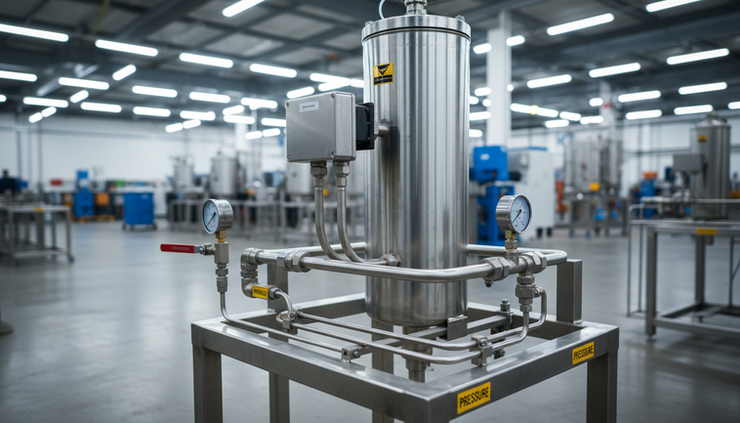
Different transmitter types serve different measurement tasks
Selecting a pressure transmitter starts with understanding the measurement task. The same plant may use several transmitter types because each one solves a specific problem.
Transmitter type | What it measures | Common uses |
Gauge pressure transmitter | Pressure relative to atmosphere | Pump discharge, utility headers, hydraulic systems |
Absolute pressure transmitter | Pressure relative to full vacuum | Vacuum systems, distillation, low-pressure vessels |
Differential pressure transmitter | Difference between two pressure points | Filters, flow elements, tank level, heat exchangers |
Sealed pressure transmitter | Pressure relative to a sealed reference | Outdoor or high-pressure applications where atmosphere varies |
Flush diaphragm transmitter | Pressure without a recessed port | Slurries, viscous fluids, hygienic processes |
High-pressure transmitter | Elevated pressure ranges | Hydraulic presses, test stands, boiler feed systems |
Smart pressure transmitter | Pressure plus digital diagnostics | Critical loops, remote configuration, asset monitoring |
Gauge pressure transmitters are common on pumps and utilities
Gauge transmitters are the standard choice when the process pressure should be measured against local atmospheric pressure. They are used on pump skids, compressed air lines, cooling water systems, lubrication systems, and general plant utilities.
A typical example is a transmitter on a centrifugal pump discharge header. The control system uses its signal to maintain outlet pressure while the pump speed changes.
Absolute pressure transmitters support vacuum and low-pressure work
Absolute transmitters measure against a vacuum reference. They are useful when atmospheric pressure changes would affect the process reading.
Vacuum distillation, freeze drying, vacuum pumping systems, and low-pressure reactors are common examples. In these applications, a small error can affect process quality or control response.
Differential pressure transmitters reveal losses and levels
Differential pressure transmitters compare two pressure points. This makes them useful for measuring pressure drop across equipment and for inferential measurements.
Across a filter, rising differential pressure indicates fouling. Across an orifice plate, differential pressure can be used to calculate flow. On a closed vessel, differential pressure can measure liquid level when density and installation geometry are known.
Flush diaphragm transmitters handle difficult fluids
Standard pressure ports can plug when exposed to heavy oils, slurries, adhesives, crystallizing fluids, or sanitary products. Flush diaphragm transmitters place the sensing surface at the process boundary, reducing pockets where material can collect.
They are common in pulp and paper, wastewater sludge, food processing, and chemical batching.
Smart transmitters add diagnostics and configuration
Smart transmitters store configuration data, support remote range changes, and provide device health information. Many also detect sensor faults, electronics issues, or out-of-range conditions.
In critical process loops, this information can reduce troubleshooting time. A technician can compare the process variable, sensor temperature, output current, and diagnostic status before removing the instrument from service.
Key features that affect performance in the field
A transmitter data sheet includes many specifications. Some matter more than others for real industrial service.
Accuracy and stability
Accuracy describes how close the transmitter output is to the true pressure under stated conditions. Long-term stability describes how well it holds that performance over time. For critical control or custody-related measurements, stability can be as important as initial accuracy.
Range and turndown
The selected range should match the normal and maximum expected process values. Oversizing the range may reduce useful resolution. Excessive turndown can also affect performance. A transmitter should cover expected operation without sacrificing measurement quality.
Overpressure and burst rating
Process systems can see pressure spikes during startup, valve closure, pump trips, and upset conditions. The transmitter must survive predictable overpressure events without damage or unsafe failure.
Wetted materials
The diaphragm, process connection, and seals must be compatible with the process fluid. Stainless steel suits many services. More corrosive fluids may require alloys or coatings. Seal materials must also handle temperature, pressure, and chemical exposure.
Temperature limits
High process temperature can damage sensing elements or electronics. Low ambient temperature can affect seals, displays, and cable systems. Remote seals, capillaries, cooling elements, or heat tracing may be needed.
Response time
Fast response supports pump protection, surge detection, and tight control. Slower response may be acceptable for tank pressure or general monitoring. The control loop, not the transmitter alone, determines the final dynamic performance.
Ingress and hazardous area ratings
Outdoor washdown, dust, corrosive atmospheres, and classified areas all shape enclosure selection. The rating must match the installation environment and local code requirements.

Accurate pressure measurement reduces risk and uncertainty
Poor pressure measurement creates hidden costs. A drifting transmitter can make a pump run harder than needed. A plugged impulse line can hide a dangerous pressure rise. A poorly ranged device can produce a control signal that looks valid but lacks useful resolution.
Accurate measurement supports:
Safer operation near pressure limits
Better pump and compressor control
Earlier detection of blockage or fouling
Reduced nuisance alarms and trips
More consistent batching and production
Better maintenance planning
Clearer troubleshooting during upsets
Calibration practices also play a role. Critical transmitters should have defined inspection and calibration intervals based on service severity, safety impact, and historical drift. Some applications benefit from impulse line checks, zero verification, loop checks, and comparison with redundant instruments.
Installation quality is just as important as transmitter quality. A high-accuracy instrument can perform poorly if installed with long unsupported impulse lines, trapped gas in liquid service, condensate in gas service, vibration, heat exposure, or the wrong process connection.
Good measurement begins with the full installation: process tap, isolation valves, seals, mounting, wiring, grounding, configuration, calibration, and control system scaling.
How to match the transmitter to the application
The best transmitter for a service is the one that fits the process conditions and the measurement goal. Start with the basics:
Define the pressure type needed, such as gauge, absolute, or differential.
Confirm normal, minimum, maximum, and upset pressures.
Check process temperature and ambient temperature.
Review fluid compatibility with wetted materials.
Identify plugging, coating, corrosion, or sanitary concerns.
Choose the output and communication method.
Confirm environmental, washdown, and hazardous area requirements.
Set the range and alarm limits for useful control system data.
Plan isolation, calibration access, and maintenance safety.
For a clean water pump discharge, a compact gauge pressure transmitter may be enough. For a hot chemical reactor, a smart transmitter with remote seal materials selected for corrosion resistance may be the better choice. For a filter bank, a differential pressure transmitter with proper impulse line layout can give maintenance teams a clear view of loading. For a viscous food product, a sanitary flush diaphragm transmitter can provide a cleaner and more reliable measurement point.
Industrial Pressure Transmitters for pumps, pipelines, and process equipment perform best when selection, installation, and maintenance are treated as one measurement system. The device matters, but so do the tap location, materials, configuration, calibration method, and how the signal is used.
Pressure is one of the most useful windows into industrial operation. Measure it accurately, and a plant gains better control, earlier warnings, and stronger protection for the equipment that keeps production moving.


Comments