
Gear Flow Meters for Asphalt and Bitumen Measuring High Viscosity Liquids with Precision
Hot asphalt and bitumen do not behave like water, solvents, or light fuels. They resist movement, change viscosity sharply with temperature, and can carry fine solids that punish the wrong meter design. In these services, flow measurement is not just a control variable. It affects batch quality, custody transfer, additive dosing, burner feed, truck loading, and plant yield.
That is why positive-displacement gear flow meters remain a strong choice for asphalt, bitumen, polymer-modified binders, heavy oils, resins, adhesives, and other high-viscosity liquids. Instead of estimating flow from velocity, they capture and count fixed volumes of liquid as it passes through precision-machined gears. For viscous products, that simple mechanical principle offers a major advantage: repeatable measurement even at low flow rates and changing process conditions.
Why gear flow meters match viscous liquids so well
A gear flow meter works by using the process fluid to rotate a pair of precision gears. As the gears turn, small, known volumes of liquid move from the inlet side to the outlet side. A pickup sensor detects gear rotation and converts it into a pulse output or flow signal.
This design makes gear meters different from many velocity-based technologies. Turbine, vortex, and ultrasonic meters can perform well in the right conditions, but high viscosity can limit their useful range or reduce signal quality. Gear meters, by contrast, often improve in repeatability as viscosity rises, provided the liquid is clean enough and the meter is sized correctly.
The main advantages include:
Direct volumetric measurement
The meter measures actual displaced volume, not inferred velocity. This helps in batching, blending, and loadout where every gallon or liter matters.
Good low-flow performance
Viscous liquids can be difficult to measure at low Reynolds numbers. Gear meters can maintain stable output at low flow because the gears continue to sweep known volumes through the chamber.
High repeatability
In asphalt plants, terminals, and chemical processing, repeatability often matters as much as absolute accuracy. A meter that repeats well can be calibrated to the process and trusted for control.
Compact installation
Gear meters usually need little straight run compared with many velocity meters. That helps in skids, additive systems, and retrofits where piping space is limited.
Useful signal output
Pulse outputs support batch controllers, PLCs, totalizers, recipe systems, and proportional dosing controls.
The key is to treat the meter as part of a system. Temperature control, filtration, piping layout, pressure drop, and calibration all affect final performance.
Asphalt and bitumen measurement starts with temperature
Temperature has the largest practical effect on asphalt and bitumen flow measurement. A binder that pumps smoothly at elevated temperature may become extremely resistant to movement when it cools. Even a modest drop in temperature can increase viscosity enough to change pressure loss, meter torque, startup load, and response time.
For this reason, gear meters in asphalt service often use one or more heating methods:
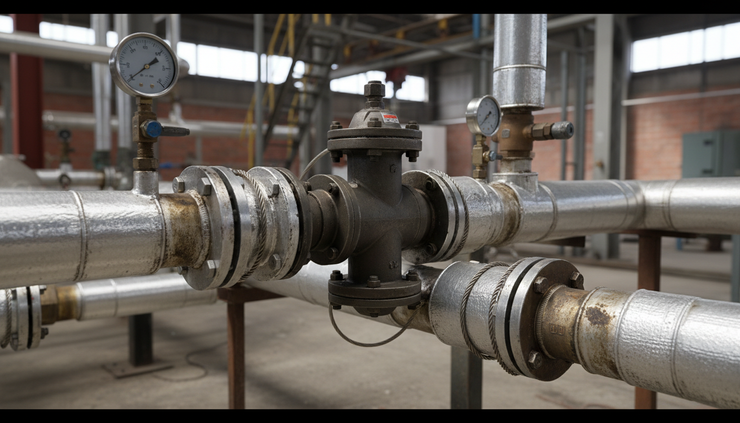
Jacketed meter bodies with hot oil or steam
Electric heat tracing on the meter and nearby piping
Insulated housings or removable thermal covers
Heated strainers, valves, and pump connections
A common mistake is heating the line but ignoring the meter body, transmitter connection, or strainer. A cold spot can become a restriction. It can also create uneven startup conditions, where the pump is ready but the meter contains partially cooled binder.
Stable temperature improves four things at once:
It keeps viscosity within the meter’s operating range.
It reduces pressure loss across the meter.
It lowers mechanical stress during startup.
It improves calibration consistency.
Temperature also affects density. A gear meter measures volume, not mass. If the process requires mass-based delivery, such as tons of binder in a mix design, the system may need temperature compensation, density correction, or integration with a mass calculation in the control system.
For plant use, the best practice is to calibrate the meter at normal operating temperature and with the actual product or a close equivalent. A cold bench calibration with a light oil may confirm mechanical function, but it will not fully represent hot bitumen behavior in service.

Filtration protects the precision measuring chamber
Gear flow meters depend on close clearances between the gears and the body. Those clearances are part of what gives the meter good resolution and repeatability. They also mean that hard particles, weld slag, grit, coke, carbonized binder, or oversized filler can cause damage.
Asphalt and bitumen are not always perfectly clean. Depending on the source and handling process, the fluid may contain:
Fine mineral particles
Rust from tanks or older piping
Pipe scale
Seal fragments
Debris from maintenance work
Agglomerated polymer or additive residue
Filtration is not optional in many viscous applications. It is a selection and installation issue, not an accessory decision at the end of the project.
The filter or strainer must remove damaging debris without creating excessive pressure loss as the product flows. This balance can be difficult with high-viscosity fluids. A screen that looks reasonable for water service may plug quickly or create a large differential pressure when used with hot asphalt.
In practice, selection usually involves three questions.
What particle size can the meter tolerate
The meter supplier should provide guidance on filtration based on gear clearance, meter size, and expected solids. Fine filtration protects the meter, but too fine a screen may become a maintenance burden. Coarser filtration may pass particles that score gears or jam the measuring chamber.
Can the strainer stay hot
A cold strainer can be worse than no strainer. Bitumen may thicken or freeze inside the screen, especially during startup, shutdown, or standby periods. Heated strainers and insulated covers help keep the whole measurement section at the correct temperature.
How will operators know it is plugging
A differential pressure gauge or transmitter across the filter gives early warning. Without it, the first sign of plugging may be poor batching performance, pump strain, or reduced flow. In severe cases, a blocked strainer can starve the meter and produce unstable readings.
For critical systems, installing a bypass for cleaning or using duplex strainers can reduce downtime. The bypass must be managed carefully so unfiltered material does not reach the meter during normal operation.
Pressure loss shapes meter size and pump selection
Every flow meter creates some pressure drop. In gear meters, pressure loss depends on flow rate, viscosity, meter size, internal clearances, and product condition. With asphalt and bitumen, this factor can dominate the selection process.
A smaller meter may give better resolution at low flow, but it may also create too much pressure drop at high flow. A larger meter may reduce pressure loss, but it might lose resolution or operate near the lower end of its recommended range. The correct choice sits between those limits.
Pressure loss matters because it affects:
Pump discharge pressure
Motor load
Heating requirements
System response during batching
Risk of cavitation or poor pump inlet conditions
Stress on seals, gaskets, and flanges
For example, consider a terminal loading hot bitumen into tanker trucks. The system needs high flow to reduce loading time, but it also needs accurate totalization for each compartment. If the meter is undersized, pressure loss may slow loading or force the pump to operate near its limit. If the meter is oversized, low-flow topping or small transfer batches may suffer.
The same issue appears in polymer-modified asphalt systems. These materials can have much higher apparent viscosity than standard paving grades, especially at lower shear or temperature. Meter sizing must account for the actual product family, not just a generic asphalt label.
A useful selection process includes:
Define minimum, normal, and maximum flow.
Identify the viscosity range at operating temperature.
Confirm maximum allowable pressure drop.
Check available pump pressure and downstream backpressure.
Review startup and cold-condition scenarios.
Select a meter size that keeps the operating range away from extremes.
The final step is often the most important. A meter that looks acceptable at normal flow may fail to start smoothly after a weekend shutdown if the product cooled inside the line.

Where gear meters are used in asphalt and heavy liquid service
Gear meters suit many points in the asphalt and high-viscosity liquid supply chain. Their value increases where batch accuracy, repeatability, and compact piping matter.
Asphalt plant binder dosing
In hot mix asphalt production, binder content has a direct effect on mix performance. Too little binder can produce dry, weak mix. Too much binder can raise cost and affect pavement behavior. Gear meters provide a clean pulse signal to the plant control system, allowing binder delivery to track aggregate flow or batch demand.
In continuous plants, the meter may feed real-time flow data to a ratio control loop. In batch plants, it may totalize the binder charge for each batch. In both cases, temperature stability and proper filtering support consistent results.
Terminal loading and unloading
Storage terminals use meters for tanker truck loading, railcar unloading, tank-to-tank transfer, and blending operations. Gear meters can serve as totalizers for delivered volume and as feedback devices for automated loading arms.
For custody or commercial transfer, local rules and approval requirements may apply. In those cases, the meter, register, calibration method, and sealing arrangement need review under the applicable measurement standards. The basic gear meter principle still works, but the full system must meet the required legal or contractual framework.
Polymer and additive injection
Small gear meters are often used on additive systems because they can measure low flows with good repeatability. Examples include anti-strip agents, warm mix additives, rejuvenators, flux oils, tackifier resins, and polymer components.
The challenge is often turndown. The additive flow may need to follow changing main-line flow while staying within a tight ratio. A properly sized gear meter with a high-resolution pulse output can support proportional control through a PLC or batch controller.
Roofing asphalt, sealants, and adhesives
High-viscosity measurement is not limited to paving. Roofing asphalt, mastics, sealants, hot melt adhesives, and industrial resins share similar measurement challenges. Flow may be slow, temperature-sensitive, and expensive to rework if the batch ratio is wrong.
Gear meters often fit these applications because they handle viscous, lubricating fluids well and provide repeatable batch totals. Material compatibility becomes especially important where products contain solvents, reactive components, or abrasive fillers.
Material, seal, and bearing choices matter
The meter body and internals must match the product and temperature. Asphalt and bitumen are usually handled hot, and the meter should be rated for the maximum process temperature, not just the average operating point.
Selection details include:
Body material suitable for process temperature and pressure
Gear material compatible with product abrasiveness and lubricity
Bearing design suited to viscous service
Seal type that can handle heat and product chemistry
Sensor design protected from heat and vibration
Electrical classification where flammable vapors may be present
For asphalt, mechanical simplicity is a benefit, but it does not remove the need for correct materials. A seal that performs well in light oil at moderate temperature may not survive long in hot binder service. A sensor mounted too close to an uninsulated hot body may also drift or fail prematurely.
Some gear meters use non-contact pickup sensors, which reduce mechanical wear in the signal generation path. Others offer high-temperature extensions or remote electronics to keep sensitive components away from heat.
Calibration and installation decide real-world accuracy
A gear meter can be precise, but the installation must give it a fair chance. The best meter will not correct for poor piping, air pockets, cold starts, or irregular pump flow.
Good installation practice includes:
Keep the meter full of liquid during operation.
Avoid flashing, foaming, or entrained air.
Install the meter in the recommended orientation.
Provide service valves for removal and cleaning.
Use strainers upstream of the meter.
Heat and insulate the full measurement section.
Place pressure and temperature taps where operators can use them.
Follow the supplier’s torque and flange alignment guidance.
Calibration should reflect the actual service. For asphalt and bitumen, that usually means proving at normal temperature, with stable flow, and with the installed electronics. If the system uses temperature compensation or density correction, verify the full signal chain, not only the mechanical meter.
A practical approach is to track meter factor over time. A stable meter factor suggests the meter is healthy and the process is consistent. A shifting meter factor can point to wear, debris, air entrainment, temperature changes, or calibration procedure issues.

Common selection mistakes to avoid
Many problems with asphalt and bitumen metering come from applying light-liquid habits to heavy-liquid service. These are the mistakes that often create the most downtime.
Sizing only for line diameter
The meter should match flow range, viscosity, pressure drop, and resolution needs. Line size alone is not enough.
Ignoring startup conditions
A system may run well when hot but struggle after cooling. Startup viscosity and warm-up procedures need review.
Using inadequate filtration
Debris damage can be expensive. A heated, accessible strainer with differential pressure monitoring is usually a better investment than frequent meter repair.
Underestimating pressure loss
High viscosity can turn a small restriction into a major bottleneck. Check pump capability, downstream pressure, and meter pressure drop together.
Calibrating under unrealistic conditions
Calibration with a different fluid, temperature, or flow profile may not reflect the installed process. Field proving is often more useful for critical asphalt applications.
The best meter is selected as part of the process
Gear flow meters are well suited to asphalt, bitumen, and many other high-viscosity liquids because they measure fixed volumes directly. They deliver strong repeatability, useful low-flow performance, compact installation, and clear pulse output for batching and control.
The details decide success. Keep the product hot enough to flow consistently. Filter it before it reaches the precision measuring chamber. Size the meter for viscosity, flow range, pressure loss, and startup behavior. Choose materials and seals that match temperature and chemistry. Then calibrate the installed system under real operating conditions.
When those pieces work together, gear flow meters for asphalt and bitumen measuring high viscosity liquids with precision become more than an instrument choice. They become a reliable part of product quality, plant control, and transfer accountability.


Comments